
How Many Calories Do You Burn Walking? A Simple Guide
Walking is one of the easiest ways to become more active. You do not need a gym membership, expensive equipment, or an advanced fitness plan. A comfortable pair of shoes and a little time are enough to get started.
But if you are walking for fitness or weight management, you may wonder, how many calories do you burn walking?
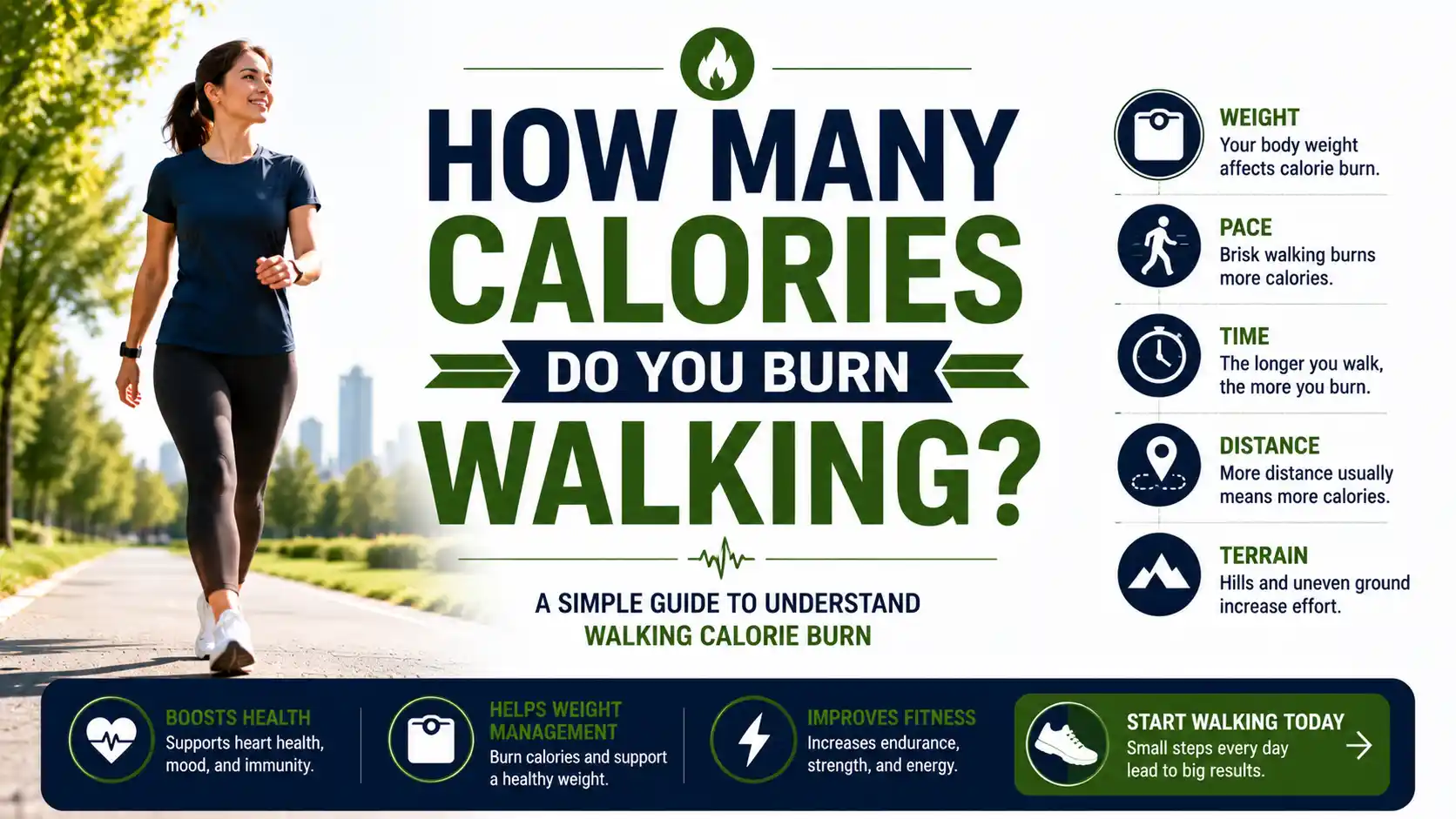
There is no single number that applies to everyone. The calories you burn while walking depend on your body weight, walking speed, distance, duration, terrain, and other individual factors.
A relaxed 20 minute walk around your neighborhood will not use the same amount of energy as a fast one hour walk up hills. Your body size also matters because moving a larger body generally requires more energy.
The good news is that you do not need to know the exact number of calories burned to benefit from walking. Regular walking can increase your daily activity, support cardiovascular health, and contribute to your overall calorie expenditure.
Let’s look at how walking calorie burn works and how you can use walking as part of a realistic fitness routine.
How Many Calories Do You Burn Walking?
The number of calories you burn walking varies from person to person.
Your body needs energy to move. The longer and more intensely you walk, the more energy the activity generally requires.
For example, a short, easy walk will usually burn fewer calories than a longer walk at a brisk pace. Walking uphill can also require more effort than walking the same distance on flat ground.
This is why calorie burn estimates should be treated as a guide rather than an exact measurement.
If a fitness watch tells you that you burned 250 calories during a walk, your actual energy expenditure may be somewhat higher or lower.
Instead of worrying about achieving an exact calorie number, it can be more useful to track your walking time, distance, pace, and consistency.
What Affects Calories Burned While Walking?
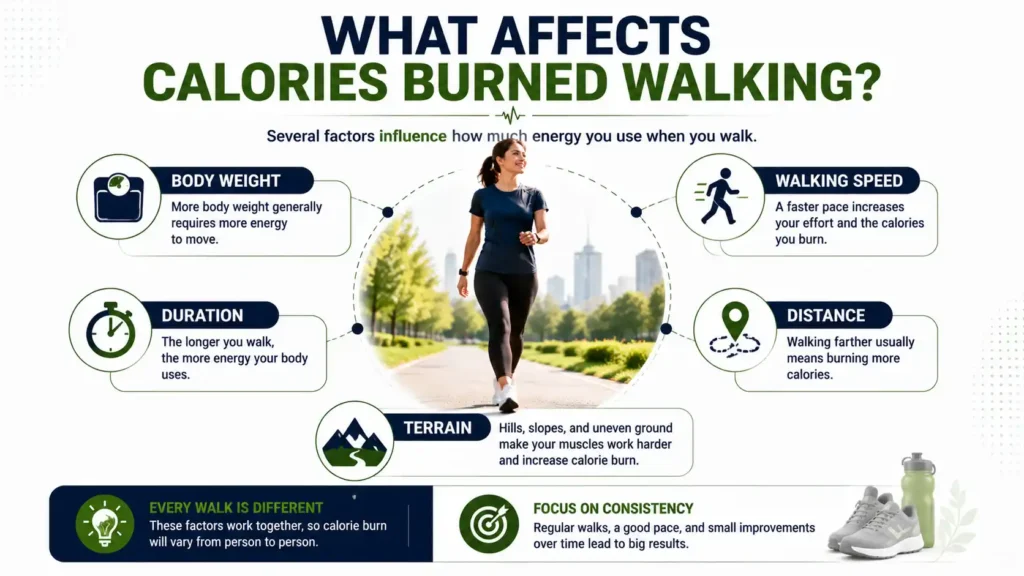
Several factors influence how much energy you use during a walk.
Body Weight
Body weight can affect walking calorie expenditure because your body has to use energy to move itself.
In general, a heavier person may expend more energy than a lighter person when completing the same walking activity under similar conditions.
However, weight is only one factor.
Fitness level, walking speed, terrain, duration, and individual physiology can also affect the result.
Walking Speed
Your pace makes a difference.
A casual stroll requires less effort than brisk walking. When you increase your speed, your muscles work harder and your heart rate may rise.
This generally increases the amount of energy required to complete the activity.
You do not have to walk as fast as possible, though. Choose a pace that is appropriate for your fitness level and that you can maintain comfortably.
Walking Duration
The amount of time you spend walking also matters.
If you walk for 60 minutes, you will generally use more energy than if you walk at the same pace for 15 minutes.
This makes duration one of the easiest variables to adjust.
If a long walk feels difficult, you can start with shorter sessions and gradually increase the amount of time you spend walking.
Distance
Walking farther generally requires more energy.
However, two people walking the same distance may not burn exactly the same number of calories.
One person may walk quickly on flat ground while another walks slowly uphill. Their body sizes may also be different.
Distance is useful for tracking progress, but it does not tell the entire story.
Terrain
Where you walk can change how demanding the activity feels.
Walking on a flat pavement is different from walking uphill or on an uneven trail.
Inclines generally require additional effort because your muscles have to work against gravity.
This is one reason treadmill incline walking has become popular among people who want to make walking more challenging without necessarily running.
Calories Burned Walking for 30 Minutes
A 30 minute walk can be a practical amount of exercise for many people.
The exact calories burned during those 30 minutes will depend on your weight, pace, terrain, and walking intensity.
Someone taking a slow walk may use less energy than someone maintaining a brisk pace for the entire session.
Rather than treating a calorie estimate as a target, think about the quality of your walk.
Can you gradually increase your pace?
Can you walk slightly farther?
Can you make 30 minute walks a regular part of your week?
Those changes may be more useful for long term fitness than trying to make every walk burn a specific number of calories.
How Many Calories Do You Burn Walking for an Hour?
Walking for an hour gives you more time to accumulate physical activity and energy expenditure.
Again, there is no universal calorie number.
A leisurely one hour walk and a fast one hour walk can have very different energy demands.
Body weight and terrain can make an additional difference.
If you are new to exercise, you also do not need to begin with an hour.
You could start with 15 or 20 minutes and gradually increase your walking duration as your fitness improves.
Consistency matters more than forcing yourself to complete long walks immediately.
Does Walking Speed Affect Calories Burned?
Yes, walking speed can influence energy expenditure.
As you increase your pace, your body usually has to work harder to maintain that speed.
A brisk walk may increase your breathing and heart rate compared with a casual stroll.
However, speed should not be your only goal.
Walking faster than you can comfortably manage may cause you to shorten your workout or make the activity less enjoyable.
A better approach is to gradually increase your pace as your fitness improves.
You can also alternate between comfortable and faster walking periods.
For example, you might walk comfortably for several minutes and then increase your pace for a short period before slowing down again.
This can add variety without turning every walk into an intense workout.
Does Body Weight Affect Walking Calorie Burn?
Yes. Body weight is one of the variables used when estimating the calories burned during physical activity.
Moving your body requires energy, so differences in body mass can influence energy expenditure.
This is also why copying someone else’s smartwatch calorie numbers is not particularly useful.
Your friend might walk beside you for the exact same distance and time but receive a different calorie estimate.
That does not mean one of you had a better workout.
Focus on your own activity and progress.
How Many Calories Does 10,000 Steps Burn?
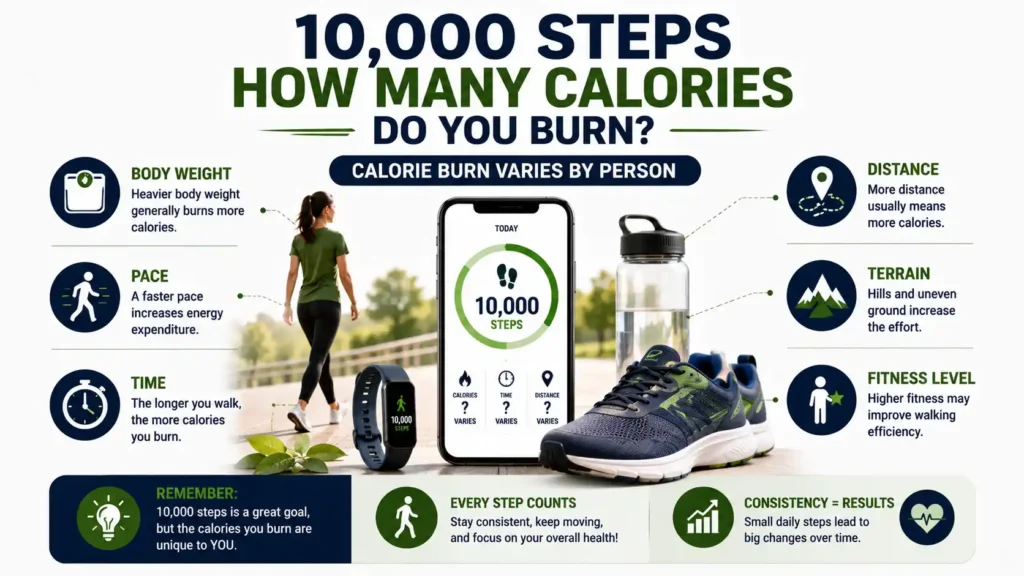
The idea of walking 10,000 steps per day has become extremely popular, but there is no fixed number of calories that everyone burns from 10,000 steps.
Your calorie expenditure will depend on factors including your body weight, stride length, pace, terrain, and the amount of time required to complete those steps.
Your 10,000 steps may also be spread throughout the entire day rather than completed during one dedicated walk.
That still counts as physical activity.
More importantly, you do not necessarily need to reach exactly 10,000 steps to benefit from walking.
The number can be a useful motivational goal, but it is not a magical threshold.
If you currently average 3,000 steps per day, increasing that to 5,000 or 6,000 may already represent a meaningful increase in your activity.
How Many Steps Does It Take to Burn 500 Calories?
There is no reliable universal number of steps required to burn exactly 500 calories.
The energy cost of walking differs between people.
Trying to convert every step into an exact calorie number can therefore create a false sense of precision.
Your fitness tracker may provide an estimate, but it should still be viewed as an estimate.
If your goal is weight loss, you also do not need to burn 500 calories specifically through walking every day.
Weight management depends on your overall energy balance over time, not on hitting one exercise calorie target.
You can learn more in our guide How Many Calories Should I Burn a Day?
Is Walking Good for Weight Loss?
Walking can certainly be part of a weight loss plan.
Walking increases physical activity, which contributes to your total daily energy expenditure.
However, walking alone does not guarantee weight loss.
Your overall calorie intake also matters.
If your body consistently receives more energy than it uses, adding a small amount of walking may not automatically create the energy deficit required for weight loss.
This is why nutrition and physical activity work well together.
A sustainable approach may include nutritious meals, appropriate portions, regular walking, strength training, adequate sleep, and other healthy habits.
If weight loss is your goal, our Calorie Deficit for Weight Loss guide explains this relationship in more detail.
Walking and Your Daily Calorie Burn
Your walking calories are only one part of the energy your body uses each day.
Your body is burning calories before, during, and after your walk.
Energy is required for basic functions such as breathing, circulation, temperature regulation, and brain activity.
You also use energy through everyday movement, exercise, and digestion.
All of this contributes to your Total Daily Energy Expenditure, commonly called TDEE.
This is an important distinction.
If your watch says you burned 300 active calories during a walk, it does not mean your body only burned 300 calories that day.
Your total daily energy expenditure will be much higher because it also includes your resting energy requirements and other activities.
Read our guide What Is TDEE and How Do You Calculate It? if you want to understand this concept in more detail.
You can also use the FitNexaPro TDEE Calculator to estimate your total daily energy needs.
Walking vs Running for Calorie Burn

Running is generally more intense than walking and typically uses more energy over the same amount of time.
But that does not automatically make running the better choice for everyone.
Walking is easier to include in everyday life and may be more comfortable for beginners.
You may also be able to walk for longer than you can run.
For example, someone might struggle to maintain a run for 30 minutes but comfortably complete a 60 minute walk.
The best exercise is not necessarily the one that produces the highest calorie estimate.
It is the activity that fits your fitness level, goals, preferences, and lifestyle well enough for you to continue doing it.
How Long Should You Walk Each Day?
You do not need to walk for hours every day to benefit from physical activity.
For general health, the CDC recommends that adults get at least 150 minutes of moderate intensity physical activity per week, or 75 minutes of vigorous intensity activity, or an equivalent combination. Adults should also include muscle strengthening activity on at least two days each week.
Brisk walking can count toward moderate intensity aerobic activity.
Those 150 minutes do not have to happen in one or two long workouts.
You can spread your activity throughout the week.
For example, a 30 minute brisk walk on five days would add up to 150 minutes.
If you are currently inactive, you can start with a smaller amount and gradually increase your activity.
How to Burn More Calories While Walking
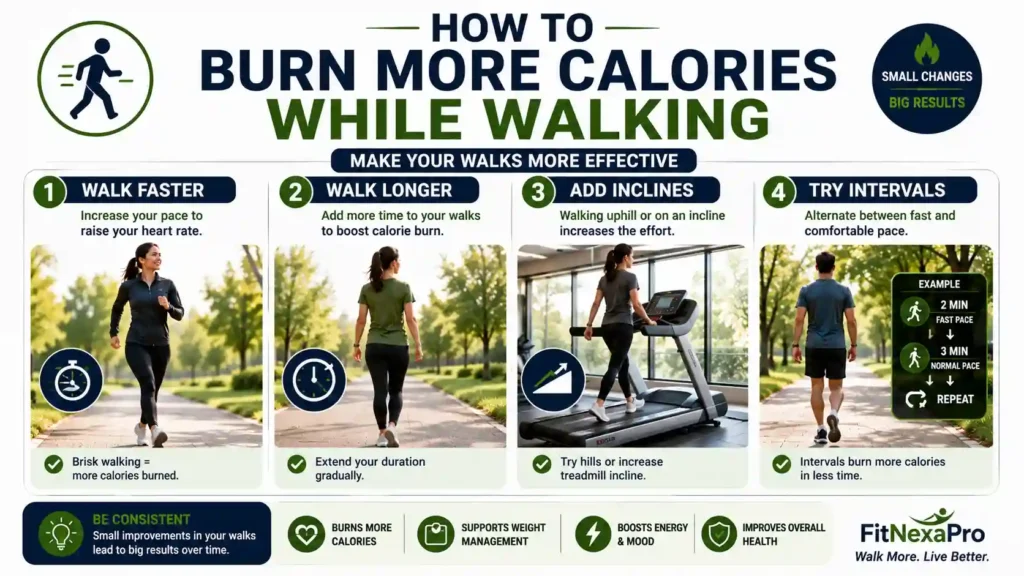
If you want to make your walks more challenging, you have several options.
One of the simplest is to gradually increase your pace.
Walking faster usually requires more effort.
You can also increase your walking duration. Adding another 5 or 10 minutes to your regular walk can increase your total activity without dramatically changing your routine.
Inclines are another option.
Walking uphill or increasing the incline on a treadmill makes your muscles work harder.
You can also include faster intervals during your walk.
For example, alternate periods of brisk walking with periods at a comfortable pace.
Another effective strategy is simply to walk more throughout the day.
You do not have to complete all your movement during one workout.
Walking during breaks, using stairs, parking farther away, and taking a short walk after meals can all contribute to your overall activity.
Is Walking Every Day Okay?
For many healthy adults, walking can be an accessible form of regular physical activity.
The appropriate amount depends on your fitness level, walking intensity, terrain, footwear, recovery, and individual circumstances.
If you are new to exercise, increase your walking gradually.
You do not need to go from almost no activity to long daily walks immediately.
Pay attention to how your body responds.
Persistent pain or symptoms that concern you are a reason to stop and seek appropriate medical advice rather than simply trying to push through them.
Does Walking Build Muscle?
Walking primarily provides aerobic activity, but your muscles are still working while you walk.
Your legs, hips, and core all contribute to movement and stability.
Walking uphill can make some muscles work harder than walking on level ground.
However, walking is not a complete replacement for resistance training if building muscle and strength is one of your main goals.
A balanced fitness routine can include both walking and muscle strengthening exercise.
The CDC recommends muscle strengthening activities on at least two days per week in addition to aerobic activity.
Can You Lose Belly Fat by Walking?
Walking can support overall fat loss when it contributes to a sustainable calorie deficit.
However, you cannot choose exactly where your body will lose fat first.
Doing more walking does not specifically force your body to remove fat from your stomach.
Body fat distribution and fat loss patterns vary between individuals.
Rather than focusing on one body area, focus on improving your overall habits and body composition over time.
Regular physical activity, appropriate nutrition, resistance training, sleep, and consistency can all be part of that approach.
Are Walking Calorie Calculators Accurate?
Walking calorie calculators provide estimates.
They usually use information such as your weight, walking duration, speed, or distance to estimate energy expenditure.
These tools can be useful for getting a general idea of how much energy an activity requires.
However, they cannot perfectly measure your individual metabolism.
The same applies to smartwatches and fitness trackers.
Research on consumer wearable devices has found that estimates of energy expenditure can have meaningful errors, even when some other measurements are reasonably accurate.
For this reason, avoid treating a calorie estimate as an exact amount of energy you have earned back through exercise.
Use it as a reference point instead.
Should You Eat Back Calories Burned From Walking?
Be careful with this approach.
If your daily calorie target is already based on your estimated TDEE and activity level, your normal walking and exercise may already be included in that estimate.
Automatically eating back every calorie displayed by your fitness watch could result in counting some activity twice.
Wearable calorie estimates are also imperfect.
Instead, choose a consistent calorie target based on your overall needs and monitor your progress over time.
If your body weight is moving differently from what you expected, you can adjust your approach gradually.
Common Mistakes When Walking for Weight Loss
A common mistake is assuming that a walk allows you to eat an unlimited amount afterward.
Walking contributes to energy expenditure, but nutrition still matters.
Another mistake is relying too heavily on fitness tracker calorie numbers.
Your watch can be helpful for tracking steps, time, and activity trends, but calorie estimates are not exact.
Some people also start too aggressively.
If you have been mostly inactive, suddenly trying to walk long distances every day may make the routine difficult to maintain.
Start at a manageable level and build gradually.
Finally, do not overlook consistency.
A realistic walking routine that you maintain for months can be more useful than an extreme routine you abandon after a week.
How to Make Walking a Regular Habit
Walking works best when it becomes part of your normal routine.
Choose a time that fits naturally into your day.
That could be before work, during lunch, after dinner, or in the evening.
You can also divide your walking into shorter sessions.
A morning walk and an evening walk may feel easier than one long session.
Tracking your steps or walking time can provide motivation, but you do not have to become obsessed with the numbers.
Look for gradual improvement.
If you walked 20 minutes most days this month, perhaps you can increase to 25 minutes next month.
Simple progress is still progress.
Frequently Asked Questions
How many calories do you burn walking for 30 minutes?
The amount varies based on body weight, pace, terrain, and other individual factors. A brisk 30 minute walk will generally require more energy than a slow 30 minute stroll.
How many calories do you burn walking for an hour?
There is no universal number. Walking speed, body size, distance, incline, and fitness level can all influence energy expenditure.
Does walking 10,000 steps burn 500 calories?
Not necessarily. There is no fixed calorie value for 10,000 steps. The amount of energy used differs between individuals and depends on how those steps are completed.
Is 30 minutes of walking a day enough?
A 30 minute brisk walk on five days per week can contribute 150 minutes toward the CDC’s weekly aerobic activity recommendation for adults. Your individual exercise needs may vary.
Is walking good for losing weight?
Walking can support weight loss by increasing physical activity and total daily energy expenditure. Weight loss still depends on overall energy balance over time.
Is it better to walk faster or longer?
Both can increase the demands of your walk. The better choice depends on your fitness level and what you can maintain consistently.
Can I walk every day?
Many people can include walking regularly in their routine. Your appropriate frequency and duration depend on your fitness level, intensity, recovery, and individual circumstances.
Final Thoughts
So, how many calories do you burn walking?
There is no single answer.
Your calorie burn depends on your body weight, walking speed, duration, distance, terrain, and other individual factors.
Instead of trying to make every walk burn an exact number of calories, focus on becoming consistently active.
Walk regularly. Gradually increase your pace or distance when appropriate. Include other forms of exercise, especially strength training, and pay attention to your overall nutrition if weight management is your goal.
Walking does not need to be complicated to be useful.
A simple walk that you can repeat consistently may contribute much more to your long term fitness than an extreme workout plan that you cannot maintain.