
Calorie Deficit for Weight Loss: A Simple Beginner’s Guide
If you are trying to lose weight, you have probably heard people talk about being in a calorie deficit for weight loss.
The term may sound complicated, but the basic idea is simple. Your body uses energy every day to keep you alive, move around, exercise, digest food, and perform normal daily activities.
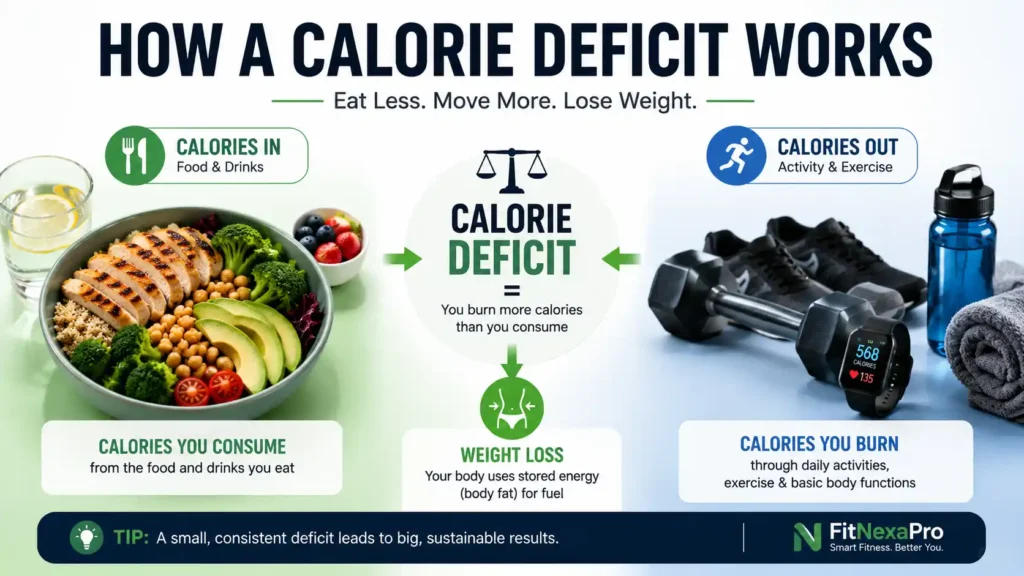
When you consistently consume fewer calories than your body uses, you create a calorie deficit. Over time, your body has to get some of the energy it needs from stored energy, including body fat.
A calorie deficit does not mean you need to starve yourself or eat tiny meals. In fact, making your calorie intake too low can make your diet harder to maintain.
The goal is to find a sensible approach that helps you lose weight gradually while still eating nutritious foods and having enough energy for your daily life.
What Is a Calorie Deficit?
A calorie deficit happens when you consume fewer calories than your body uses.
Imagine your body uses around 2,400 calories during an average day.
If you eat around 2,400 calories, you may be close to maintaining your current weight.
If you regularly eat more than your body needs, the extra energy can contribute to weight gain over time.
If you regularly eat less than your body uses, you create an energy deficit that can lead to weight loss. This basic energy-balance principle is also explained by the NHS.
However, weight loss is not perfectly predictable from a simple calorie equation. Your energy needs can change as your weight, activity level, and other factors change.
That is why calorie targets should be treated as useful estimates rather than perfect numbers.
How Does a Calorie Deficit for Weight Loss Work?
Your body requires energy every day, even if you do not exercise.
It uses calories to keep your heart beating, lungs working, brain functioning, and body temperature regulated.
You also burn energy through walking, working, exercising, household activities, and digesting food.
When the energy coming from your diet is consistently lower than the energy your body uses, your body has to make up the difference.
Over time, this can result in weight loss.
This does not mean you need to create the largest possible calorie deficit.
A more moderate approach is often easier to maintain because you can continue eating satisfying meals while getting enough protein, fiber, vitamins, minerals, and other important nutrients.
How Do I Know My Maintenance Calories?
Before creating a calorie deficit, it helps to estimate your maintenance calories.
Maintenance calories are approximately how many calories you need to consume each day to maintain your current body weight.
Your needs depend on several factors, including your age, sex, height, weight, activity level, and body composition.
This is where a calorie or TDEE calculator can be useful.

TDEE stands for Total Daily Energy Expenditure. It estimates the total amount of energy your body uses during an average day.
For example, if your estimated TDEE is 2,500 calories, that can give you a starting point for understanding your maintenance needs.
Remember that an online calculator cannot know exactly how many calories your body burns. Use the result as an estimate and adjust based on your real progress.
How Big Should Your Calorie Deficit Be?
There is no single calorie deficit that is perfect for everyone.
Your starting body weight, activity level, goals, lifestyle, and health can all influence what is appropriate for you.
The NHS, for example, uses a reduction of around 600 calories per day as general weight-loss guidance for many adults, while emphasizing steady rather than extreme weight loss.
That does not mean everyone should automatically subtract exactly 600 calories.
A smaller deficit may be more comfortable and sustainable for some people.
Instead of focusing on losing weight as quickly as possible, focus on finding an intake you can realistically maintain.
Why a Bigger Calorie Deficit Is Not Always Better
It can be tempting to think that if a small calorie deficit helps with weight loss, a huge deficit must work even better.
That approach can create problems.
Eating far too little can make it harder to meet your nutritional needs. You may also experience more hunger and have less energy available for exercise and everyday activities.
An extremely restrictive diet can also be difficult to maintain.
You may follow it successfully for a few days and then become so hungry that sticking to your plan becomes much harder.
A sustainable calorie deficit is usually more useful than an aggressive diet that you cannot maintain.
How to Create a Calorie Deficit
You can create a calorie deficit through your food intake, physical activity, or a combination of both.
Reducing your calorie intake does not mean removing every food you enjoy.
Small changes can make a meaningful difference over time.
You might reduce oversized portions, replace sugary drinks with lower calorie alternatives, use less cooking oil, choose filling snacks, and prepare more meals at home.
Physical activity can also increase your daily energy expenditure.
Walking, strength training, cycling, swimming, running, sports, and even normal daily movement all use energy.
For many people, combining sensible nutrition with regular physical activity is more practical than relying only on severe food restriction.
Focus on Filling Foods

Hunger is one of the biggest reasons people struggle to maintain a calorie deficit.
The type of food you eat can make a major difference.
Foods containing protein and fiber can be particularly useful because they can help make meals more satisfying.
Good protein options include eggs, chicken, fish, Greek yogurt, cottage cheese, beans, lentils, tofu, lean meats, and other protein-rich foods.
For fiber, consider vegetables, fruits, beans, lentils, oats, whole grains, nuts, and seeds.
You do not need to eat only low-calorie foods.
Instead, build meals that provide good nutrition and help you feel satisfied.
Protein Is Important During Weight Loss
Protein deserves special attention when you are losing weight, especially if you also exercise.
Your body uses protein for many important functions, including maintaining and repairing tissues.
Try to include a source of protein in your main meals.
Breakfast might include eggs or Greek yogurt. Lunch could include chicken, tuna, beans, or tofu. Dinner might include fish, lean meat, lentils, or another protein source.
Protein powders can be convenient, but they are not necessary for everyone.
Whole foods can provide plenty of protein if your diet is planned well.
Calculate Your Daily Protein👉🏻 Protein Calculator
Do You Have to Count Calories to Lose Weight?
No.
Calorie counting can be useful, but it is not the only way to create a calorie deficit.
Some people enjoy tracking their meals because it gives them a clearer picture of how much they are eating.
Other people find tracking every meal frustrating.
You can reduce your calorie intake without counting everything by controlling portions, choosing more filling foods, limiting frequent high-calorie drinks, eating more vegetables, and becoming more active.
The NHS also notes that calorie counting is not the only approach to weight loss and that balanced meals and portion changes can help.
Choose an approach you can realistically follow.
Common Calorie Tracking Mistakes
If you decide to track calories, accuracy matters.
One common mistake is forgetting cooking oils. Oil contains a significant amount of energy, and pouring it directly into a pan can make it difficult to know how much you used.
Sauces, dressings, spreads, and toppings are also easy to overlook.
Drinks matter too.
Sugary coffee drinks, juices, soft drinks, smoothies, and other beverages can add calories without making you feel as full as a complete meal.
Portion sizes are another common problem.
The amount you actually eat may be very different from the serving size shown on the package.
You do not need to measure everything forever, but learning what normal portions look like can make tracking more useful.
Why Does Weight Change Even When You Are in a Deficit?
Your body weight does not move in a perfectly straight line.
You might follow your calorie target carefully and still wake up heavier one morning.
That does not necessarily mean your calorie deficit has stopped working.
Body weight can temporarily change because of water retention, sodium intake, carbohydrate intake, digestion, exercise, and hormonal changes.
For this reason, avoid judging your progress based on one weigh-in.
Look at your overall trend over several weeks instead.
Exercise and a Calorie Deficit
Exercise can be an important part of a healthy weight-management plan.
It increases your physical activity and provides benefits beyond the number of calories burned.
However, be careful about relying too heavily on the calorie number displayed by a smartwatch, treadmill, or fitness app.
These numbers are estimates.
You do not necessarily need to eat back every calorie your device says you burned.
Instead, consider your activity level when estimating your overall calorie needs and then monitor your progress.
Strength Training During Weight Loss

If possible, include resistance training in your fitness routine.
Resistance training includes activities such as weight training, bodyweight exercises, resistance bands, and similar exercises that challenge your muscles.
Instead of focusing only on making the scale go down, think about improving your overall body composition and fitness.
Combine resistance training with adequate protein, regular movement, nutritious food, and sufficient recovery.
This creates a much more complete approach than simply trying to eat as little as possible.
Why Weight Loss Can Slow Down
Many people notice that weight loss becomes slower after following a diet for some time.
This is normal.
As your body weight changes, your energy requirements can also change. The simple idea that every fixed calorie deficit will produce exactly the same amount of weight loss indefinitely does not reflect how the body adapts over time. Research underlying the NIH Body Weight Planner accounts for these changing energy needs.
This is why your original calorie target may eventually need adjustment.
But do not change your calories simply because your weight did not move for two or three days.
Give yourself enough time to identify a genuine trend.
How Often Should You Check Your Progress?
There is no need to obsess over the scale.
If you weigh yourself, try to do it under reasonably consistent conditions.
Then look at the trend rather than individual numbers.
You can also monitor other signs of progress.
Your waist measurement may change. Clothes may fit differently. Your fitness may improve. You may become stronger or find daily activities easier.
Tracking progress can help you identify what is working and where adjustments may be useful. NIDDK also recommends monitoring progress when working on healthier habits.
When Should You Adjust Your Calories?
Give your plan enough time before changing it.
If your weight trend is gradually moving in the direction you want, there may be no reason to reduce calories further.
If your progress has genuinely stopped for an extended period, review your habits first.
Check portion sizes, drinks, snacks, cooking oils, weekend meals, and changes in physical activity.
Sometimes the issue is not that your calorie target needs to become much lower. Your actual intake may simply be higher than you realize.
If an adjustment is needed, making a small change is usually easier to evaluate than dramatically cutting your food intake.
Can You Eat Your Favorite Foods in a Calorie Deficit?
Yes.
You do not have to completely remove pizza, chocolate, burgers, desserts, or other foods you enjoy simply because you want to lose weight.
What matters is your overall eating pattern.
Most of your diet should provide nutritious foods that help you meet your protein, fiber, vitamin, mineral, and energy needs.
Your favorite foods can still fit in reasonable portions.
This can make your diet feel much more realistic and easier to maintain.
How Long Should You Stay in a Calorie Deficit?
There is no universal answer.
How long you remain in a deficit depends on your starting point, goals, rate of progress, lifestyle, and health.
Weight management should not be treated as a race.
The NIH Body Weight Planner is designed around personalized calorie and physical activity plans for reaching a goal over a chosen period and maintaining the result afterward, which is a useful reminder that maintenance matters too.
If you reach your desired weight, your next goal generally shifts toward finding an intake and lifestyle that help you maintain it.
Frequently Asked Questions
What is a calorie deficit for weight loss?
A calorie deficit means consuming less energy than your body uses over time. This creates an energy shortage that can lead to weight loss.
How many calories should I cut to lose weight?
There is no perfect number for everyone. Your calorie needs depend on factors such as your body size, activity level, age, and goals. Estimate your maintenance needs first and use a sensible deficit rather than choosing an extremely low calorie target.
Can I lose weight with a 300 calorie deficit?
A relatively modest deficit may support gradual weight loss for some people. Actual results vary because calorie requirements and energy expenditure differ between individuals.
Is a 500 calorie deficit good for weight loss?
A 500-calorie deficit is a commonly discussed starting point, but it is not automatically appropriate for everyone. Your total calorie intake, nutritional needs, body size, activity level, and health should also be considered.
Can I create a calorie deficit without exercise?
Yes. A calorie deficit can be created by reducing calorie intake.
However, physical activity offers many benefits and can be valuable as part of a balanced weight-management plan.
Why am I not losing weight in a calorie deficit?
Short-term scale changes can hide progress because body weight is affected by water, digestion, sodium, carbohydrates, exercise, and other factors.
If there is no downward trend over a longer period, review your actual food intake, portions, activity level, and calorie estimate.
Is it safe to eat very few calories to lose weight faster?
Very restrictive diets can make it difficult to get adequate nutrition and may not be appropriate without professional supervision. NIDDK specifically warns against very low intake in its weight-management resources.
If you have a medical condition, take medications that affect weight or appetite, are pregnant or breastfeeding, are under 18, or have a current or past eating disorder, get advice from a qualified healthcare professional before intentionally restricting calories.
Final Thoughts
A calorie deficit for weight loss does not have to be complicated.
Start by understanding approximately how many calories your body needs. Then create a reasonable deficit through nutritious food choices, portion awareness, physical activity, or a combination of these approaches.
Avoid turning weight loss into a competition to see how little you can eat.
A plan that provides enough nutrition, keeps you reasonably satisfied, supports your activity, and fits your lifestyle is much more useful than an extreme diet you cannot maintain.
Monitor your progress over time and make small adjustments when necessary.
Most importantly, think beyond the number on the scale. Regular exercise, balanced nutrition, adequate protein, good sleep, and sustainable habits all contribute to a healthier long-term approach.




4 Comments