What Are Macronutrients? Protein, Carbs & Fats Explained
If you’ve ever tracked calories, followed a workout plan, or looked at a nutrition label, you’ve probably seen the words protein, carbohydrates and fat. These nutrients are often discussed separately, but together they form the major energy-providing nutrients in your diet.
Understanding what macronutrients are can make nutrition much easier to navigate. Instead of thinking of foods simply as “good” or “bad,” you can start understanding what different foods provide and how they fit into your overall eating pattern.
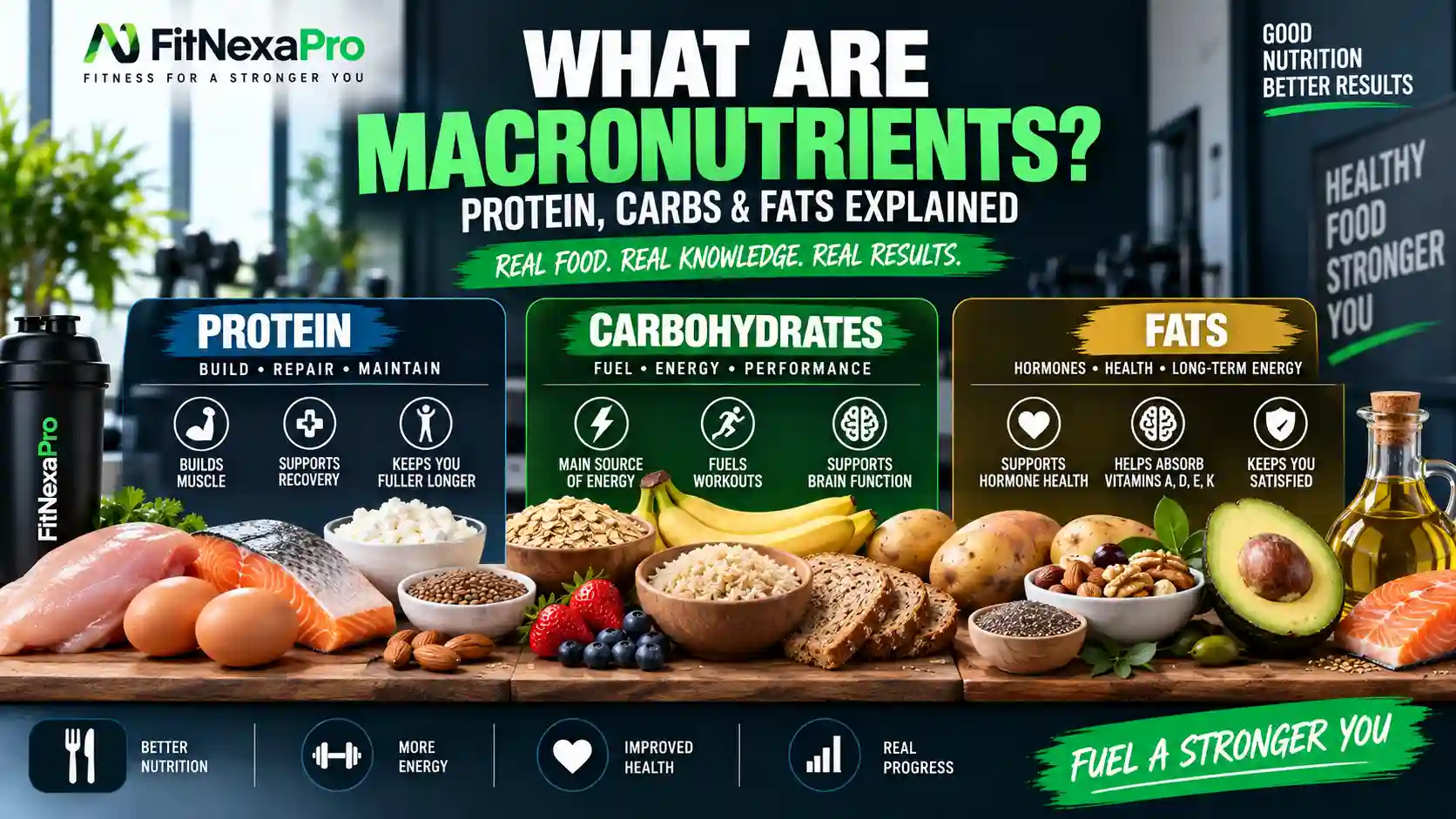
Protein helps build and maintain body tissues, including muscle. Carbohydrates are an important source of energy. Dietary fats provide concentrated energy and perform several important functions, including helping your body absorb certain vitamins.
This beginner-friendly guide explains each macronutrient, where to find it, how many calories it provides, and how protein, carbohydrates and fats can work together in a practical diet.
What Are Macronutrients?
Macronutrients are nutrients your body uses in relatively large quantities. In everyday nutrition discussions, the three main macronutrients are:
Protein
Carbohydrates
Fat
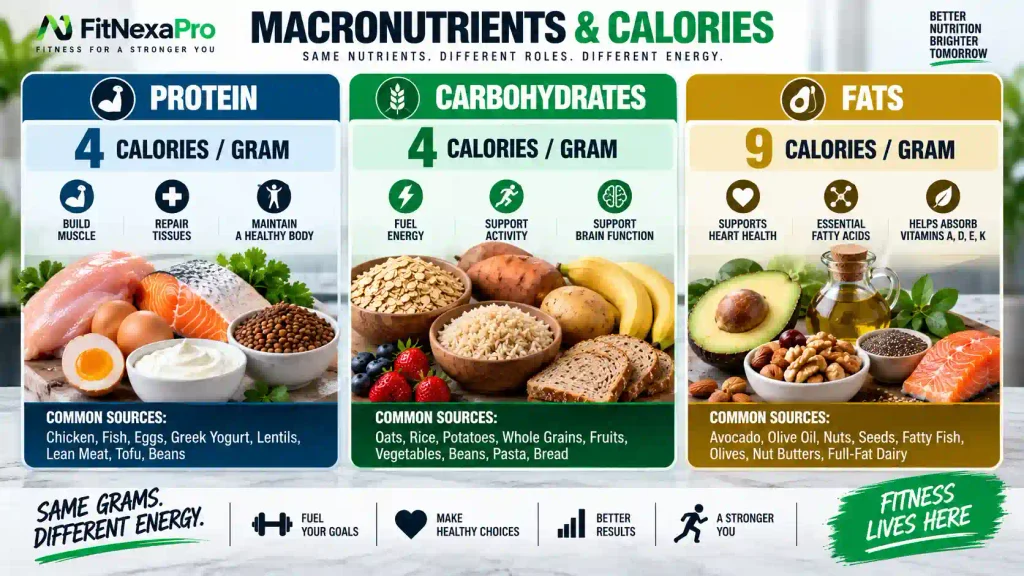
All three contribute energy to the diet, but they don’t provide the same number of calories.
Protein: 4 calories per gram
Carbohydrates: 4 calories per gram
Fat: 9 calories per gram
This is why two foods of similar size can contain very different numbers of calories. Fat provides more than twice as much energy per gram as protein or carbohydrates.
Macronutrients shouldn’t be confused with micronutrients, such as vitamins and minerals. Your body needs micronutrients in smaller amounts, but they are still essential components of nutrition.
Water is also an essential nutrient, although it doesn’t provide calories.
1. Protein: The Building and Repair Macronutrient
Protein gets plenty of attention in the fitness world, and for good reason.
Your body needs dietary protein to build and maintain tissues including muscle, bone and skin. Proteins are made from smaller components called amino acids.
For someone who exercises regularly, protein is therefore an important part of an overall diet.
But protein isn’t only for bodybuilders.
Everyone needs protein.
Common Protein Foods
Protein can come from both animal and plant foods.
Examples include:
- Chicken and turkey
- Fish and seafood
- Eggs
- Milk, yogurt and cottage cheese
- Lean meat
- Beans
- Lentils
- Chickpeas
- Tofu and other soy foods
- Nuts and seeds
Rather than depending on one protein food every day, eating a variety of foods can also provide a wider range of other nutrients.
How Many Calories Does Protein Provide?
Each gram of protein provides approximately 4 calories.
For example, a food containing 25 grams of protein would provide about:
25 × 4 = 100 calories from protein
That doesn’t necessarily mean the entire food contains only 100 calories.
A serving of salmon, for example, can contain protein and fat. Yogurt might contain protein, carbohydrates and fat depending on the type.
Real foods often contain multiple macronutrients at the same time.
That’s an important concept we’ll return to later.
If you want to estimate your own protein needs, read our How Much Protein Do You Need Per Day? guide.
2. Carbohydrates: An Important Energy Source
Carbohydrates sometimes receive an unnecessarily negative reputation.
Carbohydrates are one of the three main nutrients found in foods and drinks. During digestion, the body breaks many carbohydrates down into glucose, which can be used for energy or stored in the liver and muscles for later use.
This makes carbohydrate-containing foods particularly relevant when discussing daily activity and exercise.
Different Types of Carbohydrates
“Carbohydrates” describes a broad category rather than one specific food.
They include:
Sugars
These can occur naturally in foods such as fruit and milk or be added to foods and drinks.
Starches
These are found in foods such as potatoes, rice, bread, pasta, grains and legumes.
Fiber
Fiber is a type of carbohydrate that isn’t digested in the same way as sugars and starches. Fiber contributes to digestive health and is found in foods including fruits, vegetables, whole grains, beans and legumes.
Better Carbohydrate Choices
Rather than asking whether carbohydrates are “good or bad,” a more useful question is:
Where are my carbohydrates coming from?
Whole grains, fruits, vegetables, beans and legumes can provide carbohydrates alongside fiber, vitamins, minerals and other nutrients.
Highly processed foods and sugary drinks can also provide carbohydrates, but their overall nutritional profile may be very different.
NIH’s MedlinePlus recommends emphasizing sources such as whole grains, fruits, vegetables, beans and legumes rather than relying heavily on refined grains and foods high in added sugar.
NIH MedlinePlus guide to carbohydrates
How Many Calories Do Carbohydrates Provide?
Like protein, carbohydrates provide approximately 4 calories per gram.
For example:
50 grams carbohydrate × 4 = 200 calories
Again, that’s only the energy coming from the carbohydrate portion of the food.
If the food also contains protein or fat, those macronutrients contribute additional calories.
3. Dietary Fat: More Than Just Stored Energy
Fat is another macronutrient that is often misunderstood.
Dietary fat provides energy, supplies essential fatty acids and helps your body absorb the fat-soluble vitamins A, D, E and K.
It therefore isn’t something that needs to be eliminated from a normal diet.
How Many Calories Does Fat Provide?
Fat provides approximately:
9 calories per gram
That’s more than twice the energy per gram supplied by protein or carbohydrates.
For example:
20 grams fat × 9 = 180 calories
This higher energy density helps explain why relatively small portions of foods rich in fat can contain substantial calories.
That doesn’t automatically make high-fat foods unhealthy.
Foods such as nuts, seeds, avocado, olive oil and fatty fish can contribute useful nutrients. Portion size and the overall eating pattern still matter.
Different Types of Dietary Fat
Dietary fats include saturated and unsaturated fats.
Unsaturated fats include monounsaturated and polyunsaturated fats and are found in foods such as certain vegetable oils, nuts, seeds, avocado and fish.
Saturated fat occurs in foods including butter, full-fat dairy, fatty meats, coconut oil and palm oil.
The type of fat matters, not simply the total amount. MedlinePlus recommends favoring unsaturated fats in place of saturated fats where appropriate.
NIH MedlinePlus guide to dietary fats
Protein vs Carbs vs Fat: What’s the Difference?
Here’s the simplest way to remember their major roles:
Protein → building and maintaining body tissues
Carbohydrates → an important source of energy
Fat → concentrated energy, essential fatty acids and support for functions including absorption of fat-soluble vitamins
But this simplified explanation doesn’t mean each macronutrient performs only one function.
Human nutrition is much more interconnected.
That’s also why trying to label one macronutrient as “good” and another as “bad” usually isn’t a useful approach.
Most Foods Contain More Than One Macronutrient
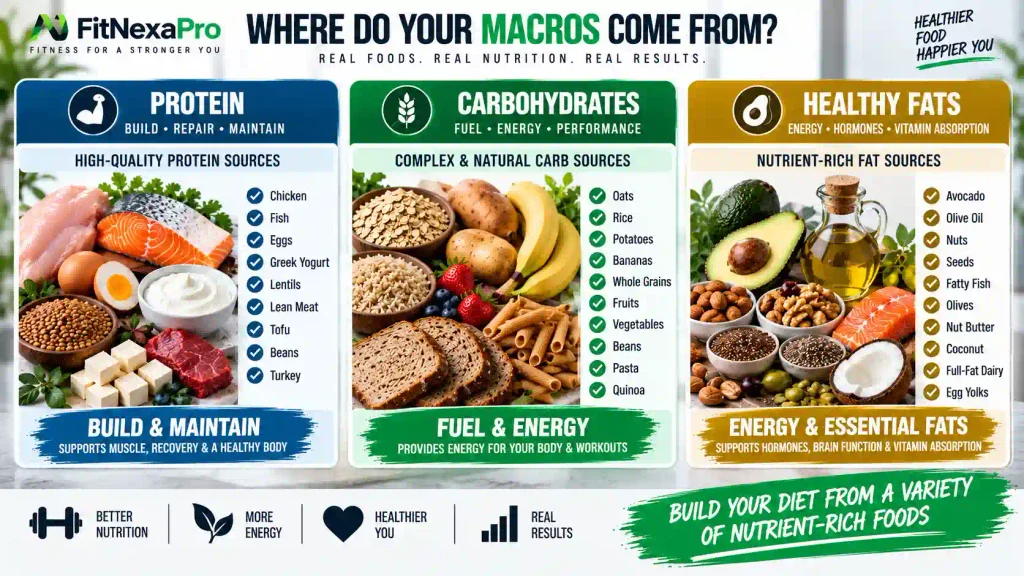
Protein, carbohydrates and dietary fats can come from many different foods, and most whole foods contain more than one nutrient.This is one of the easiest things for beginners to misunderstand.
Chicken breast is commonly called a “protein.”
Rice is called a “carb.”
Peanut butter is called a “fat.”
But these labels are shorthand.
Most foods aren’t made entirely from one macronutrient.
For example:
Eggs contain protein and fat.
Milk can contain protein, carbohydrates and fat.
Beans provide carbohydrates and protein.
Nuts contain mostly fat but also provide protein and carbohydrates.
Oats contain mostly carbohydrates while also providing protein and some fat.
When someone calls a food a “protein source,” they generally mean protein is one of its nutritionally important characteristics—not that protein is the only nutrient it contains.
Understanding this makes food labels much easier to interpret.
How Macronutrients Create Your Calories
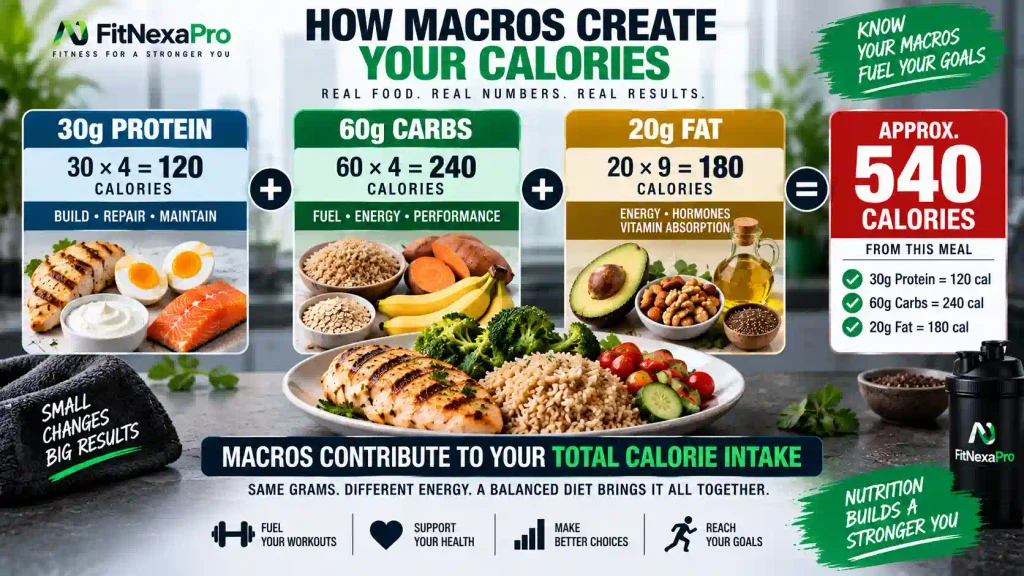
Here’s where macros and calories connect.
Imagine a meal contains:
30 g protein
60 g carbohydrate
20 g fat
We can estimate the calories supplied by those macronutrients.
Protein:
30 × 4 = 120 calories
Carbohydrates:
60 × 4 = 240 calories
Fat:
20 × 9 = 180 calories
Together:
120 + 240 + 180 = approximately 540 calories
This simple example shows why calories and macros aren’t competing concepts.
Macronutrients contribute to the calorie content of your diet.
If you’re trying to understand your overall energy needs first, our How Many Calories Should I Eat a Day? guide is the better starting point.
Do You Need to Track Macronutrients?
No.
You can eat a nutritious diet without weighing every meal or entering everything into an app.
Macro tracking is simply one tool.
Some people find it useful because it helps them understand how much protein, carbohydrate and fat they’re eating.
Others find detailed tracking unnecessarily complicated.
If you’re a beginner, learning how to build reasonably balanced meals may be more useful than immediately trying to hit exact macro numbers every day.
You can always become more precise later if your goals require it.
A Simple Way to Build a Balanced Fitness Meal
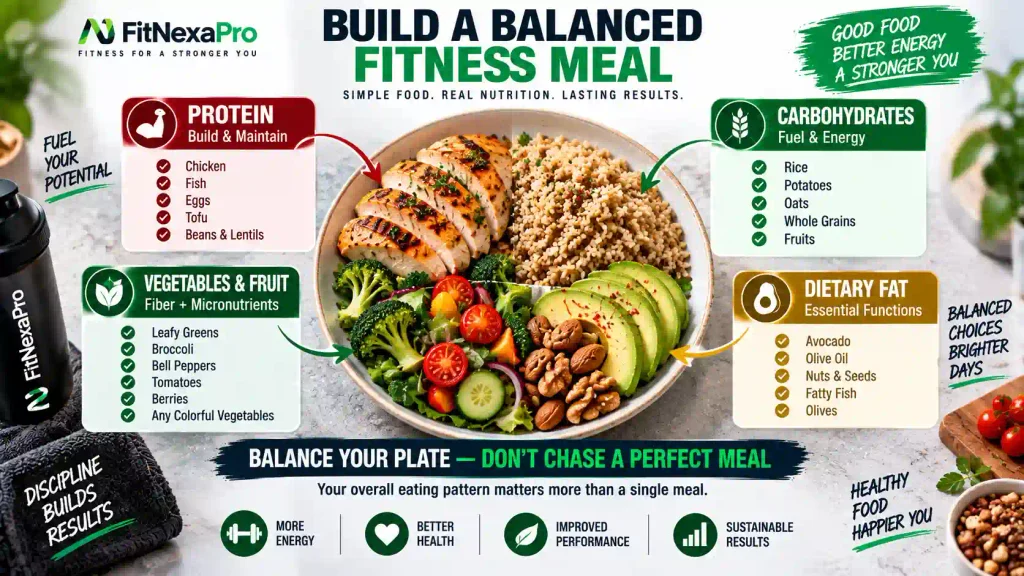
You don’t need a calculator every time you make lunch.
A practical meal might combine:
A protein source
Chicken, fish, eggs, yogurt, tofu, beans or lentils.
A carbohydrate source
Rice, potatoes, oats, whole-grain bread, pasta, fruit or another grain.
Vegetables or fruit
These add fiber and a variety of vitamins, minerals and other dietary components.
A source of dietary fat
Olive oil, avocado, nuts, seeds, eggs or fatty fish, depending on what is already included in the meal.
For example:
Grilled chicken + rice + mixed vegetables + olive oil
Or:
Greek yogurt + oats + berries + nuts
Or:
Lentils + rice + vegetables + avocado
You don’t need to force every meal into exactly the same ratio.
Your entire day’s eating pattern matters more than making every plate mathematically perfect.
Should Your Macros Change Based on Your Goal?
They can.
Someone training regularly for strength or muscle gain may organize their food differently from someone who is primarily trying to manage calorie intake.
Likewise, an endurance athlete may have different carbohydrate requirements from someone who exercises recreationally a few times per week.
That’s why copying someone else’s macro targets from social media isn’t particularly useful.
Individual needs can depend on factors including:
- Total calorie needs
- Body size
- Activity level
- Training type
- Fitness goals
- Age
- Food preferences
- Health considerations
There isn’t one ideal macro split for every person.
Historical Dietary Reference Intake ranges for adults have allowed fairly broad proportions of calories from carbohydrate, fat and protein, illustrating that healthy eating does not depend on one narrow universal ratio.
Macronutrients and Weight Loss
If your goal is weight loss, macronutrients still matter—but they don’t replace the importance of overall energy intake.
A calorie deficit occurs when energy intake is lower than energy expenditure over time.
Changing your macronutrient distribution doesn’t remove that basic energy relationship.
However, the foods you choose can influence things such as meal satisfaction, dietary quality, training performance and how easy a diet feels to maintain.
Instead of simply trying to eat “as little as possible,” focus on building an eating pattern you can realistically follow.
For a deeper explanation, read our Calorie Deficit for Weight Loss: A Simple Beginner’s Guide.
Macronutrients and Muscle Building
For people performing resistance training, protein receives particular attention because it supplies amino acids used to build and maintain body tissues, including muscle.
But that doesn’t mean muscle-building diets should consist almost entirely of protein.
Carbohydrates and fats remain components of a balanced diet, and your total energy intake also matters.
Think of nutrition as a system rather than searching for one “muscle-building nutrient.”
Training provides the stimulus.
Food provides energy and nutrients.
Recovery gives your body time to adapt.
Consistency connects everything.
Three Common Macronutrient Mistakes
1. Treating One Macronutrient as the Enemy
Carbohydrates and fats are frequently blamed for weight gain, while protein is sometimes presented as automatically beneficial regardless of context.
Nutrition isn’t that simple.
All three macronutrients can fit within a balanced diet.
2. Focusing on Macros but Ignoring Food Quality
Two diets could theoretically contain similar amounts of protein, carbohydrates and fat while being very different nutritionally.
Fruits, vegetables, whole grains, legumes, lean protein foods, nuts and other nutrient-rich foods provide vitamins, minerals, fiber and other components that macro numbers alone don’t capture.
MedlinePlus describes a healthy eating pattern as including a variety of foods rather than focusing narrowly on individual nutrients.
3. Copying Someone Else’s Macro Targets
A fitness influencer’s numbers aren’t automatically appropriate for you.
Start with your own energy needs, activity and goals.
Then adjust your nutrition accordingly.
How to Read Macros on a Nutrition Label
Nutrition labels make it relatively easy to see the macronutrient content of packaged foods.
Look for:
Total Fat
Total Carbohydrate
Protein
But always check the serving size first.
If a package contains two servings and you eat the entire package, the amount of calories and macronutrients you consume will generally be twice the values listed for one serving.
Nutrition Facts labels also provide additional information such as saturated fat, dietary fiber, total sugars and added sugars.
This makes food labels useful for understanding what you’re actually eating rather than relying only on front-of-package marketing claims.
The Bottom Line
So, what are macronutrients?
Protein, carbohydrates and fats are major nutrients that contribute energy and perform important roles in the body.
Protein provides approximately 4 calories per gram and helps build and maintain body tissues.
Carbohydrates provide approximately 4 calories per gram and are an important source of energy.
Fat provides approximately 9 calories per gram, supplies essential fatty acids and helps with functions including absorption of fat-soluble vitamins.
You don’t need to fear one macro or obsess over achieving a perfect ratio.
Start by understanding what each macronutrient does, choose a variety of nutrient-rich foods, and adjust your overall intake according to your needs and fitness goals.
Once you understand these basics, concepts such as calories, protein targets, calorie deficits and macro calculations become much easier to understand.