

How Many Calories Should I Eat a Day?
If you are trying to lose weight, gain muscle, or simply stay healthy, one of the first questions you may have is: how many calories should I eat a day?
There is no single calorie number that works for everyone. Your body needs a different amount of energy depending on your age, sex, height, weight, activity level, and fitness goals.
For example, someone who works at a desk and rarely exercises will usually need fewer calories than someone who trains at the gym five days a week. A person trying to lose weight may also eat differently from someone trying to build muscle.
The good news is that you do not need to make calorie counting complicated. Once you understand your maintenance calories and how your activity affects your needs, you can find a reasonable starting point for your goal.
What Are Calories?
A calorie is simply a unit of energy.
Your body gets energy from the food and drinks you consume. It uses that energy throughout the day to keep you alive and active.
Even when you are sleeping, your body is using energy. Your heart is beating, your lungs are working, your brain is active, and your body is maintaining its normal temperature.
You use additional energy when you walk, work, exercise, clean your home, climb stairs, or perform other physical activities.
This is why your body needs calories every day.
Calories are not automatically good or bad. What matters is how many calories you consume, where those calories come from, and whether your overall diet provides the nutrients your body needs.

How Many Calories Should I Eat a Day?
Your daily calorie needs depend on several personal factors.
Many adults may need somewhere around 1,600 to 3,000 calories per day, but this is only a broad range. Some people may need less, while highly active people may need considerably more.
Instead of choosing a random calorie target, it is better to estimate your own daily energy needs.
Your calorie requirement is mainly affected by your age, biological sex, height, weight, activity level, and body composition.
Your goal also matters.
If you want to maintain your current weight, you generally need to consume around the same amount of energy that your body uses.
If you want to lose weight, you generally need to consume fewer calories than you use over time.
If you want to gain weight or support muscle growth, you may need to consume more calories than you use.

What Are Maintenance Calories?
Maintenance calories are the approximate number of calories you need each day to maintain your current body weight.
Imagine your body uses around 2,400 calories during an average day.
If you consistently eat around 2,400 calories and your activity remains similar, your weight may stay relatively stable.
If you regularly eat substantially more than your body uses, your weight may increase over time.
If you consistently eat less than your body uses, your weight may decrease.
This idea is often called energy balance.
However, your body is not a perfect calculator. Daily energy use can change, and body weight naturally moves up and down because of water, food intake, sodium, hormones, and other factors.
For this reason, a calorie estimate should be treated as a starting point rather than a perfect number.
What Is BMR?
BMR stands for Basal Metabolic Rate.
Your BMR is an estimate of how much energy your body needs to perform basic functions while at rest.
This includes breathing, circulating blood, maintaining body temperature, supporting your brain, and keeping your organs functioning.
You should not normally use your BMR as your daily calorie target because you also use energy through movement, digestion, work, exercise, and normal daily activities.
This is where TDEE becomes useful.
What Is TDEE?
TDEE stands for Total Daily Energy Expenditure.
It represents an estimate of the total number of calories your body uses during an entire day.
Your TDEE includes your basic energy needs as well as the energy you use through normal movement, exercise, and digestion.
For example, imagine your estimated TDEE is 2,500 calories.
Eating around 2,500 calories per day may be a reasonable starting point for maintaining your weight.
Eating somewhat below that amount may support gradual weight loss.
Eating somewhat above it may support weight gain, depending on your training and other factors.
A TDEE calculator can make this process much easier because you do not need to calculate everything manually.
How Activity Level Changes Your Calorie Needs
Your activity level can make a significant difference to the number of calories you need.
Someone who spends most of the day sitting may have lower energy needs than someone who is constantly moving at work.
Exercise matters too.
Running, cycling, swimming, strength training, sports, and other physical activities require energy. But exercise is only one part of your daily activity.
Walking around your office, taking the stairs, shopping, doing housework, and playing with your children also contribute to your daily energy use.
This is why two people of the same age, height, and weight can have different calorie requirements.
When using a calorie calculator, choose the activity level that most closely represents your normal lifestyle rather than selecting a higher activity level just because you occasionally exercise.
How Many Calories Should I Eat to Lose Weight?
Weight loss generally requires a calorie deficit.
A calorie deficit means that, over time, you consume less energy than your body uses.
Suppose your estimated maintenance requirement is 2,400 calories per day. Eating somewhat below your maintenance level may create a calorie deficit.
You do not necessarily need an extreme deficit.
A moderate approach is often easier to maintain because it allows you to continue eating satisfying meals while making progress.
Very aggressive calorie restriction can make it harder to get enough protein, fiber, vitamins, minerals, and other nutrients. It may also leave you feeling hungry or low on energy.
Rather than trying to lose weight as quickly as possible, focus on habits you can realistically maintain.
How Big Should My Calorie Deficit Be?
There is no perfect deficit for everyone.
A commonly used starting approach is to reduce daily calorie intake moderately below estimated maintenance needs and then monitor progress.
For some people, a few hundred calories below maintenance may be enough to produce gradual changes.
Your ideal approach depends on your starting weight, activity level, lifestyle, training routine, appetite, and health needs.
The important part is consistency.
Eating very little Monday through Friday and then greatly exceeding your needs over the weekend can make progress difficult.
A smaller calorie deficit that you can maintain consistently may be more practical than a very large deficit that leaves you constantly hungry.
How Many Calories Should I Eat to Gain Muscle?
Building muscle requires more than simply eating as many calories as possible.
Your body needs resistance training, sufficient protein, enough overall nutrition, and adequate recovery.
If your goal is muscle gain, eating around maintenance or in a modest calorie surplus may be appropriate depending on your training experience and circumstances.
A calorie surplus means consuming slightly more energy than your body uses.
For example, if your maintenance level is around 2,500 calories, you might begin slightly above that amount rather than immediately adding hundreds or thousands of extra calories.
More food does not automatically mean more muscle.
A very large calorie surplus can result in unnecessary fat gain.
Your strength training program is therefore just as important as your calorie intake.
Protein Matters Too
Calories tell you how much energy you are consuming, but they do not tell you everything about the quality of your diet.
Protein is particularly important for people who exercise.
Protein helps your body maintain and repair muscle tissue. It can also help meals feel more satisfying.
Good protein sources include eggs, chicken, fish, lean meat, Greek yogurt, cottage cheese, milk, lentils, beans, tofu, and other soy foods.
Protein powders can also be convenient, but they are not required if you already get enough protein from your regular diet.
Your diet should also include carbohydrates and healthy sources of fat.
Carbohydrates provide useful energy, especially for active people, while dietary fats are important for many normal body functions.
Food Quality Still Matters
You could technically reach the same calorie target using very different foods, but the nutritional value of those diets could be completely different.
For example, 2,000 calories from mostly highly processed snacks would not provide the same balance of protein, fiber, vitamins, minerals, and other nutrients as a varied diet built around nutritious foods.
Try to base most of your diet around foods such as vegetables, fruits, whole grains, legumes, lean proteins, dairy or suitable alternatives, nuts, seeds, and other minimally processed foods.
You can still enjoy your favorite foods.
A healthy diet does not have to be perfect.
What matters most is the overall pattern of what you eat.
Do I Need to Count Calories Every Day?
No.
Calorie counting is a tool, not a requirement.
Some people enjoy tracking their food because it helps them understand portion sizes and stay aware of what they eat.
Other people find constant tracking stressful or inconvenient.
If you choose to count calories, you may find it helpful to track your normal diet for a short period. This can show you where most of your calories are coming from and help you understand your usual portion sizes.
Eventually, you may become comfortable estimating portions without tracking every meal.
You can also focus on simple habits such as eating enough protein, including vegetables and fruit, choosing filling foods, watching portion sizes, and limiting frequent high calorie drinks.
Why Is My Weight Changing Even When My Calories Are the Same?
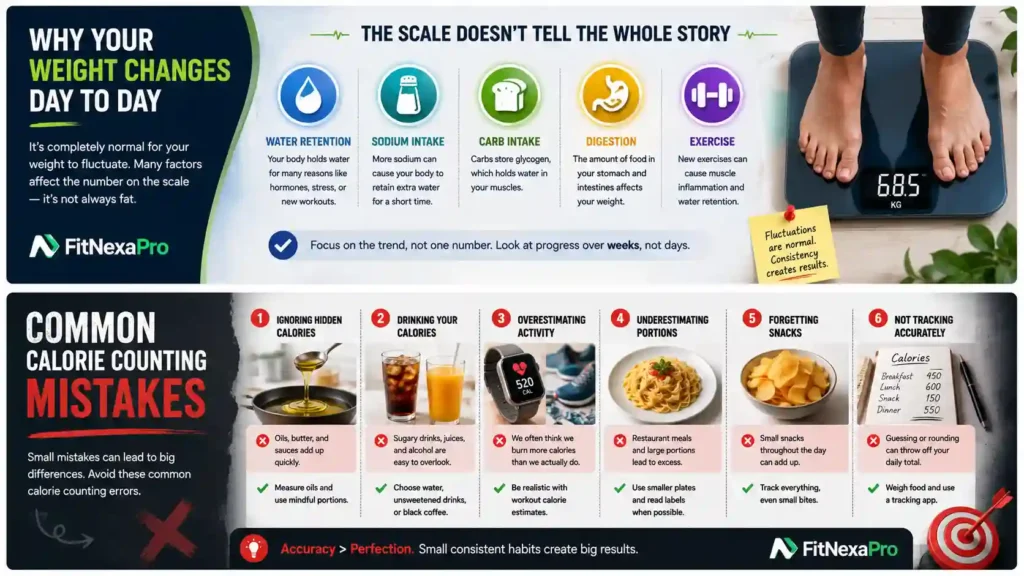
Your scale weight can change from one day to another even when your calorie intake stays similar.
This does not necessarily mean you gained or lost body fat overnight.
Your weight can temporarily change because of water retention, carbohydrate intake, sodium intake, digestion, bowel movements, exercise, and hormonal changes.
This is why looking at a longer term trend is usually more useful than focusing on a single weigh in.
For example, if your weight is slightly higher today than yesterday, there is usually no reason to immediately cut your calories.
Give your plan enough time before making major changes.
Are Online Calorie Calculators Accurate?
Calorie calculators provide estimates.
They use formulas based on information such as your age, height, weight, sex, and activity level to estimate your energy needs.
They cannot know exactly how many calories your individual body uses every day.
Your actual calorie requirements can be affected by body composition, genetics, lifestyle, exercise, sleep, and other factors.
This does not make calorie calculators useless.
They can provide a helpful starting point.
You can use the estimate for a few weeks while monitoring your weight, measurements, energy, hunger, and gym performance. You can then adjust your intake if necessary.
How Often Should I Adjust My Calories?
You do not need to change your calorie target every few days.
Body weight naturally fluctuates, so changing your diet after every small movement on the scale can make things unnecessarily complicated.
Instead, look for trends over several weeks.
If your goal is weight loss and your average weight is gradually decreasing, your current approach may be working.
If nothing changes for an extended period, you may need to review your calorie intake, portion sizes, activity level, or tracking accuracy.
The same principle applies when trying to gain weight.
Small, gradual adjustments are generally easier to evaluate than making dramatic changes.
Common Calorie Counting Mistakes
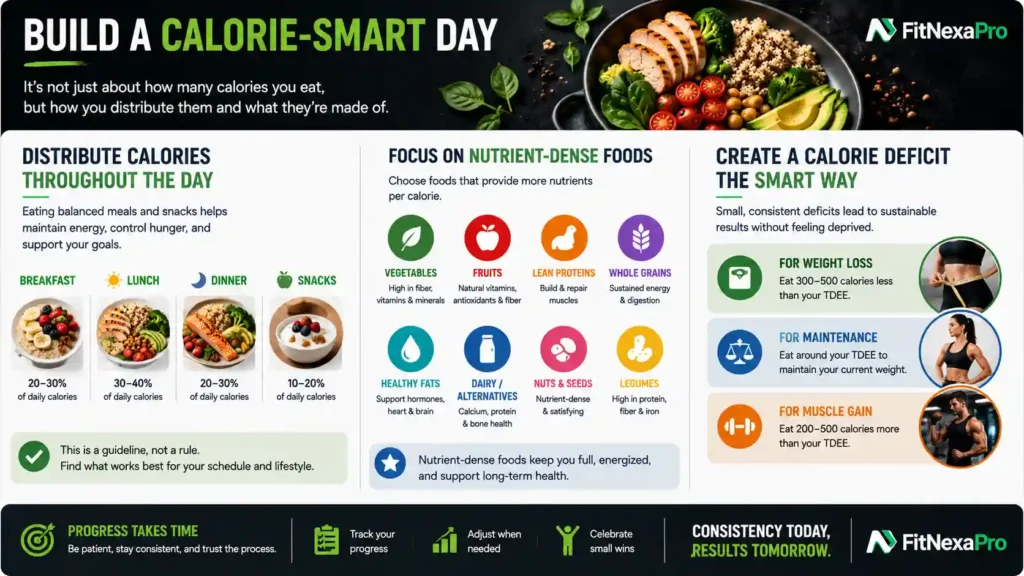
One common mistake is forgetting about drinks.
Coffee with sugar or cream, soft drinks, juices, smoothies, and other beverages can contribute calories.
Another common issue is overlooking cooking oils, sauces, dressings, and spreads. A small amount may not seem important, but frequent extras can add up.
Portion sizes can also be difficult to estimate.
A bowl of cereal, spoonful of peanut butter, or serving of rice may contain more or less than you think.
This does not mean you need to weigh every piece of food forever.
It simply means that understanding portions can make your calorie estimate more useful.
Should Men and Women Eat the Same Number of Calories?
Not necessarily.
Calorie needs vary from person to person regardless of sex.
Body size and body composition play important roles. On average, larger bodies require more energy to maintain than smaller bodies.
Activity can make an even bigger difference.
A highly active woman may require more calories than a sedentary man, for example.
This is another reason generic calorie recommendations should not be treated as personal targets.
Your calorie intake should be based on your individual circumstances.
Does Age Affect Calorie Needs?
Yes, age can affect energy requirements.
Your activity level and body composition may change as you get older, which can influence how many calories your body needs.
Muscle mass is particularly important because maintaining muscle requires energy.
Regular resistance training, staying physically active, getting enough protein, and maintaining a balanced diet can become increasingly important as you age.
Instead of assuming you must eat very little as you get older, focus on your actual lifestyle, body weight trend, nutrition, and activity level.
Frequently Asked Questions
Is 2,000 calories a day enough?
It depends on the person.
For some adults, 2,000 calories may be close to maintenance. For others, it may create a calorie deficit. Highly active or larger individuals may need considerably more.
Use your personal information and activity level to estimate your needs rather than assuming 2,000 calories is right for everyone.
How many calories should I eat to lose weight?
You generally need to consume fewer calories than your body uses over time to lose weight.
Instead of choosing an extremely low calorie target, estimate your maintenance calories first and consider a moderate deficit that you can realistically maintain.
Can I lose weight without counting calories?
Yes.
You can create a calorie deficit without tracking every calorie.
Eating more filling foods, getting enough protein and fiber, controlling portions, reducing high calorie drinks, and increasing physical activity can all help.
Should I eat back the calories I burn during exercise?
Be careful with exercise calorie estimates.
Fitness watches and exercise machines can provide useful information, but their calorie burn estimates are not always precise.
Automatically eating back every calorie shown on your device may make it harder to understand your true energy balance.
Can eating too few calories be unhealthy?
Consistently eating far below your energy needs can make it difficult to get enough nutrients and may affect energy levels, training, recovery, and overall wellbeing.
If you are considering a very low calorie diet, have a medical condition, are pregnant or breastfeeding, are under 18, or have a history of disordered eating, speak with a qualified healthcare professional before making major dietary changes.
Final Thoughts
So, how many calories should you eat a day?
The answer depends on you.
Your age, height, weight, sex, activity level, body composition, and goal all influence your calorie needs.
Start by estimating your maintenance calories. From there, you can adjust your intake depending on whether you want to maintain your weight, lose weight, or gain weight.
Remember that calorie calculators provide estimates rather than perfect answers.
Use the number as a starting point, pay attention to your progress, and make gradual adjustments when necessary.
Most importantly, do not focus only on calories.
A sustainable fitness plan should include nutritious foods, enough protein, regular physical activity, good sleep, and habits you can maintain over the long term.


One Comment