

How Many Calories Should I Burn a Day? A Simple Guide
If you are trying to lose weight, improve your fitness, or simply become more active, you may be wondering, how many calories should I burn a day?
There is no single number that works for everyone.
Your body burns calories all day, even when you are sleeping or sitting. You also burn additional calories through walking, working, exercising, doing household tasks, and other physical activities.
The number of calories you burn each day depends on several factors, including your age, sex, height, weight, body composition, and activity level.
This means you do not necessarily need to burn a certain number of calories through exercise every day.
Instead, it is more useful to understand your total daily calorie burn and how it relates to your food intake and fitness goals.
How Many Calories Should I Burn a Day?
The number of calories you should burn per day depends on your individual energy needs.
Your body requires energy just to stay alive. Your heart needs to beat, your lungs need to breathe, your brain needs to function, and your body needs to maintain its temperature and repair tissues.
On top of that, you use energy whenever you move.
For this reason, your total daily calorie burn is much higher than the calories displayed on your smartwatch after a workout.
For example, someone might burn a few hundred calories during exercise but use considerably more energy across the entire day.
Your goal should not necessarily be to achieve the highest calorie burn possible. A better approach is to understand approximately how much energy your body uses and then adjust your nutrition and activity according to your goal.
Your Body Burns Calories All Day
One common misconception is that calories are only burned when you exercise.
In reality, your body is constantly using energy.
Even while you sleep, energy is required to support breathing, circulation, brain activity, temperature regulation, and other essential functions.
When you wake up and begin moving, your energy expenditure increases.
Walking to your car, climbing stairs, cooking dinner, cleaning your home, going shopping, and working can all contribute to your daily calorie expenditure.
Exercise adds another layer of energy use.
This is why understanding total daily energy expenditure, rather than focusing only on workout calories, gives you a better picture of how many calories you burn each day.
What Determines How Many Calories You Burn?
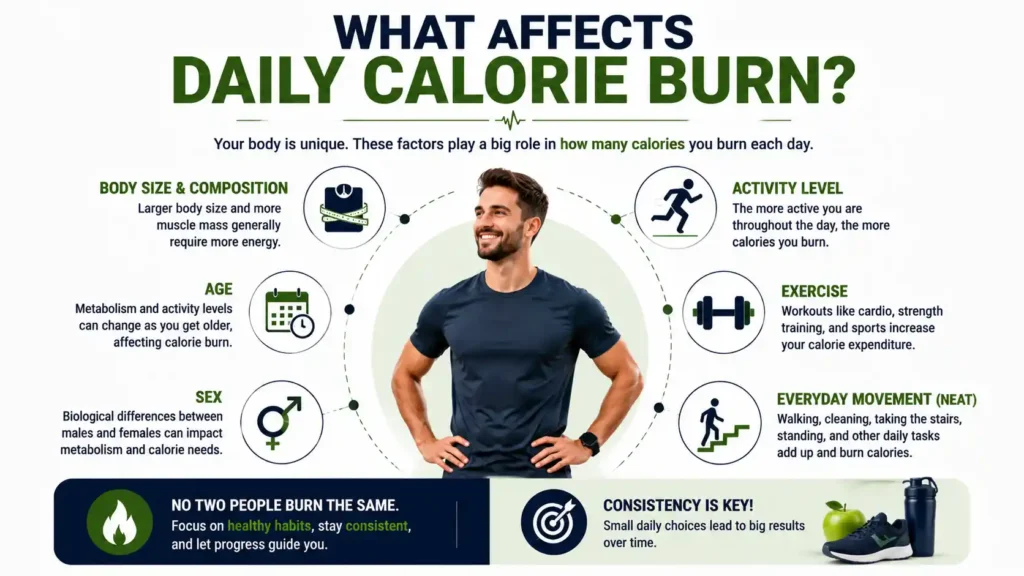
Your daily calorie burn is influenced by several factors.
Your Body Size
Larger bodies generally require more energy to maintain than smaller bodies.
Your height and weight therefore play a role in estimating how much energy you use each day.
This does not mean two people who weigh the same will automatically burn exactly the same number of calories.
Other factors matter too.
Your Age
Energy requirements can change as you get older.
Changes in body composition, activity, and other physiological factors can influence how much energy you use.
This is one reason age is commonly included in calorie and metabolic rate calculators.
Your Sex
Predictive equations used to estimate resting energy expenditure commonly include sex as one of their variables.
This helps provide a more individualized estimate of calorie requirements.
Your Activity Level
Your activity level can make a major difference to your daily calorie expenditure.
Someone who works at a desk and spends most of the day sitting may use less energy than someone with a physically demanding job.
Exercise also contributes to your total energy expenditure.
Running, cycling, swimming, resistance training, sports, and other activities all require energy.
Your Everyday Movement
Exercise is only one type of movement.
Walking around your workplace, cleaning your house, carrying groceries, standing, taking the stairs, and performing other daily tasks also contribute to calorie expenditure.
This type of activity is often discussed as non-exercise activity thermogenesis, or NEAT.
Small amounts of movement throughout the day can add up.
What Is the Difference Between Active Calories and Total Calories?
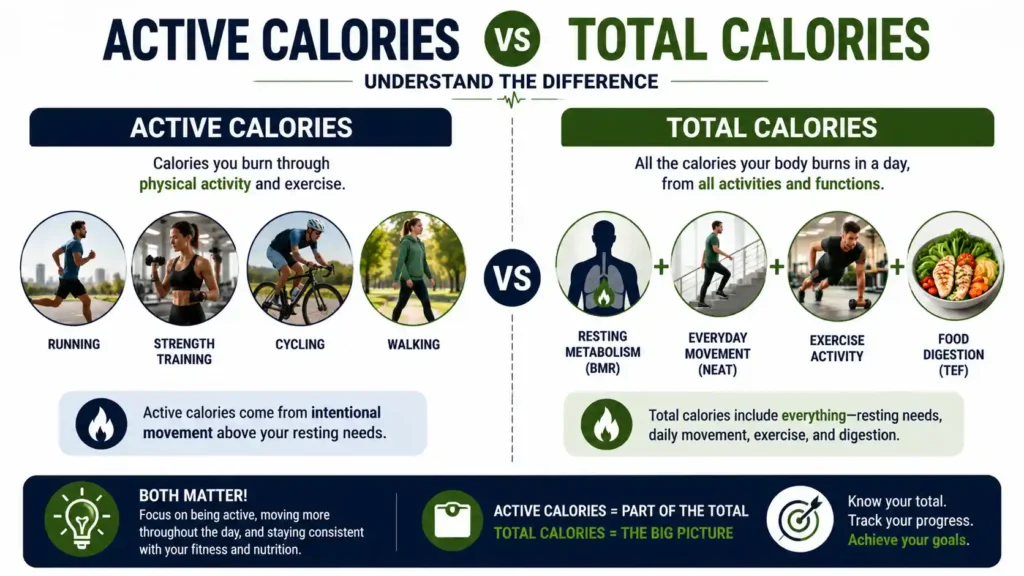
This is one of the most important things to understand when asking how many calories you should burn a day.
Active calories generally refer to energy used through physical activity above your resting needs.
Your fitness tracker might show active calories from walking, running, gym sessions, or other movement.
Total calories burned, however, include much more.
They include the calories your body uses at rest plus energy from movement, exercise, and food processing.
Suppose your watch says you burned 450 active calories.
That does not mean your body only used 450 calories that day.
Your total daily expenditure could be much higher because your body was using energy during all the hours you were not exercising as well.
This distinction is particularly important when planning calories for weight management.
What Is BMR?
BMR stands for Basal Metabolic Rate.
It refers to the energy your body needs to maintain essential functions under basal conditions.
Think of it as the energy needed to keep your body’s basic systems running.
Your BMR does not represent your complete daily calorie burn because it does not account for all of your normal daily activities.
However, it provides an important starting point when estimating your overall energy requirements.
You can use the FitNexaPro BMR Calculator to estimate your basal metabolic rate.
What Is TDEE?
TDEE stands for Total Daily Energy Expenditure.
This is usually a much more useful number when you want to understand how many calories you burn during an entire day.
TDEE includes your resting energy expenditure together with physical activity and other components of daily energy use.
Your TDEE is therefore typically higher than your BMR.
For example, your body may require a certain amount of energy at rest, but once you add walking, working, exercising, and normal daily activities, your total energy expenditure increases.
If you want a deeper explanation, read What Is TDEE and How Do You Calculate It?
You can also use the FitNexaPro TDEE Calculator to estimate your total daily calorie needs.
How Many Calories Do I Burn a Day Without Exercise?
You still burn calories even if you do not exercise.
Your body never stops using energy.
You need energy for your brain, heart, lungs, circulation, digestion, temperature regulation, and countless other processes.
You also probably move more than you realize.
Getting out of bed, walking around your home, preparing food, working, standing, and completing everyday tasks all require energy.
This means a rest day does not equal zero calorie burn.
Your body continues using energy throughout the day regardless of whether you complete a formal workout.
How Many Calories Should I Burn Through Exercise?
There is no universal exercise calorie target that everyone needs to reach.
You do not have to burn 500, 700, or 1,000 calories in every workout to make progress.
Instead of focusing entirely on calories burned, it is usually better to focus on building a sustainable exercise routine.
For general health, the U.S. Centers for Disease Control and Prevention recommends that adults get at least 150 minutes of moderate-intensity aerobic physical activity each week, or 75 minutes of vigorous-intensity activity, or an equivalent combination. Adults are also advised to perform muscle-strengthening activity on at least two days per week.
That approach focuses on activity and health rather than chasing a specific calorie number.
How Many Calories Should I Burn a Day to Lose Weight?
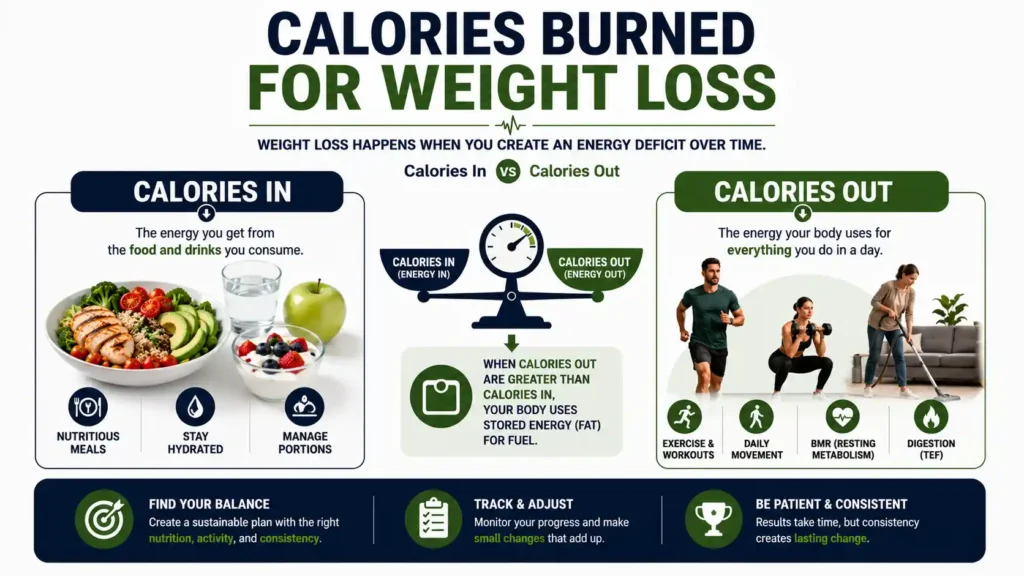
If weight loss is your goal, the relationship between your calorie intake and total energy expenditure becomes important.
Weight loss requires an energy deficit over time.
In simple terms, your body needs to use more energy than it receives from food and drinks.
However, this does not mean all of that deficit has to come from exercise.
You can create an energy deficit through changes to your calorie intake, increased physical activity, or a combination of both.
For example, imagine your estimated total daily energy expenditure is around 2,400 calories.
You would not necessarily need to complete workouts that burn hundreds or thousands of additional calories.
Instead, you could build your plan around your overall calorie intake and activity level.
The National Institute of Diabetes and Digestive and Kidney Diseases explains that consuming fewer calories and increasing physical activity can help with weight management.
For a detailed explanation, read our Calorie Deficit for Weight Loss: A Simple Beginner’s Guide.
Should I Try to Burn 500 Calories Every Day?
You may have heard that you should burn 500 calories through exercise every day to lose weight.
That is not a requirement.
Your appropriate activity level depends on your fitness, lifestyle, nutrition, goals, and overall health.
Trying to force yourself to burn a particular number of exercise calories every day can also make exercise unnecessarily stressful.
Instead, look at your overall energy balance.
Someone who is active throughout the day may already have substantial energy expenditure even without completing an intense workout.
Someone else may have a sedentary lifestyle and benefit from gradually increasing daily movement.
Focus on consistency rather than chasing one specific calorie number.
Is Burning 1,000 Calories a Day Good?
This question can be misleading because it depends on what you mean by “burning 1,000 calories.”
Your body already uses substantial energy throughout the day simply to function.
If you mean burning an additional 1,000 calories specifically through exercise every day, that is a very different situation.
For many people, deliberately trying to achieve extremely high exercise calorie burns every day may be unnecessary and difficult to sustain.
More is not automatically better.
Exercise should support your health and fitness rather than becoming a competition with the calorie counter on your watch.
How Many Calories Should I Burn a Day to Maintain Weight?
If you are maintaining your weight, you generally want your energy intake and energy expenditure to be roughly balanced over time.
This does not mean they must match perfectly every day.
Some days you may eat more.
Other days you may move more.
Your body weight can also fluctuate because of water, food intake, sodium, carbohydrate intake, and other factors.
The longer-term trend matters more.
If your average body weight remains relatively stable over several weeks, your average calorie intake may be reasonably close to your actual energy expenditure.
How Many Calories Should I Burn to Gain Muscle?
Building muscle does not require you to minimize physical activity.
Exercise, especially resistance training, is an important part of developing muscle and strength.
However, people trying to gain weight or muscle generally need to make sure their energy intake is sufficient to support their goal.
If you are extremely active while eating too little, gaining body weight may become more difficult.
Protein intake is also important for muscle growth and recovery.
If this is your goal, read our guide How Much Protein Do You Need Per Day?
Does Walking Burn Enough Calories?
Walking is one of the simplest ways to increase daily physical activity.
You do not need an intense workout every time you want to move more.
Walking contributes to your total daily energy expenditure and can be incorporated into normal life.
You might walk during your lunch break, take the stairs, park farther from an entrance, or take an evening walk.
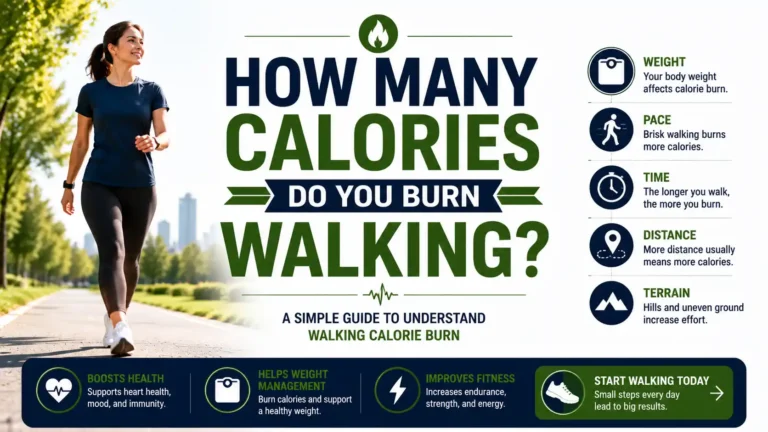
The exact calories burned while walking vary based on factors such as body size, walking speed, duration, and terrain.
Rather than obsessing over the exact calorie number, consider walking as part of your overall activity routine.
Are Smartwatch Calorie Estimates Accurate?
Smartwatches and fitness trackers can be useful for monitoring activity, but their calorie estimates should not be treated as exact measurements.
Research evaluating wrist-worn devices has found that estimates of energy expenditure can have meaningful error.
This means your watch may say you burned 600 calories during an activity while your actual energy expenditure could be different.
That does not make fitness trackers useless.
They can still help you monitor trends, steps, workout duration, heart rate, and general activity.
Just avoid treating the calorie number as perfectly accurate.
Should You Eat Back Calories Burned During Exercise?
This depends on how your calorie target was calculated.
If your daily calorie target already uses a TDEE estimate that includes your normal exercise and activity level, automatically adding all of your smartwatch exercise calories back to your food allowance may result in counting some activity twice.
This is another reason understanding the difference between BMR, activity calories, and TDEE is helpful.
Keep your approach consistent.
Estimate your daily calorie needs, follow your plan, monitor your progress, and adjust based on longer-term results rather than constantly changing your intake because of one workout.
How Can I Increase My Daily Calorie Burn?

You do not necessarily need longer and harder workouts.
Increasing everyday movement can also help.
Walking more, taking stairs, standing regularly, completing household tasks, cycling, playing sports, and performing resistance training are all ways to become more active.
You can also gradually improve your fitness so that physical activity becomes a normal part of your lifestyle.
The best activity plan is one you can maintain consistently.
Do Strength Workouts Burn Calories?
Yes.
Resistance training requires energy.
However, you should not judge a strength workout only by the number of calories shown on a fitness tracker.
Strength training provides benefits beyond immediate calorie expenditure.
The CDC recommends muscle-strengthening activities involving all major muscle groups on two or more days each week for adults.
Building a balanced fitness routine is generally more useful than choosing workouts solely because they appear to burn the most calories.
Common Mistakes When Tracking Calories Burned
One common mistake is assuming smartwatch calorie estimates are exact.
Another is focusing only on workout calories while ignoring the energy your body uses throughout the rest of the day.
Some people also overestimate their activity level when calculating TDEE.
Another mistake is believing that an intense workout automatically cancels out everything you eat.
Nutrition and physical activity should work together rather than being treated as a system of earning and burning food.
Finally, avoid comparing your calorie burn directly with someone else’s.
Different people can perform the same activity and use different amounts of energy.
How to Estimate Your Daily Calorie Burn
You do not need laboratory equipment to get a useful starting estimate.
First, estimate your BMR.
Next, consider your overall activity level.
A TDEE calculator can combine these factors to estimate your total daily energy expenditure.
Use the FitNexaPro TDEE Calculator to get your starting estimate.
You can then monitor your body weight and progress over several weeks.
If your weight stays relatively stable while your calorie intake is consistent, your actual maintenance requirements may be reasonably close to your average intake.
If your weight consistently decreases or increases, you can use that information to refine your estimate.
Frequently Asked Questions
How many calories should I burn a day?
There is no single daily calorie burn target for everyone. Your total energy expenditure depends on factors such as your age, sex, body size, activity level, and lifestyle.
How many calories should I burn a day to lose weight?
Weight loss depends on creating an energy deficit over time. The deficit can come from eating fewer calories, increasing physical activity, or combining both approaches.
Do I need to burn 500 calories through exercise every day?
No. There is no requirement to burn exactly 500 exercise calories every day. Your overall calorie intake, total energy expenditure, activity, and long-term consistency matter more.
Do I burn calories while sleeping?
Yes. Your body continues using energy while you sleep to support essential functions such as breathing, circulation, brain activity, and temperature regulation.
Is burning more calories always better?
No. More exercise and higher calorie expenditure are not automatically better. Your activity should be appropriate for your fitness level, recovery, nutrition, and goals.
Does walking count toward calories burned?
Yes. Walking requires energy and contributes to your total daily physical activity.
Should I trust the calories shown on my smartwatch?
Treat them as estimates rather than exact measurements. Wearable devices can be helpful for tracking activity trends, but research has found limitations in the accuracy of energy-expenditure estimates.
Final Thoughts
So, how many calories should I burn a day?
There is no universal number.
Your body burns calories continuously through basic biological functions, everyday movement, digestion, and physical activity.
Instead of setting an arbitrary goal such as burning 500 or 1,000 exercise calories every day, focus on understanding your total daily energy expenditure.
If you want to maintain your weight, your average energy intake and expenditure should be reasonably balanced over time.
If you want to lose weight, a sustainable energy deficit is more important than trying to burn huge numbers of calories through exercise.
If you want to build muscle, make sure your nutrition, protein intake, resistance training, and recovery support that goal.
Start by using the FitNexaPro TDEE Calculator to estimate your daily energy expenditure.
Then use your real progress to guide your decisions.
A calculator gives you a starting point. Your longer-term results help you understand what actually works for you.





One Comment