
Full Body Workout for Beginners: A Simple Routine to Get Started
Starting a workout routine can feel confusing when you are new to fitness. You may wonder which exercises to do, how many sets you need, how often you should train, or whether you need complicated gym equipment.
The good news is that your first workout routine does not need to be complicated.
A full body workout for beginners can be one of the simplest ways to start exercising because you train the major muscle groups in a single session. Instead of dedicating separate days to your chest, back, legs, and arms, you perform a small number of exercises that work your entire body.
This approach can be particularly useful if you can only train two or three times per week.
In this guide, you will learn how full body training works, which exercises beginners can start with, how many sets and repetitions to perform, how much rest to take, and how to gradually make your workouts more challenging.
What Is a Full Body Workout?
A full body workout is a training session that works most of the major muscle groups in your body.
A typical session includes movements for your:
- Legs
- Chest
- Back
- Shoulders
- Arms
- Core
You do not necessarily need a separate exercise for every individual muscle.
For example, a squat works several muscles in your lower body at the same time. Push-ups train your chest, shoulders, and triceps, while rows primarily target muscles in your back while also involving your arms.
This allows you to train your entire body with a relatively small number of exercises.
Are Full Body Workouts Good for Beginners?
Full body workouts can be an excellent option for beginners.
When you are starting out, you generally do not need a highly specialized bodybuilding routine with numerous exercises for each muscle group.
A simpler routine allows you to focus on learning fundamental movements and gradually building consistency.
Full body training can also make scheduling easier.
Instead of needing to visit the gym five or six days each week, you may be able to perform a full body routine two or three times per week.
That can make exercise much easier to fit around work, family, and other responsibilities.
Benefits of a Full Body Workout for Beginners
There are several reasons beginners may benefit from full body training.
You Train Major Muscles Regularly
When you perform full body workouts multiple times during the week, your major muscle groups receive regular training.
You do not have to wait an entire week before performing a movement again.
This gives you more opportunities to practice exercises and improve your technique.
Your Routine Stays Simple
Beginners are often overwhelmed by complicated workout programs.
Full body training keeps things manageable.
Instead of learning 15 different exercises immediately, you can focus on a handful of fundamental movements.
You Don’t Need to Train Every Day
More exercise is not automatically better.
Your body also needs time to recover between challenging training sessions.
A beginner full body routine can work well with rest or lighter activity days between workouts.
It Can Build a Strong Fitness Foundation
Basic movements such as squats, presses, rows, hip hinges, and core exercises can help develop a foundation for more advanced training later.
Once you become comfortable with these exercises, you can gradually add resistance or progress to more challenging variations.
How Often Should Beginners Do Full Body Workouts?
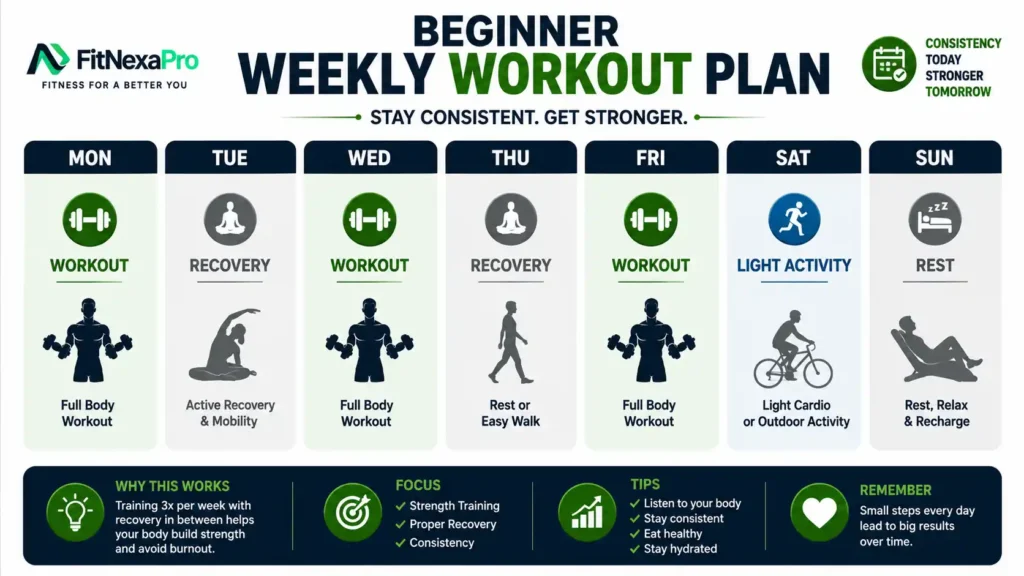
For many beginners, two or three full body workouts per week can be a practical starting point.
You could train on:
Monday: Full body workout
Tuesday: Rest or light walking
Wednesday: Full body workout
Thursday: Rest
Friday: Full body workout
Saturday: Light activity
Sunday: Rest
You do not have to follow those exact days.
The important part is creating a schedule you can maintain.
If three workouts feel like too much initially, start with two.
Consistency is more valuable than creating an ambitious routine that you abandon after a few weeks.
Should You Warm Up Before a Full Body Workout?
A short warm-up can help prepare your body for exercise.
You do not need to turn your warm-up into another workout.
Start with approximately five to ten minutes of easy movement.
This might include brisk walking, easy cycling, or another comfortable activity that gradually increases your body temperature.
You can then perform controlled movements related to the exercises you are about to do.
For example, before weighted squats, you might perform several bodyweight squats.
Before a chest press, you could begin with a lighter resistance.
Your warm-up should prepare you for training rather than leave you exhausted before your workout begins.
Beginner Full Body Workout Routine
Here is a simple routine you can use as a starting point.
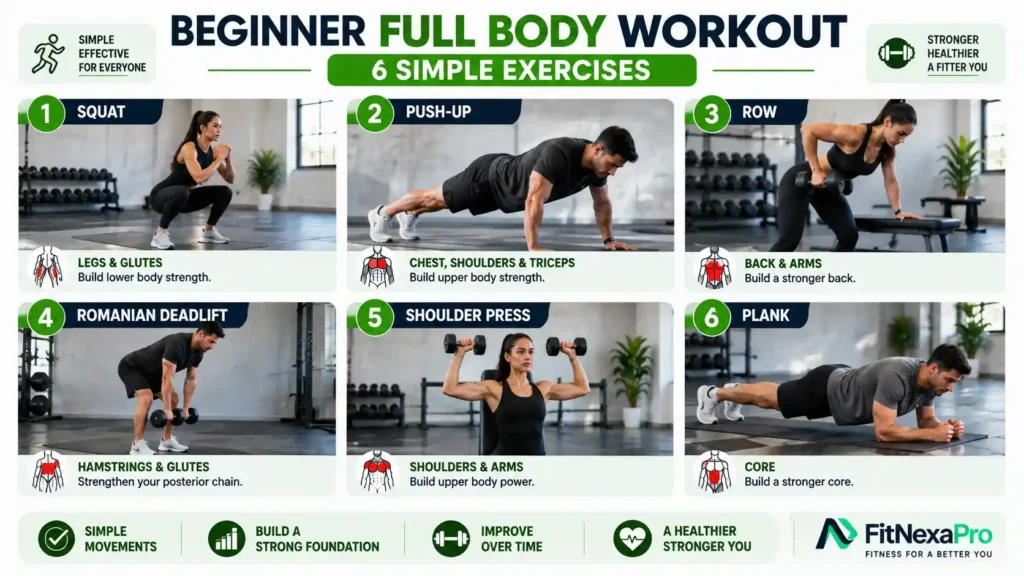
The workout contains six movements covering the major areas of your body.
1. Squat — 2 to 3 Sets of 8–12 Reps
Squats are a fundamental lower-body movement.
They primarily involve your quadriceps and glutes while requiring several other muscles to help stabilize your body.
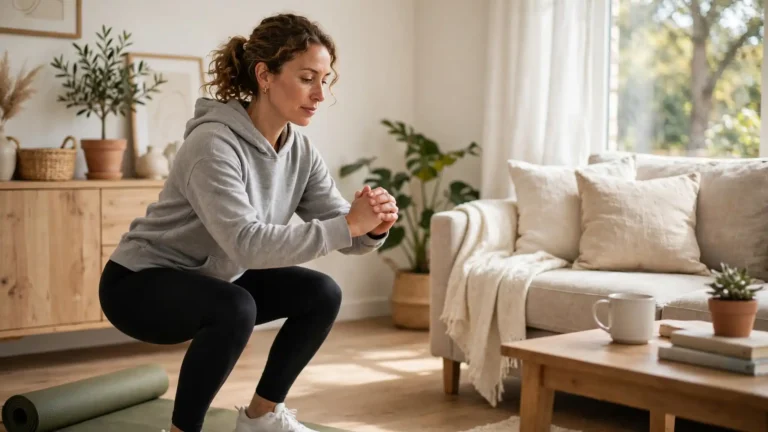
Beginners can start with bodyweight squats.
Stand with your feet in a comfortable position, keep your torso controlled, and lower yourself by bending at your hips and knees.
Go only as deep as you can while maintaining comfortable, controlled movement.
As you become stronger, you can progress to goblet squats or other weighted variations.
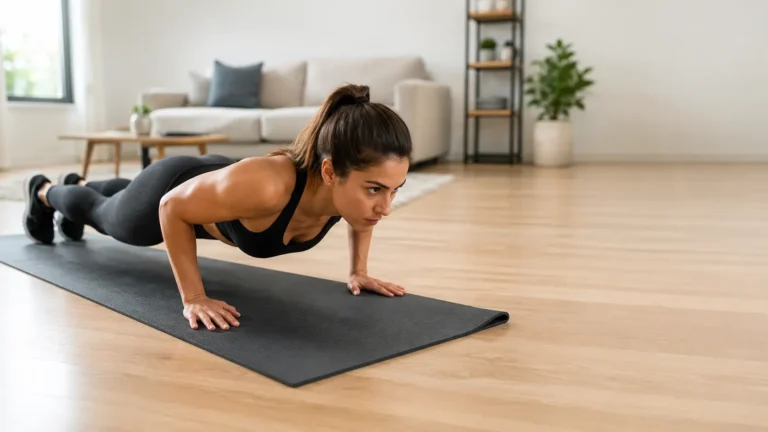
2. Push-Up or Chest Press — 2 to 3 Sets of 8–12 Reps
Next, include a pushing movement for your upper body.
Push-ups are a convenient option because they require little or no equipment.
If standard push-ups are currently too difficult, you can start with your hands elevated on a stable surface.
If you train at a gym, a machine or dumbbell chest press can be another beginner-friendly option.
Choose the variation that allows you to perform controlled repetitions.
3. Row — 2 to 3 Sets of 8–12 Reps
Rows provide a pulling movement for your upper body.
They mainly work your back while also involving your arms.
At a gym, beginners can use a seated cable row or supported rowing machine.
At home, resistance bands can provide another option if you have a secure setup.
Focus on controlled movement rather than trying to pull the heaviest weight possible.
4. Romanian Deadlift — 2 to 3 Sets of 8–12 Reps
The Romanian deadlift introduces a hip-hinge movement.
It primarily trains muscles around your hips and the back of your thighs.
Keep the resistance light while learning the movement.
Push your hips backward while maintaining a controlled torso position, then return to standing by extending your hips.
Technique is particularly important with loaded hinge exercises.
If you are unsure how to perform the movement safely, learn the technique with very light resistance and consider getting guidance from a qualified fitness professional.
5. Shoulder Press — 2 to 3 Sets of 8–12 Reps
The shoulder press is another upper-body pushing exercise.
You can perform it with dumbbells, resistance bands, or a shoulder press machine.
Start with manageable resistance.
Press upward under control and avoid using excessive momentum simply to move more weight.
Your goal as a beginner is to learn the movement and gradually become stronger.
6. Plank — 2 to 3 Sets of 20–30 Seconds
Finish your routine with a simple core exercise.
A plank trains your core by requiring you to maintain a stable body position.
Keep your body controlled rather than focusing on holding the position for as long as possible.
If 20 seconds is currently difficult, start with a shorter duration.
You can gradually increase your time as your core endurance improves.
How Many Sets Should a Beginner Do?
You do not need a huge amount of training volume when you first start exercising.
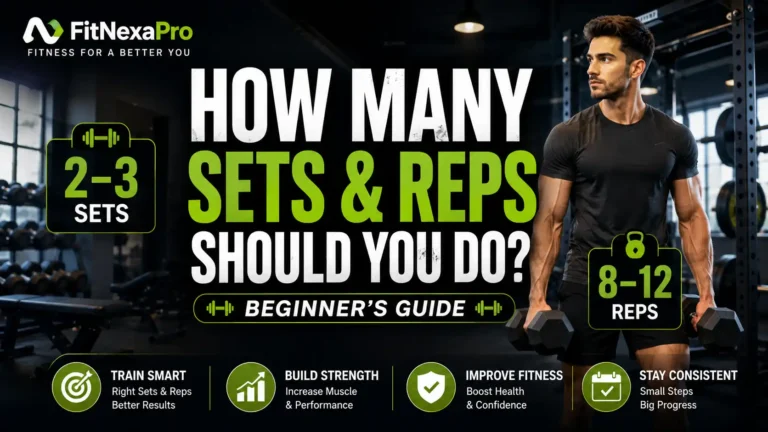
Beginning with around two working sets per exercise can make the routine easier to manage while you learn the movements.
As your fitness improves, you may gradually progress toward three sets for some exercises.
Avoid adding more sets simply because you think more is always better.
Training quality, recovery, and consistency matter too.
How Many Reps Should Beginners Do?
For many of the exercises in this routine, 8–12 controlled repetitions provides a simple starting range.
However, the number itself is not a strict rule.
Some exercises and goals may use different repetition ranges.
As a beginner, focus primarily on performing each repetition with good control.
If you cannot maintain reasonable technique, the resistance may be too heavy or you may need to stop the set.
How Much Weight Should a Beginner Use?
There is no universal starting weight.
Someone else’s beginner weight may be far too heavy or far too light for you.
Choose resistance that allows you to complete your repetitions with controlled technique while still making the final repetitions feel challenging.
Avoid choosing weights just because another person in the gym is using them.
Your first few workouts are an opportunity to discover what resistance is appropriate for you.
Starting lighter than necessary is usually easier to correct than starting too heavy.
You can always increase the resistance gradually.
How Long Should You Rest Between Sets?
Beginners often rush between sets because they believe shorter rest automatically creates a better workout.
That is not necessarily true.
For this routine, you might start with roughly 60–120 seconds of rest between sets, adjusting based on the exercise and how you feel.
More demanding movements may require additional recovery.
The goal is to recover enough that you can perform your next set with good control.
You do not need to follow your stopwatch perfectly.
If you still feel extremely out of breath or unable to perform another quality set, give yourself more time.
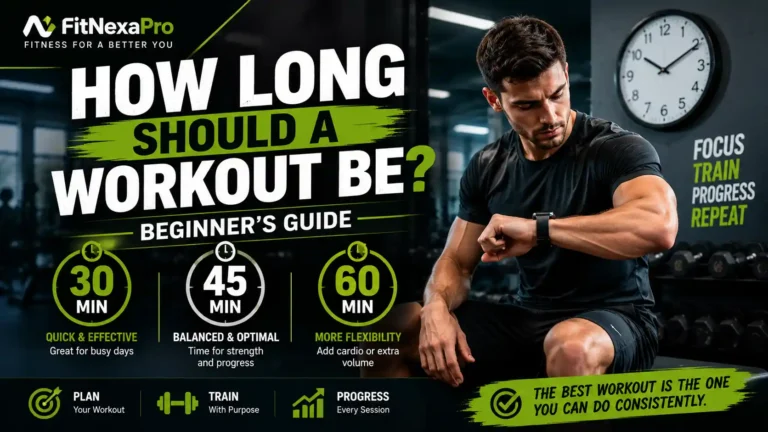
How Long Should a Beginner Full Body Workout Take?
A beginner workout does not need to last two hours.
With six exercises, reasonable rest periods, and a short warm-up, many people can complete a straightforward full body session in approximately 45–60 minutes.
Some workouts may be shorter or longer.
Workout quality matters more than trying to reach a particular duration.
Once you become familiar with the exercises and your gym setup, your sessions may also become more efficient.
How Hard Should Beginners Train?
You want your muscles to work, but you do not need to push every set to absolute failure.
When you are learning exercises, leaving some repetitions in reserve can make it easier to maintain good technique.
For example, you might finish a set when you feel you could still perform another two or three controlled repetitions.
As you gain experience, you will become better at judging how difficult a set actually is.
There is no need to prove yourself during your first weeks in the gym.
Your goal is to establish a routine you can progressively build upon.
How to Progress Your Full Body Workout
Your body gradually adapts to training.
A weight that feels challenging today may become much easier after several weeks of consistent exercise.
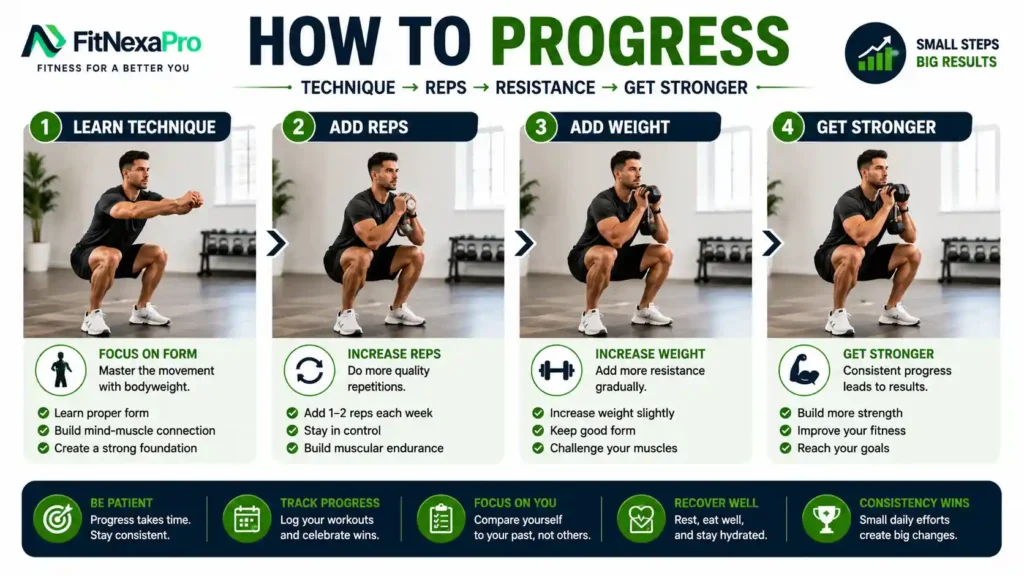
When that happens, you can gradually make the exercise more challenging.
This is often called progressive overload.
You can progress in several ways.
You might add a repetition.
You could gradually increase the resistance.
You could improve your exercise technique or range of motion.
You may eventually add another set when appropriate.
The important word is gradually.
You do not need to increase something during every workout.
A Simple Way to Progress
Suppose you are performing goblet squats for two sets of 8 repetitions.
Over the next several workouts, you might progress like this:
Workout 1: 8 reps
Workout 2: 9 reps
Workout 3: 10 reps
Workout 4: 11 reps
Workout 5: 12 reps
Once you can comfortably perform the top of your target range with good technique, you could consider a small increase in resistance.
You might then return toward the lower end of your repetition range and gradually build up again.
Progress does not always happen this smoothly, but the example demonstrates the basic idea.
Should Beginners Train When They Are Sore?
Some muscle soreness can occur when you start a new workout program.
However, soreness is not required for a workout to be effective.
You also should not deliberately try to make yourself extremely sore.
If your muscles are mildly sore, light movement may feel fine.
If soreness significantly affects your movement or exercise technique, additional recovery may be sensible.
Sharp pain is different from ordinary post-workout muscle soreness and should not simply be ignored.
Full Body Workout at Home
You do not necessarily need a gym to perform full body training.
Many movements can be adapted for home workouts.
For example:
Squat: Bodyweight squat
Chest: Push-ups
Back: Resistance-band row with a secure anchor
Hip movement: Bodyweight hip hinge or glute bridge
Shoulders: Resistance-band press
Core: Plank
Your available equipment will determine which variations are practical.
If you prefer training at home, check our guide to 5 Beginner Home Workouts You Can Do Without Equipment for additional ideas.
Full Body Workout at the Gym
A gym gives you access to additional resistance and exercise options.
Beginners do not need to use every machine they see.
You could build a simple gym session around:
- Goblet squat or leg press
- Machine or dumbbell chest press
- Seated cable row
- Light Romanian deadlift
- Shoulder press machine
- Plank
Machines can sometimes make it easier for beginners to learn certain movement patterns because they provide a more fixed path.
Free weights also have advantages.
You do not need to choose one exclusively.
Use the equipment that helps you train comfortably and progressively.
Do Beginners Need Cardio Too?
Strength training and cardiovascular exercise provide different benefits, so you do not necessarily need to choose between them.
Walking is one of the easiest ways to add aerobic activity around your strength workouts.
For example, you could walk on days between your full body sessions.
The CDC recommends that adults aim for at least 150 minutes of moderate-intensity aerobic activity per week, or 75 minutes of vigorous-intensity activity, or an equivalent combination. Adults are also advised to perform muscle-strengthening activities on at least two days each week.
CDC Physical Activity Guidelines for Adults
You do not need to reach all of these targets immediately if you are currently inactive. Building your activity gradually can make your routine easier to sustain.
What Should You Do on Rest Days?
Rest days do not necessarily mean you have to stay on the sofa all day.
You can still perform normal daily activities.
Light walking, mobility work, or other comfortable movement can fit well between strength-training sessions.
Your recovery also depends on factors outside the gym.
Getting adequate sleep and eating a balanced diet can support your overall training routine.
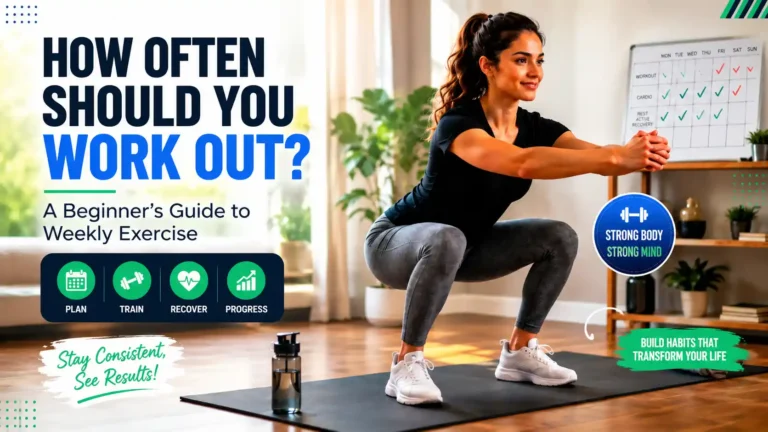
If you are trying to determine how much exercise to include in your week, read our guide How Often Should You Work Out?
Common Beginner Workout Mistakes
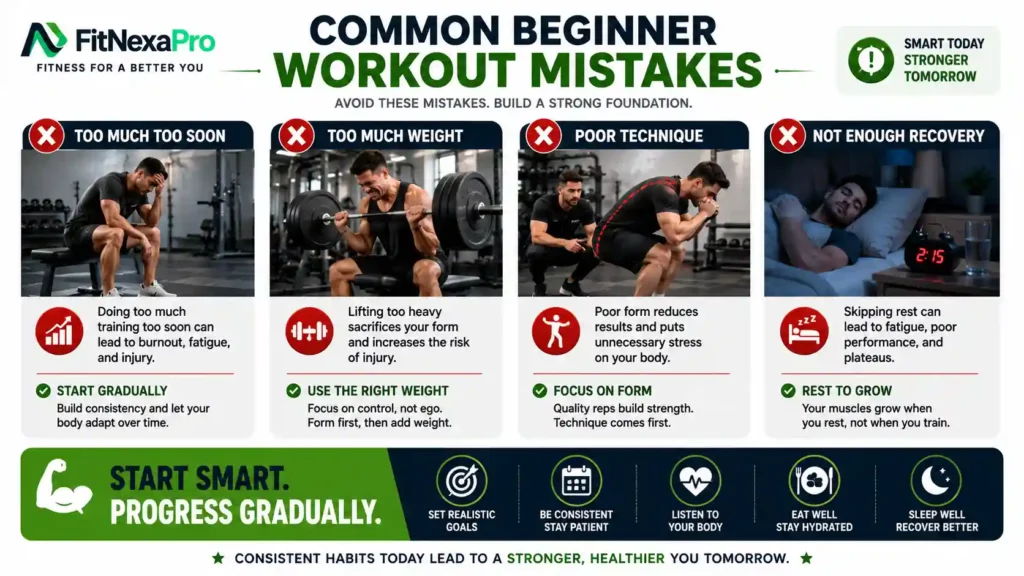
Doing Too Much Too Soon
Enthusiasm is great, but suddenly going from no exercise to intense daily workouts can make your routine difficult to sustain.
Start at a manageable level and build from there.
Using Too Much Weight
Do not sacrifice control just to lift a heavier weight.
Learning the movement should come first.
Changing Your Routine Every Workout
You do not need a completely different workout every time you train.
Repeating fundamental exercises gives you an opportunity to practice them and track your progress.
Comparing Yourself With Experienced Lifters
Someone who has trained consistently for five years should not determine what your first month in the gym looks like.
Focus on your own progress.
Ignoring Recovery
Training provides the stimulus, but recovery is part of the process too.
Avoid assuming that taking a rest day means you are being lazy.
Only Training the Muscles You Can See
It can be tempting to focus only on your chest, arms, or abs.
A balanced routine should include movements for your lower body, back, and other major muscle groups too.
Do You Need Supplements to Start Working Out?
You do not need a cupboard full of supplements before you can begin exercising.
Your priorities should be much simpler:
Train consistently.
Eat a balanced diet.
Consume appropriate amounts of protein and other nutrients.
Stay hydrated.
Get adequate sleep.
Then, if you are interested in specific supplements later, evaluate them individually rather than assuming every fitness product is necessary.
When Will You See Results?
This is one of the most common questions beginners ask.
There is no exact timeline.
Changes depend on your starting point, training consistency, nutrition, sleep, genetics, goals, and many other factors.
Strength improvements may occur before dramatic visual changes become noticeable.
Avoid judging your progress based only on what you see in the mirror after a few workouts.
Instead, track useful indicators such as whether you can perform more repetitions, use slightly more resistance, improve your technique, or complete exercises that previously felt difficult.
Frequently Asked Questions
Is a full body workout good for beginners?
Yes. Full body training can provide beginners with a simple way to train major muscle groups while learning fundamental exercises.
How many days a week should a beginner do full body workouts?
Two or three sessions per week can be a practical starting point for many beginners, with recovery between challenging sessions.
Is three exercises enough for a full body workout?
It depends on the exercises and your goals. A small number of compound movements can train several muscle groups, although a somewhat broader routine may provide more complete coverage.
Can I do full body workouts every day?
Beginners generally do not need to perform challenging full body strength sessions every day. Recovery between sessions can be useful, particularly while adapting to training.
Should beginners do full body or split workouts?
Both approaches can work, but full body routines are often easier for beginners because they can train major muscle groups several times per week without requiring many gym days.
Can I build muscle with a full body workout?
Full body resistance training can support muscle development when combined with appropriate training progression, nutrition, and recovery.
Can I lose weight doing full body workouts?
Strength training can contribute to your overall activity and help preserve or develop muscle. Weight loss, however, depends largely on maintaining an appropriate energy balance over time.
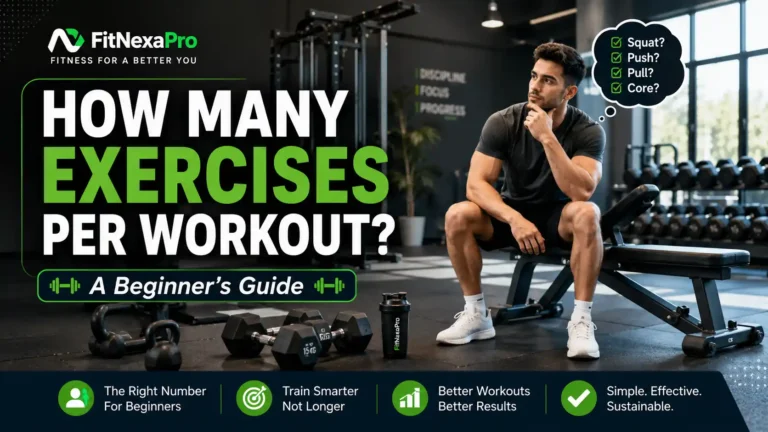
How many exercises should a beginner do per workout?
There is no perfect number, but a routine containing several well-chosen exercises that cover the major movement patterns can be sufficient. The six-exercise routine in this guide provides a simple starting point.
Final Thoughts
A full body workout for beginners does not need dozens of exercises, complicated machines, or hours in the gym.
Start with the fundamentals.
Use a squat, an upper-body push, an upper-body pull, a hip-hinge movement, a shoulder exercise, and some core work.
Begin with manageable resistance and concentrate on controlled technique.
Two or three workouts per week may be enough to establish a solid routine while still giving your body time to recover.
Most importantly, give yourself time.
Your first goal is not to create the perfect workout program. It is to develop a sustainable exercise habit, learn the movements, and gradually become stronger.
Once those foundations are in place, you can make your training more advanced as your goals and experience develop.
One Comment