
How Many Sets and Reps Should You Do? A Beginner’s Guide
If you are new to strength training, terms like sets, reps, volume, and resistance can make a simple workout sound more complicated than it needs to be.
You might see one person doing five heavy repetitions, another doing 10, and someone else performing 15 or 20. This naturally raises an important question: how many sets and reps should you do?
There isn’t one combination that is perfect for everyone.
The right number depends on your training experience, goals, exercise selection, resistance, and how often you train. However, beginners don’t need a complicated system to get started.
For many exercises, starting with a moderate number of repetitions and a manageable number of sets allows you to practice proper technique while gradually building strength.
This guide explains sets and reps in simple terms and shows you how to choose a practical starting point.
What Are Sets and Reps?
Before deciding how many sets and reps to perform, it helps to understand what these terms mean.
A rep, short for repetition, is one complete performance of an exercise.
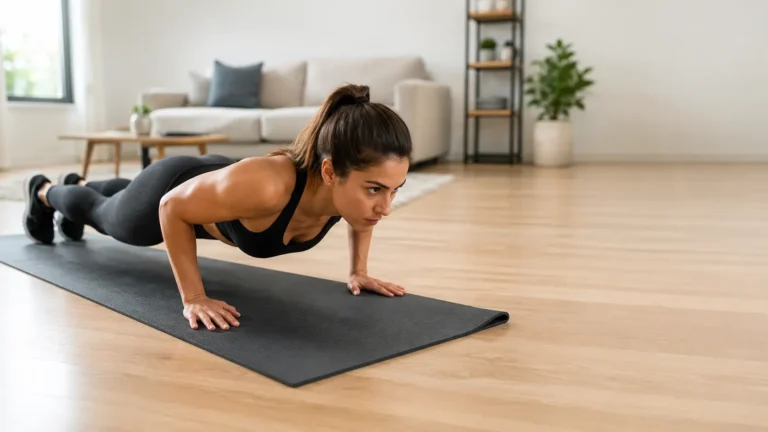
If you perform a squat by lowering your body and returning to the starting position, you have completed one repetition.
If you do that 10 times, you have completed 10 reps.
A set is a group of repetitions performed before you rest.
For example:
You perform 10 squats, rest, perform another 10, rest again, and perform a final 10.
That means you completed 3 sets of 10 reps.
You will often see this written as:
3 × 10
The first number represents the sets, while the second represents the repetitions.
How Many Sets and Reps Should Beginners Do?
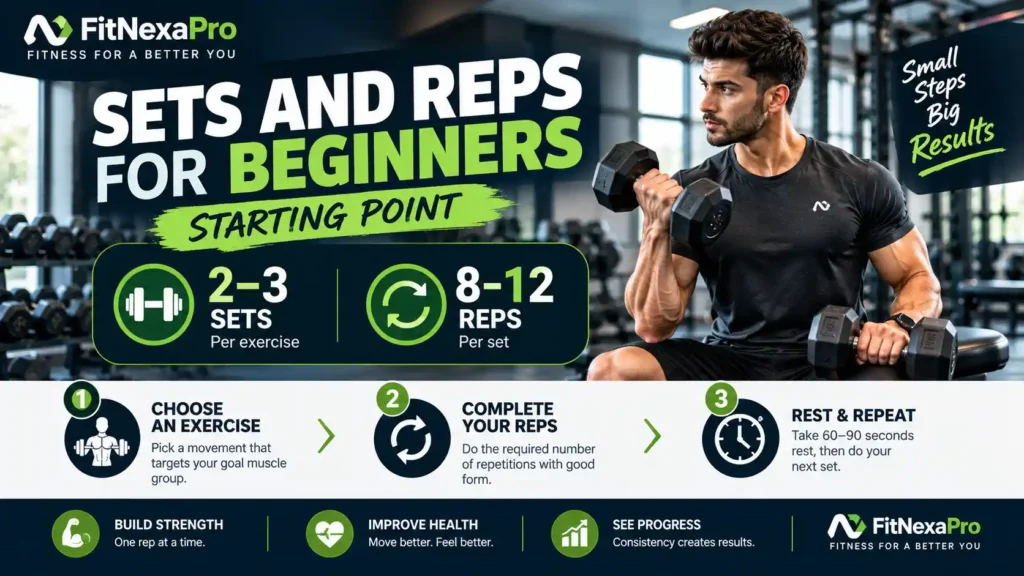
For a beginner, 2–3 sets of roughly 8–12 repetitions per exercise can be a simple starting framework for many conventional resistance exercises.
This isn’t a rule that every exercise must follow.
Different exercises and goals can work well with different repetition ranges.
Current guidance from the American College of Sports Medicine emphasizes that resistance-training prescriptions should be matched to the individual’s goal rather than treating one set-and-rep scheme as universally optimal. ACSM’s 2026 recommendations also emphasize consistency and progressive training over unnecessarily complicated programs.
If you are completely new to training, you might initially perform only two working sets while learning the exercises.
As you become more comfortable, you can gradually adjust your training.
How Many Sets Per Exercise Should You Do?
For many beginners, 2–3 working sets per exercise is reasonable.
Suppose your workout contains five exercises.
If you perform two sets of each, that gives you 10 working sets across the session.
Three sets of each would give you 15.
You don’t necessarily need to start with the higher number.
Beginning with a manageable amount of training makes it easier to focus on exercise technique and understand how your body responds.
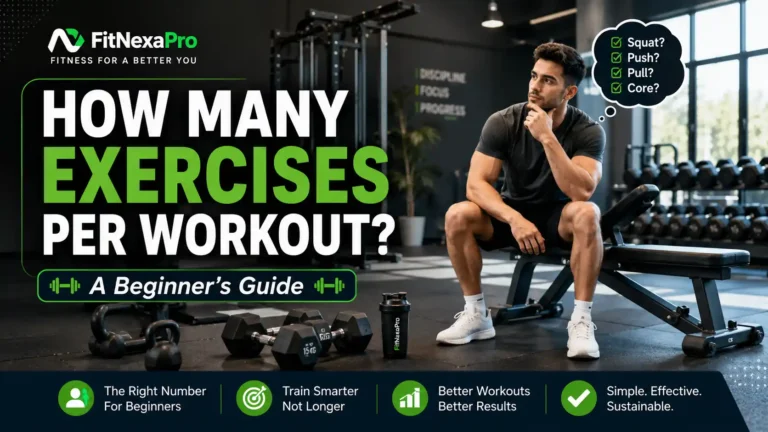
This is also why exercise selection matters. Our guide on How Many Exercises Per Workout explains how beginners can build a routine without filling it with unnecessary movements.
How Many Reps Should You Do?
A moderate range such as 8–12 repetitions is commonly used in general resistance-training programs, but it isn’t the only effective range.
ACSM’s general resistance-training resource, for example, describes 2–3 sets of 8–12 repetitions with good form as a practical approach for resistance training aimed at health.
Your appropriate rep range depends partly on what you want to achieve.
Lower repetition ranges are commonly associated with heavier resistance and strength-focused training.
Moderate and higher repetition ranges can also be useful depending on your goals and how challenging the resistance is.
For beginners, the bigger priority is learning to perform exercises correctly and consistently.
Sets and Reps for General Fitness
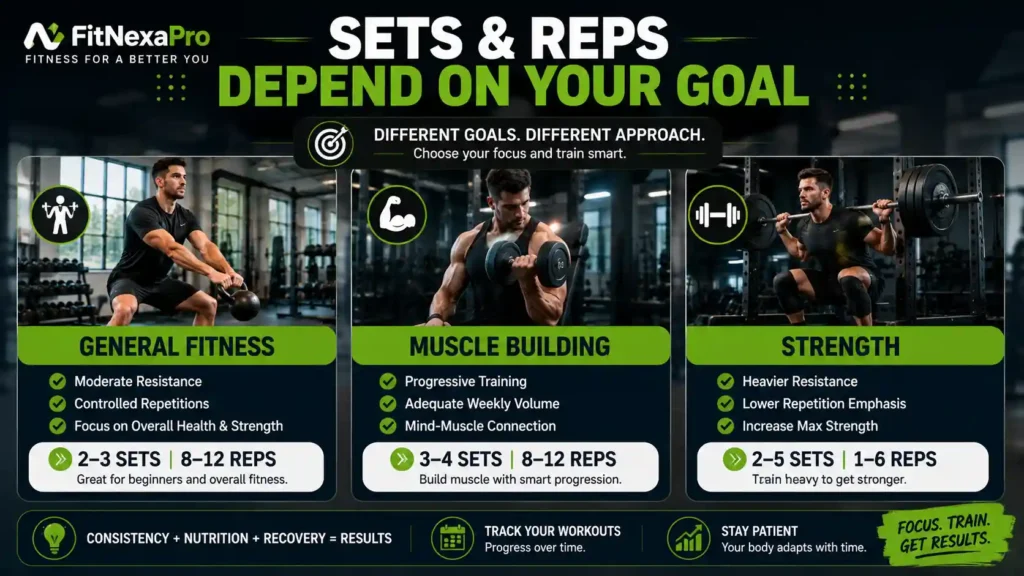
If your main goal is becoming stronger, healthier, and more physically capable rather than maximizing a particular performance outcome, you can keep things simple.
A routine might involve:
2–3 sets per exercise
and approximately:
8–12 controlled repetitions per set
Choose resistance that makes the exercise challenging while still allowing you to maintain good technique.
You don’t need to reach complete muscular failure on every set.
Your first months of training should be about establishing consistency, improving movement quality, and gradually becoming stronger.
Sets and Reps for Building Muscle
Muscle growth is often associated with moderate repetition ranges, but hypertrophy is more nuanced than choosing one magical number.
Training volume, effort, progression, exercise selection, nutrition, and recovery all influence results.
The latest ACSM resistance-training recommendations highlight weekly training volume as an important consideration for muscle growth, with approximately 10 sets per muscle group per week identified as a useful target when hypertrophy is the priority.
That does not mean a beginner should immediately perform 10 sets for every muscle in one workout.
Those sets can be distributed across multiple exercises and training sessions during the week.
For example, your chest might receive training from chest presses during one session and push-ups or another pressing exercise later in the week.
Beginners should build volume gradually rather than jumping straight into high-volume bodybuilding programs.
Sets and Reps for Strength
If your primary goal eventually becomes maximizing strength, your training may shift toward heavier resistance and lower repetition ranges for certain exercises.
ACSM’s 2026 guidance notes that strength-focused training can emphasize heavier loads—around 80% of one-repetition maximum—with approximately 2–3 sets per exercise.
However, beginners do not need to test their maximum strength or immediately start lifting extremely heavy weights.
Learning the movement comes first.
A new lifter can become stronger while using moderate resistance because the body is adapting to resistance training and improving its ability to perform the exercises.
Once you have developed good technique and training experience, your routine can become more specific to your strength goals.
What About High Repetitions?
Higher-repetition sets aren’t automatically ineffective.
They can be used for muscular endurance and other training purposes.
However, doing 30 easy repetitions with resistance that barely challenges you isn’t necessarily the same as performing a demanding set.
The relationship between repetitions and resistance matters.
Generally, heavier resistance limits how many repetitions you can perform, while lighter resistance allows more repetitions.
This is why simply asking whether 10 or 15 reps is “better” doesn’t provide the whole picture.
You also need to consider how challenging those repetitions are.
How Much Weight Should You Use?
Instead of choosing a weight based on what another person uses, choose resistance appropriate for your current ability.
Suppose your target is 8–12 repetitions.
If you can barely perform four controlled reps, the resistance is probably too heavy for that target.
If you perform 12 reps effortlessly and feel like you could immediately do another 15, the resistance may be too light to provide the intended challenge.
A useful beginner approach is to finish your set feeling challenged while still maintaining control.
You don’t need to force yourself to complete repetitions when your technique is clearly breaking down.
Should You Train to Failure?
Training to failure means continuing a set until you cannot complete another repetition.
Beginners do not need to take every set to absolute failure.
In fact, ACSM’s updated 2026 guidance notes that training to momentary muscle failure is not consistently necessary for the average healthy adult to obtain results.
You can finish many sets while feeling that you could still perform another one, two, or perhaps a few repetitions with good technique.
This can be particularly useful while you’re learning exercises.
Your goal isn’t to leave the gym completely exhausted.
Your goal is to provide a useful training stimulus that you can recover from and repeat consistently.
How Long Should You Rest Between Sets?
Rest periods affect your ability to perform your next set.
If you only rest for 20 seconds after a challenging set of squats, you may still be heavily fatigued when the next set begins.
That can reduce the number or quality of repetitions you can perform.
There is no single perfect rest period for every exercise.
As a practical beginner approach, you might use around:
60–90 seconds for smaller or less demanding exercises.
90–180 seconds for more demanding compound movements.
You can adjust based on how you feel and what you’re training for.
You don’t win anything by deliberately rushing your rest periods.
Give yourself enough recovery to perform your next set with good technique.
Should Every Exercise Use the Same Sets and Reps?
No.
Your workout does not need to look like:
3 × 10
3 × 10
3 × 10
3 × 10
3 × 10
for every exercise forever.
Different movements may benefit from different approaches.
For example, you might perform moderate repetitions for a squat, slightly higher repetitions for lateral raises, and measure a plank in seconds instead of repetitions.
The exercise itself and your training goal should influence the prescription.
That said, using a similar range for several exercises can make your first workout program easier to follow.
Simplicity is useful when you’re learning.
How to Progress Your Sets and Reps
Eventually, the same workout will become easier.
That’s a good thing.
It means you’re adapting.
At that point, you need some form of progressive overload if you want training to remain challenging.
You can progress by:
- Performing additional repetitions
- Increasing resistance
- Adding a set when appropriate
- Improving your range of motion
- Improving exercise control
- Progressing to a more difficult exercise variation
You don’t need to change everything simultaneously.
A Simple Rep Progression Method
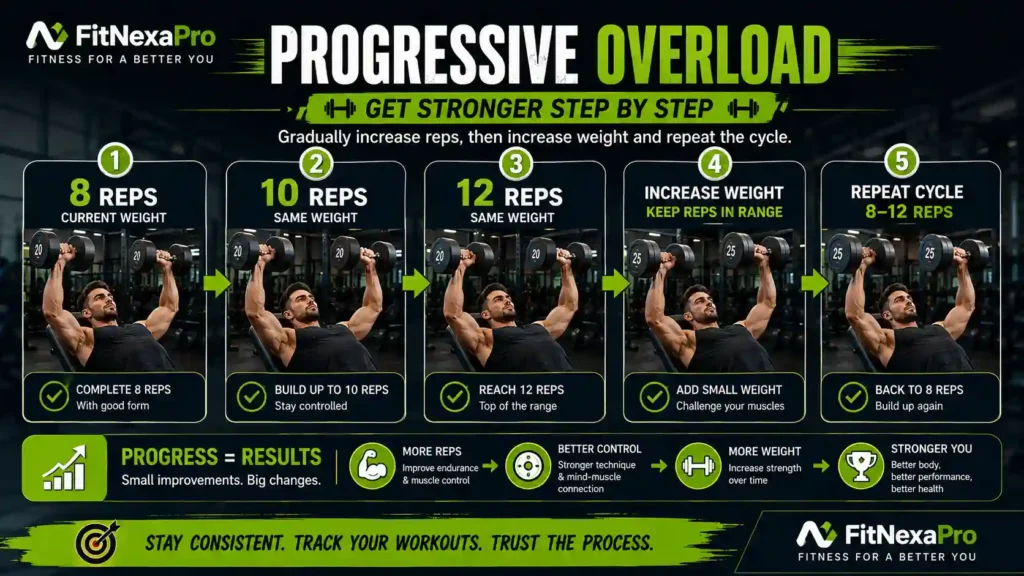
Imagine you’re performing a dumbbell chest press for 2 sets of 8–12 reps.
During your first workout, you manage:
Set 1: 9 reps
Set 2: 8 reps
After several sessions, you may reach:
Set 1: 12 reps
Set 2: 12 reps
If both sets are controlled and the resistance is no longer sufficiently challenging, you could increase the weight slightly.
Your repetitions may then drop toward the lower end of your range.
You gradually work your way upward again.
This is a simple way for beginners to track progress without constantly changing exercises.
Should You Add Reps or Weight First?
For beginners, adding repetitions before increasing weight can be an easy progression strategy.
If your target range is 8–12 reps, work toward performing controlled repetitions near the upper end.
Once you can consistently reach the top of the range with good technique, consider a small resistance increase.
Don’t make huge jumps just because you’ve reached 12 repetitions once.
Progress should be gradual.
You are trying to build strength over months and years, not prove how much weight you can lift during one workout.
How Often Should You Train?
Sets and repetitions are only part of your overall training program.
Frequency matters too.
The U.S. Physical Activity Guidelines recommend that adults perform muscle-strengthening activities involving the major muscle groups on at least two days per week, alongside aerobic activity recommendations.
Physical Activity Guidelines for Americans
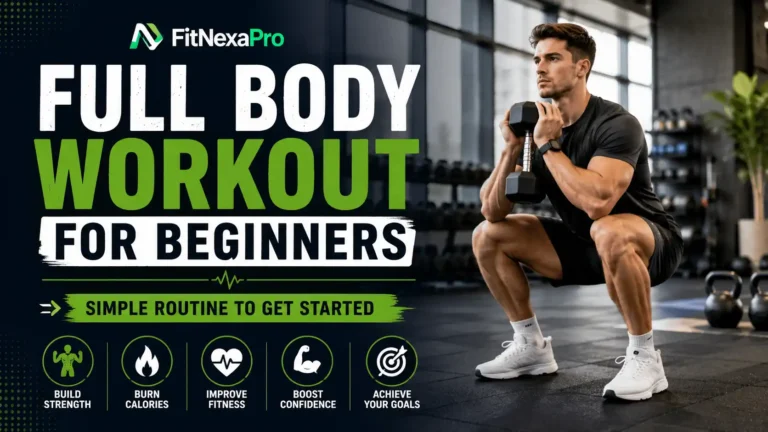
If you’re just getting started, our Full Body Workout for Beginners provides a simple way to organize exercises across the week.
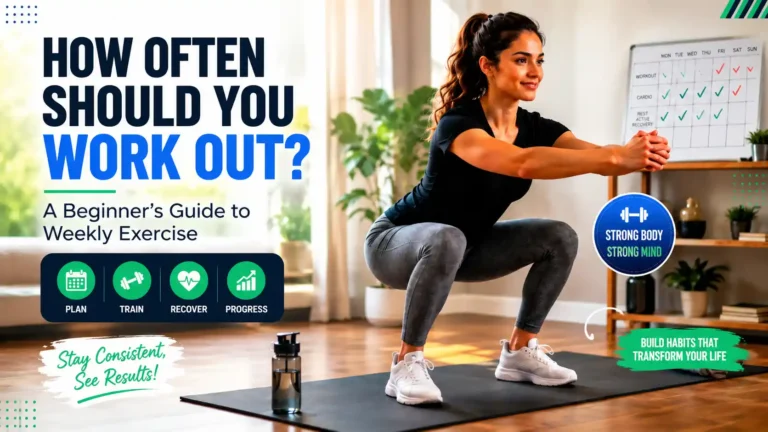
You can also read How Often Should You Work Out? for more detail on building a weekly schedule.
Common Sets and Reps Mistakes Beginners Make
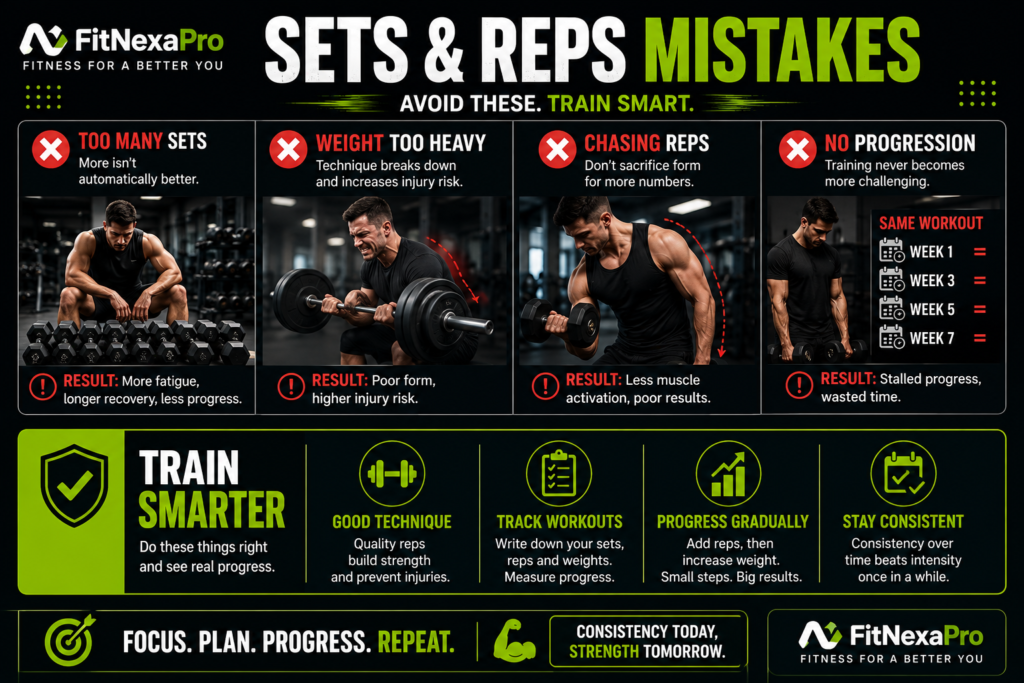
Doing Too Many Sets
If two or three productive sets are enough for your current program, adding several more isn’t automatically better.
More training also creates more fatigue.
Using Weight That Is Too Heavy
Your set isn’t productive simply because the dumbbells look impressive.
Use resistance you can control.
Chasing a Specific Rep Number With Poor Form
If your target says 12 repetitions but your technique breaks down at rep nine, don’t sacrifice form simply to reach the number.
Changing the Rep Range Every Workout
You don’t need to constantly switch between five, eight, 12, 15, and 20 repetitions.
Following a consistent program makes progress easier to measure.
Doing Every Set to Failure
Beginners can make progress without exhausting themselves on every set.
Never Increasing the Challenge
The opposite problem also occurs.
If you’ve used the same resistance for months and your sets have become extremely easy, your training may need progression.
A Simple Beginner Starting Point
If you’re still unsure how many sets and reps to use, keep your first program straightforward.
For many conventional strength exercises, you can start around:
2 sets per exercise
8–12 repetitions per set
Use controlled technique and manageable resistance.
After gaining experience, you might move some exercises to three sets or adjust your repetition ranges according to your goals.
Combine this approach with roughly 4–6 well-selected exercises rather than trying to perform every machine in the gym.
Most importantly, track what you do.
Write down the exercise, resistance, sets, and repetitions.
Your training log will make it much easier to see whether you’re actually progressing.
Frequently Asked Questions
Is 3 sets of 10 good for beginners?
Three sets of 10 can be a perfectly reasonable structure for many exercises, but it isn’t a universal requirement. Beginners may also start with two sets while learning movements.
Is 2 sets enough for beginners?
Two working sets can provide a practical starting point, especially for someone new to resistance training. Training volume can be adjusted as experience increases.
Is 3 sets of 12 good for muscle growth?
It can contribute to muscle-building training, but muscle growth isn’t determined by one set-and-rep combination. Weekly volume, effort, progression, nutrition, and recovery also matter.
Should I do 8, 10, or 12 reps?
All can be useful. Rather than treating one number as perfect, you can work within a range such as 8–12 and gradually progress.
Should I increase weight every workout?
No. Increase resistance when appropriate rather than forcing an increase every session. Improving repetitions, technique, or control can also represent progress.
How many sets should I do per muscle?
This depends on your experience and goals. Beginners don’t need to chase high weekly volumes immediately. Start with a manageable program and gradually increase training as needed.
Final Thoughts
So, how many sets and reps should you do?
For many beginners, 2–3 sets of approximately 8–12 repetitions provides a simple starting framework for many resistance exercises.
But don’t turn those numbers into rigid rules.
Your goals, exercise selection, resistance, training frequency, effort, and recovery all matter.
Start with a manageable workload. Learn proper exercise technique. Track your workouts and gradually make your training more challenging as you improve.
You don’t need the most complicated program.
You need one that you can perform consistently, recover from, and gradually progress.

One Comment