
How Many Exercises Per Workout? A Beginner’s Guide
If you’re new to working out, it is easy to assume that a good workout needs a long list of exercises.
You might walk into the gym and see someone performing 10 or 12 different movements in a single session. Then you look at your own workout with five exercises and wonder whether you’re doing enough.
The reality is simpler.
There is no perfect number of exercises that everyone should perform. The right amount depends on your experience level, training goals, workout structure, available time, and how much work you’re doing for each exercise.
For many beginners, a relatively small number of well-chosen exercises can provide a productive workout without making training unnecessarily complicated.
In this guide, we’ll look at how many exercises per workout beginners may need, how to choose them, and how to avoid adding exercises simply for the sake of doing more.
How Many Exercises Per Workout Should You Do?
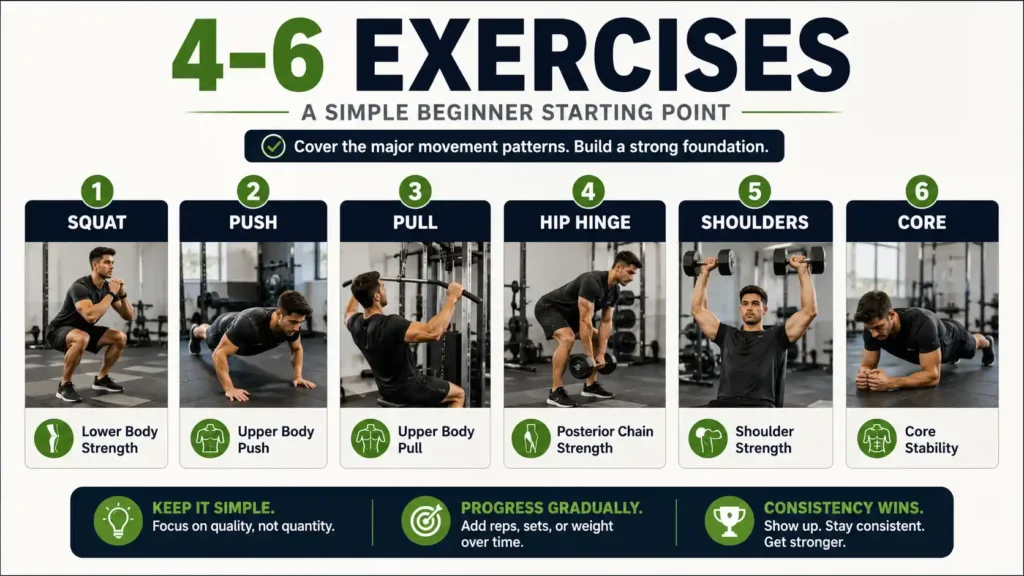
For many beginners, around 4–6 exercises per workout can be a practical starting point.
That is not a strict rule.
Some effective workouts may contain only three or four exercises, while others may include six or seven.
Instead of focusing entirely on the number, consider whether your exercises collectively train the muscles and movement patterns you intended to work.
A beginner full-body workout, for example, might include:
- A squat movement
- A hip-hinge movement
- An upper-body pushing movement
- An upper-body pulling movement
- A shoulder exercise
- A core exercise
That gives you six exercises covering most major areas of the body without requiring a huge workout.
If you’re following our Full Body Workout for Beginners, you’ll notice that it uses this same simple approach.
Why More Exercises Aren’t Always Better
A common beginner mistake is assuming that adding exercises automatically makes a workout more effective.
It doesn’t necessarily work that way.
Imagine performing five exercises with good technique, appropriate resistance, and consistent effort.
Now compare that with performing 12 exercises where the final several movements are rushed because you’re exhausted and want to leave the gym.
The longer workout isn’t automatically superior.
Your ability to recover matters too.
Every challenging exercise contributes to your overall training workload. Continuously adding movements can increase fatigue without necessarily providing a meaningful benefit.
A better goal is to choose exercises that have a clear purpose.
Quality Matters More Than Exercise Count
When deciding how many exercises to perform, focus first on quality.
Ask yourself:
What is this exercise doing in my workout?
If you already have several exercises targeting the same muscles in similar ways, another movement may not add much value.
Beginners generally benefit from spending more time learning fundamental exercises rather than constantly adding new ones.
Repeating movements also gives you an opportunity to improve.
You can track your repetitions, resistance, and technique over time instead of starting from scratch every workout.
How Many Exercises for a Full Body Workout?
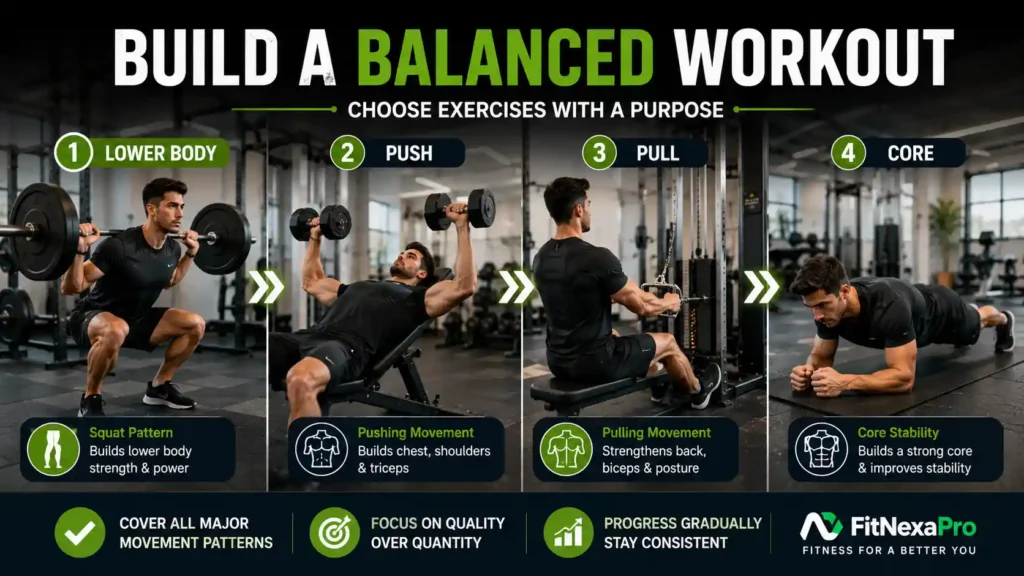
A beginner full-body workout may contain approximately 4–6 exercises.
The goal is to cover several major movement patterns without turning the session into a marathon.
For example, you could perform:
1. Squat
A squat variation primarily trains the lower body.
Bodyweight squats, goblet squats, and leg presses are possible options depending on your ability and available equipment.
2. Chest Press or Push-Up
This gives you an upper-body pushing movement.
Push-ups can work well at home, while dumbbell or machine chest presses are convenient gym options.
3. Row
A rowing movement provides an upper-body pull and trains muscles in your back and arms.
4. Romanian Deadlift
This introduces a hip-hinge movement and trains areas including the hamstrings and glutes.
5. Shoulder Press
A shoulder press adds a vertical pushing movement.
6. Plank
A plank provides straightforward core training.
You don’t necessarily need all six during every workout, but this demonstrates how a relatively small selection can cover the major areas of your body.
How Many Exercises for Chest?
If you’re training your chest as part of a full-body routine, one well-chosen chest exercise may be enough for that particular session, especially for a beginner.
For example, you might perform a dumbbell chest press or push-ups.
If you’re doing an upper-body or dedicated chest workout, you may include additional movements.
These could involve a pressing exercise plus another movement performed at a different angle.
The important point is that you don’t need five different chest exercises just because you’ve seen advanced lifters doing them.
Your training structure and weekly workload matter more than copying someone else’s routine.
How Many Exercises for Back?
Your back contains multiple muscles and is involved in different pulling patterns.
A beginner might use one or two back exercises depending on the workout.
A horizontal pulling movement such as a seated cable row is one option.
A vertical pulling movement such as a lat pulldown is another.
If you’re performing a short full-body session, you might choose one.
If you’re doing an upper-body workout, you may choose both.
Again, the goal is not to collect as many exercises as possible.
Choose movements you can perform well and progressively improve.
How Many Exercises for Legs?
Leg training can include movements for your quadriceps, hamstrings, glutes, and calves.
A full-body session might use two lower-body movements, such as:
Squat or leg press for a knee-dominant movement.
Romanian deadlift for a hip-hinge movement.
A dedicated lower-body workout may contain more exercises because the entire session is focused on your legs.
For beginners, this might mean roughly four to six movements covering different lower-body functions.
You don’t need to perform every leg machine in the gym during a single session.
How Many Exercises for Arms?
Your biceps and triceps already contribute to many upper-body compound exercises.
Rows and pulldowns involve your biceps, while presses involve your triceps.
That means beginners may not need large amounts of direct arm work.
If you want additional arm training, one biceps exercise and one triceps exercise can be a simple addition.
For example:
Biceps: Dumbbell curl
Triceps: Cable pushdown
Performing multiple curl variations in the same beginner workout is rarely necessary.
How Many Exercises for Shoulders?
Your shoulders also participate in several pressing movements.
A beginner routine might include a shoulder press as its main direct shoulder exercise.
Depending on your program, you could eventually include movements such as lateral raises.
But don’t assume you need several shoulder exercises in every session.
Your chest pressing exercises are already involving parts of your shoulders.
This is why looking at your workout as a whole is more useful than treating every muscle as completely separate.
Compound vs Isolation Exercises
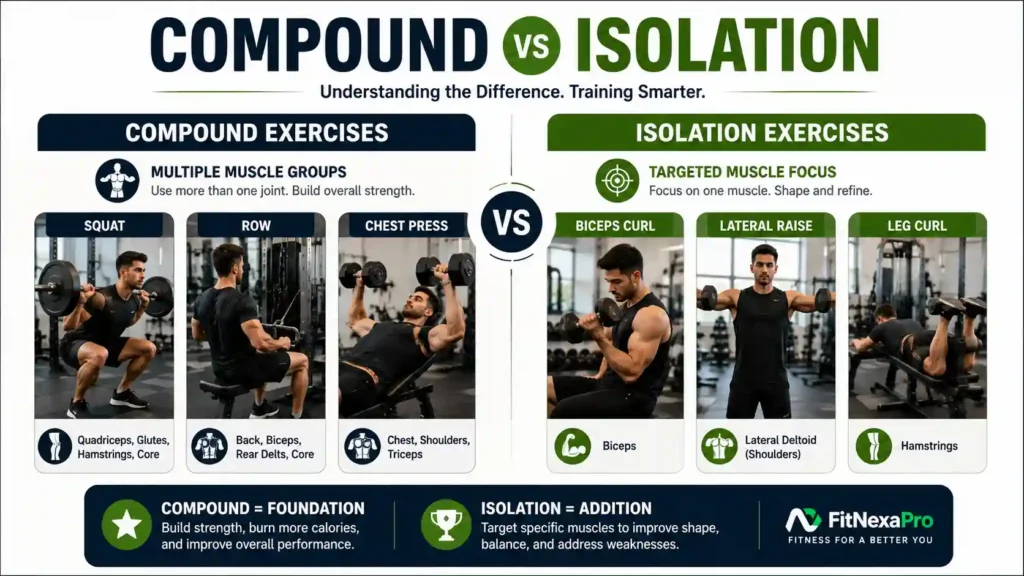
Understanding the difference between compound and isolation exercises can help you build shorter, more efficient workouts.
Compound Exercises
Compound movements involve multiple joints and muscle groups.
Examples include:
- Squats
- Romanian deadlifts
- Push-ups
- Chest presses
- Rows
- Pulldowns
- Shoulder presses
Because these exercises train multiple muscles at once, they can form the foundation of a beginner routine.
Isolation Exercises
Isolation exercises place greater emphasis on a particular muscle.
Examples include:
- Biceps curls
- Triceps extensions
- Lateral raises
- Leg curls
- Calf raises
Isolation exercises aren’t bad.
They simply serve a different purpose.
A beginner could perform their larger compound movements first and then add a small number of isolation exercises if needed.
How Many Exercises Should You Do for Each Muscle Group?
There isn’t a universal number that works for every muscle.
Instead of asking only how many exercises you need, consider your total training volume across the week.
An exercise isn’t just one unit of training.
You also need to consider how many sets you perform and how challenging those sets are.
For example, three exercises performed for three sets each creates a very different workload from three exercises performed for one set each.
Your training frequency matters as well.
Someone training a muscle once per week may structure their sessions differently from someone training it two or three times per week.
This is why exercise count alone doesn’t tell the whole story.
How Many Sets Per Exercise?
Beginners can often start with around 2–3 working sets per exercise.
You don’t need to immediately perform four or five sets of everything.
Starting with a manageable workload gives you time to learn how your body responds to resistance training.
For many common exercises, a beginner routine might use a moderate repetition range such as 8–12 repetitions.
However, appropriate repetitions can vary depending on the movement, resistance, training goal, and individual.
We’ll cover this topic in much more detail in our upcoming guide on how many sets and reps you should do.
How Long Should Your Workout Be?
Your exercise count also affects workout duration.
If you perform five exercises with two or three sets each and take reasonable rest periods, your workout may take somewhere around 45–60 minutes.
There is nothing magical about that duration.
Some productive sessions are shorter.
Others are longer.
Avoid adding exercises simply because you believe you need to stay in the gym for a certain amount of time.
Once you’ve completed the work your program requires, the workout has served its purpose.
How Many Exercises for Muscle Building?
People interested in building muscle often assume they need many different exercises.
Variety can be useful, but constantly changing exercises can also make progress difficult to track.
A sensible muscle-building program generally combines appropriate resistance training volume with progressive overload, nutrition, and recovery.
Rather than doing every possible exercise for a muscle in one session, you can distribute your training across the week.
For example, you might perform one chest exercise during one full-body workout and a different chest movement later in the week.
This gives you some variety without turning every workout into an extremely long session.
How Many Exercises for Weight Loss?
There isn’t a special number of exercises required for weight loss.
Fat loss depends largely on your overall energy balance over time.
Strength training can still be valuable because it helps you train your muscles while you’re managing your body weight.
Instead of trying to burn as many calories as possible by performing endless exercises, build a balanced routine that you can maintain.
You can combine resistance training with activities such as walking or other forms of cardio.
The CDC recommends that adults perform muscle-strengthening activities involving the major muscle groups on at least two days each week, alongside recommended aerobic activity.
How Many Exercises Should Beginners Start With?
If you’re completely new to resistance training, simplicity is useful.
Start with approximately 4–6 exercises covering the major areas you want to train.
You could initially perform two sets of each movement.
That gives you enough work to practice resistance training without immediately creating an enormous routine.
After several weeks, you can evaluate your progress.
Are you becoming stronger?
Is your technique improving?
Are you recovering between workouts?
Do you enjoy the routine enough to continue?
If everything is progressing well, you don’t necessarily need to change anything.
When Should You Add More Exercises?
Don’t add exercises simply because you’ve been following your routine for a few weeks.
Add something when there is a reason.
For example, you may eventually discover that a particular muscle or movement isn’t receiving enough attention.
Your goals might also become more specific.
Someone who starts exercising for general health may later decide they want to focus more heavily on muscle development.
At that point, their program may become more detailed.
Your routine should evolve with your experience and goals rather than becoming complicated simply because time has passed.
Signs You May Be Doing Too Many Exercises
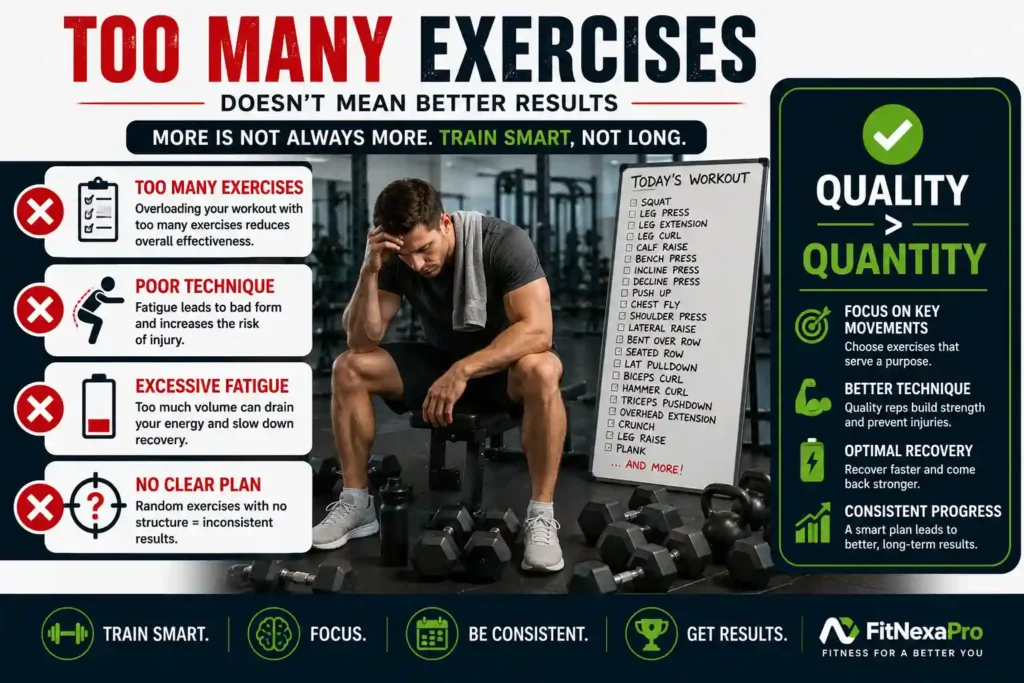
A long workout isn’t automatically excessive, but there are signs that your routine may need adjustment.
You may notice that your exercise technique deteriorates significantly toward the end of every workout.
Your sessions may regularly become so long that you struggle to fit them into your schedule.
You might also find yourself constantly sore or unable to recover before your next training session.
Another clue is redundancy.
If you’re performing multiple exercises that accomplish almost exactly the same thing without a clear reason, your workout may be unnecessarily complicated.
Removing an exercise can sometimes improve a program rather than weaken it.
Common Beginner Mistakes
Copying Advanced Bodybuilding Workouts
An experienced bodybuilder’s program is designed for their goals, training history, and recovery capacity.
It isn’t automatically appropriate for someone in their first month of training.
Doing Too Many Isolation Exercises
Curls and lateral raises can have a place in your program, but don’t neglect fundamental movement patterns.
Changing Exercises Constantly
If you replace every exercise each week, it becomes difficult to determine whether you’re actually progressing.
Training Without a Plan
Walking around the gym choosing whichever machine happens to be free makes progress difficult to measure.
Write down your routine.
Track your exercises, sets, repetitions, and resistance.
Thinking More Means Faster Results
Your body needs training, but it also needs recovery.
More exercises aren’t automatically going to produce faster progress.
A Simple Beginner Approach
If you’re unsure where to start, keep your first program straightforward.
Choose around 4–6 exercises.
Cover your major muscle groups.
Perform around 2–3 sets per exercise.
Use resistance that allows controlled repetitions.
Rest appropriately between sets.
Repeat your routine consistently enough to learn the movements.
Track your progress.
Then gradually adjust the program based on your goals and experience.
You don’t need to build the perfect workout on day one.
Frequently Asked Questions
Is 5 exercises enough for a workout?
Yes. Five well-chosen exercises can provide a productive workout, particularly if they cover the major muscles or movement patterns relevant to your training session.
Is 10 exercises too much for one workout?
Not necessarily, but many beginners don’t need 10 exercises. The total number of sets, exercise difficulty, training frequency, goals, and recovery all matter.
Is 3 exercises enough for a workout?
It can be. A short workout built around three major compound movements may still provide meaningful training, depending on your goals and program.
Should I do the same exercises every workout?
You don’t need identical exercises forever, but repeating key movements for a period of time can help you practice technique and measure progress.
How many exercises should I do for a full body workout?
Around 4–6 well-selected exercises can provide a simple starting point for many beginners.
Should beginners do compound exercises?
Compound exercises can be useful because they train multiple muscle groups simultaneously. Beginners should select variations appropriate for their ability and focus on learning proper technique.
Final Thoughts
So, how many exercises per workout should you do?
For many beginners, approximately 4–6 exercises is a practical place to start.
But don’t treat that number as a strict rule.
The quality and structure of your workout matter more than simply counting exercises.
Choose movements that have a purpose. Focus on good technique. Perform an appropriate number of sets. Allow yourself to recover, and gradually progress as you become stronger.
A simple workout you consistently perform and improve is far more useful than a complicated routine filled with exercises you don’t need.
2 Comments