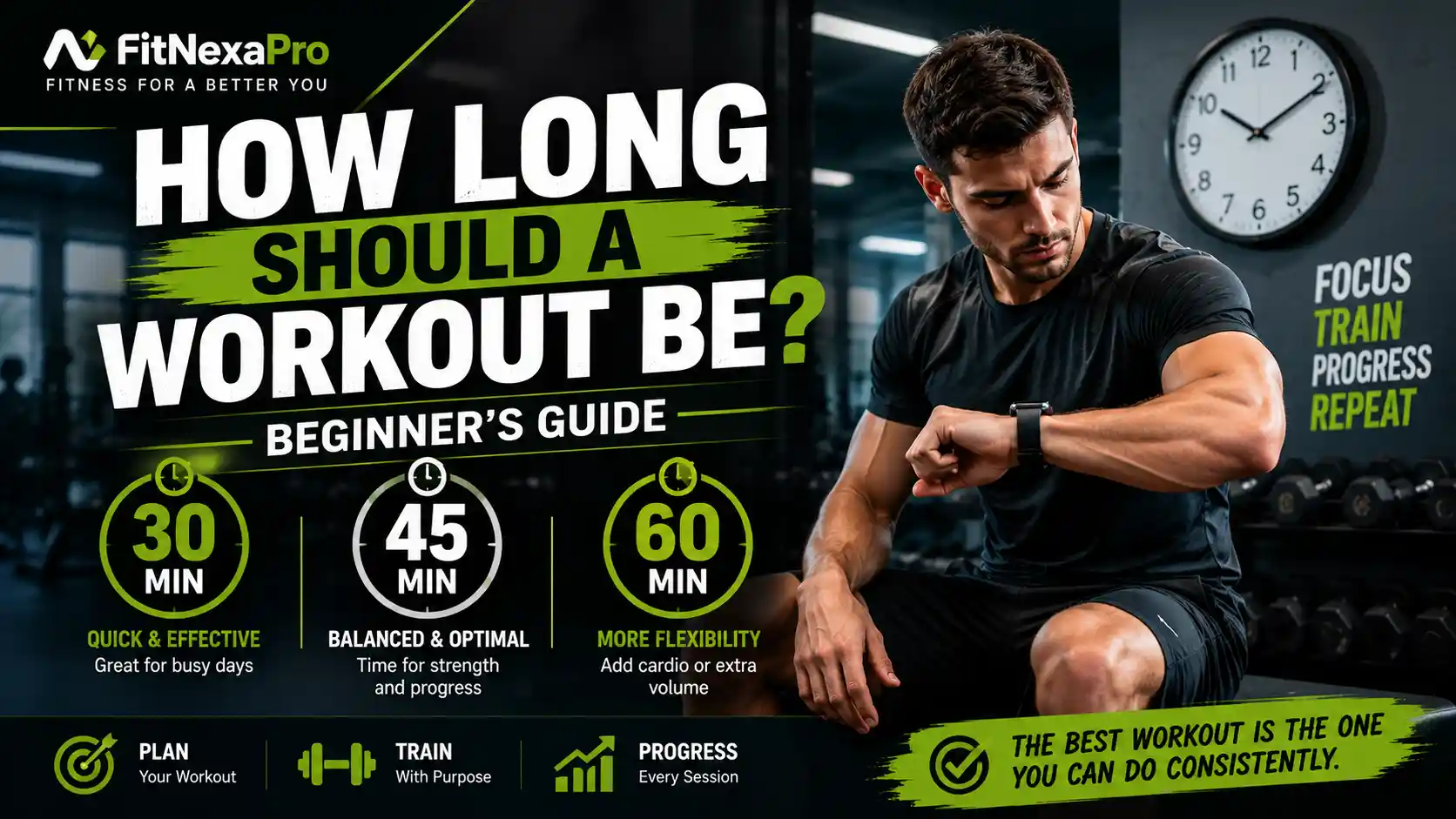
How Long Should a Workout Be? A Beginner’s Guide
When you first start exercising, it is easy to assume that spending more time in the gym will automatically produce better results. You may see some people finish their workouts in 30 minutes while others train for 90 minutes or longer.
So, how long should a workout be?
There is no single perfect workout duration for everyone. Your ideal training time depends on your goals, fitness level, workout type, number of exercises, rest periods, and training intensity.
For many beginners, a workout lasting roughly 30–60 minutes can be a practical starting range. Some sessions may be shorter, while others may take longer. More important than watching the clock is completing an appropriate amount of quality exercise that you can recover from and perform consistently.
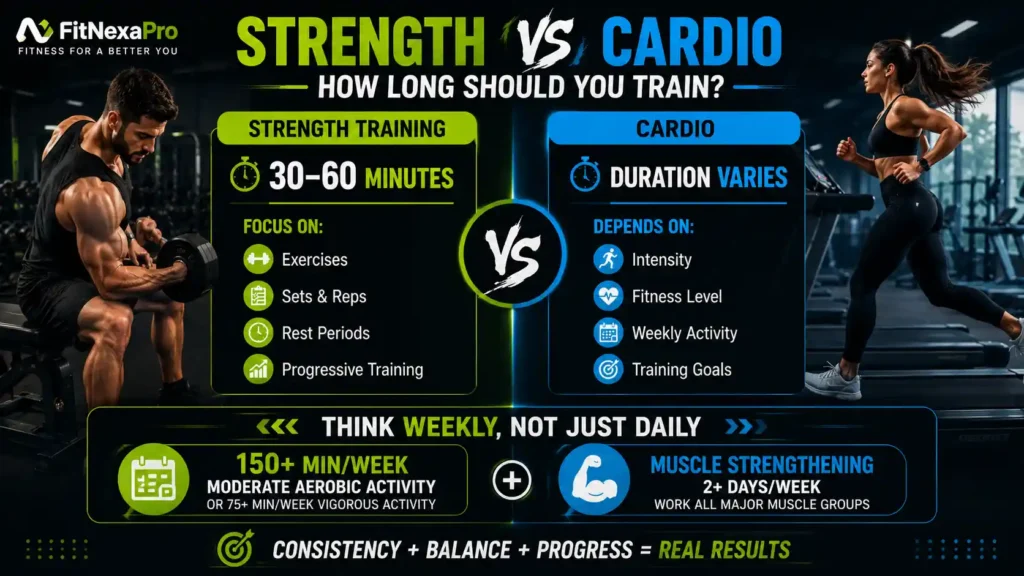
Current U.S. physical-activity guidelines are based primarily on weekly activity, not a requirement that every workout last a specific number of minutes. Adults are advised to accumulate at least 150 minutes of moderate-intensity aerobic activity per week, or 75 minutes of vigorous activity (or an equivalent combination), plus muscle-strengthening activity on at least two days per week.
Let’s look at what this means for your actual workouts.
How Long Should a Workout Be?
For a beginner, a useful general target is:
30–60 minutes per workout
That is not a strict rule.
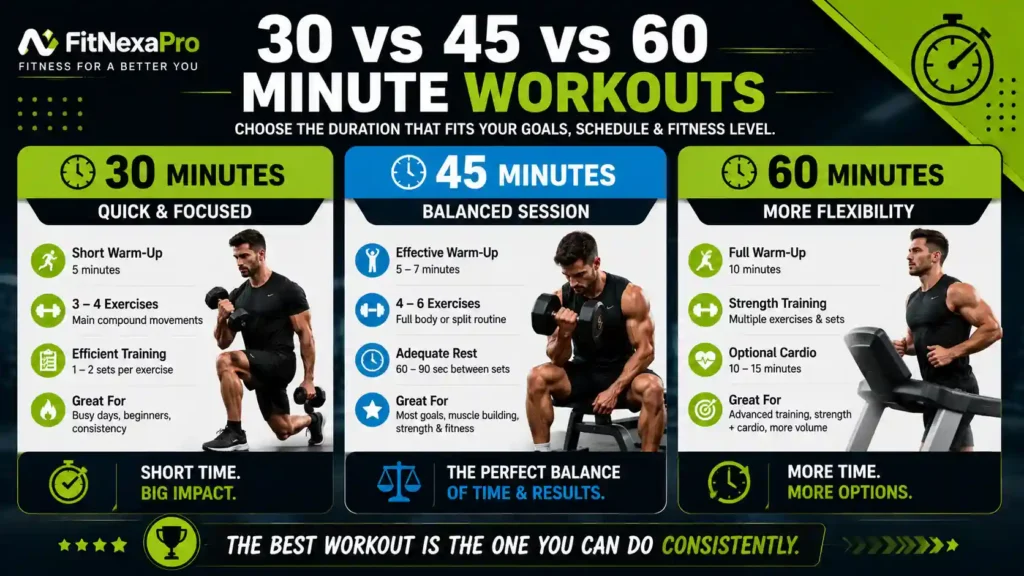
A focused 30-minute workout can be productive, while a well-designed 60-minute session may allow more exercises, sets, rest, or cardio.
Your workout might include:
- 5–10 minutes of warming up
- 20–45 minutes of resistance training or cardio
- A few minutes of cooling down or light movement
The exact structure will depend on what you’re doing that day.
Instead of trying to make every workout last exactly 45 or 60 minutes, concentrate on completing your planned exercises with good technique.
How Long Should Beginners Work Out?
Beginners often make one of two mistakes.
Some barely exercise long enough to create a meaningful training session. Others immediately copy advanced gym routines and spend 90 minutes or more performing exercise after exercise.
Neither approach is necessary.
If you are just starting, around 30–45 minutes of structured exercise can be plenty for many sessions.
For example, a beginner strength workout could include:
5 minutes of warming up, followed by four or five exercises, two working sets of each exercise, appropriate rest between sets, and a short cool-down.
As your fitness improves, you can gradually increase your workload when necessary.
You do not need to earn results by staying in the gym for a predetermined amount of time.
Is a 30-Minute Workout Enough?
Yes. A 30-minute workout can absolutely be worthwhile.
In fact, current physical-activity guidance no longer requires aerobic exercise to occur in bouts of at least 10 minutes for it to count. Moderate-to-vigorous physical activity accumulated in bouts of any duration can contribute toward overall activity.
A focused 30-minute session might look like:
5 minutes: warm-up
20 minutes: resistance training or cardio
5 minutes: cool-down
You could also use most of the 30 minutes for strength training if you have already warmed up through lighter movements.
The important part is how those 30 minutes are used.
Thirty minutes of purposeful exercise can be more useful than spending an hour in the gym while taking unnecessarily long breaks, scrolling through your phone, or performing exercises without a plan.
Is a 45-Minute Workout Enough?
For many beginners, 45 minutes is an excellent amount of time for a workout.
It gives you enough time to warm up, complete several exercises with reasonable rest periods, and avoid feeling rushed.
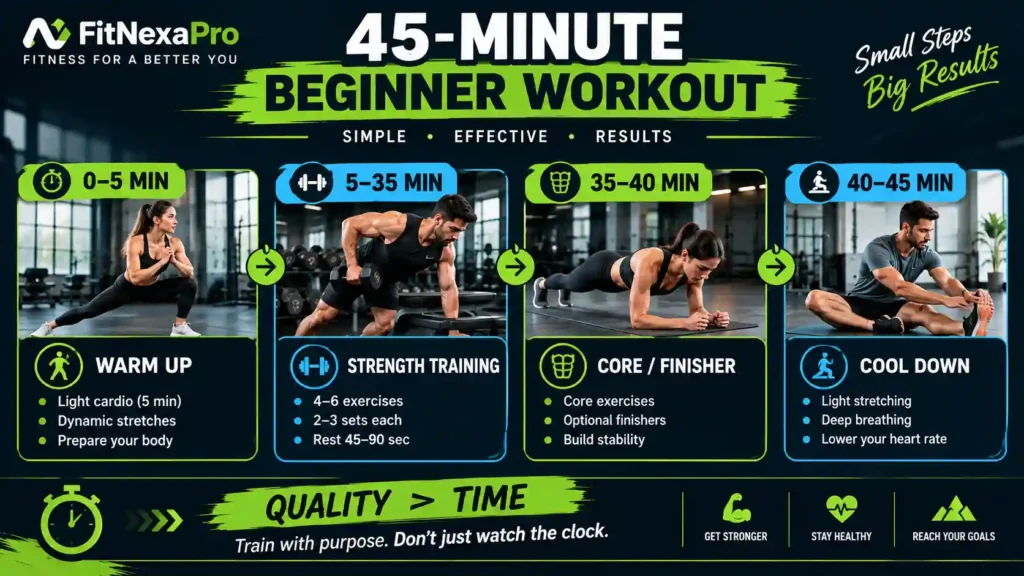
A 45-minute strength session could include:
5–7 minutes: warm-up
30–35 minutes: strength training
3–5 minutes: cool-down or light movement
If you perform around four to six exercises with two or three working sets each, a session of this length can accommodate a well-structured beginner routine.
Our guide on How Many Exercises Per Workout explains why you don’t need a huge exercise list to build an effective session.
Is a 60-Minute Workout Better?
A 60-minute workout isn’t automatically better than a 30- or 45-minute workout.
It simply gives you more time.
That additional time may be useful if your workout contains more exercises, longer rest periods, a combination of strength training and cardio, or additional warm-up work.
For example, someone might spend:
10 minutes warming up
40 minutes strength training
10 minutes doing cardio
That can make a perfectly reasonable 60-minute session.
But deliberately stretching a 40-minute workout to an hour doesn’t make it more effective.
The goal should be to perform the training you need—not to remain in the gym until a certain number appears on the clock.
How Long Should a Strength-Training Workout Be?
Many beginner strength-training sessions can fit comfortably into approximately 30–60 minutes.
However, workout duration depends heavily on:
The number of exercises you perform, how many sets you complete, how long you rest, how difficult your exercises are, whether you train your whole body or selected muscles, and how busy the gym is.
A workout containing five exercises and two sets per exercise will generally take less time than eight exercises with four sets each.
That’s why workout duration shouldn’t be considered independently from training volume.
If you haven’t already, read our guide to How Many Sets and Reps Should You Do? It will help you understand how sets, repetitions, resistance, and rest influence the structure of your session.
How Long Should a Full-Body Workout Be?
A beginner full-body workout will often take approximately 45–60 minutes, although shorter sessions are possible.
You don’t need several exercises for every individual muscle.
Instead, your routine can focus on major movement patterns.
For example:
Squat or leg movement
Push
Pull
Hip-hinge movement
Shoulder movement
Core exercise
With sensible sets and rest periods, those exercises can create a complete workout without requiring two hours in the gym.
Our Full Body Workout for Beginners provides a straightforward routine you can use as a starting point.
How Long Should a Cardio Workout Be?
Cardio duration depends on intensity, fitness level, and your overall weekly activity.
Current guidelines recommend adults accumulate 150–300 minutes of moderate-intensity aerobic activity per week, or 75–150 minutes of vigorous-intensity activity, or an equivalent combination, for substantial health benefits.
That doesn’t mean every cardio workout needs to last 30 or 60 minutes.
You could distribute your activity across the week.
For example, the CDC shows 30 minutes of moderate activity on five days as one way to reach 150 minutes, but explicitly notes that the weekly activity can be broken into smaller chunks.
If you’re a beginner, start with an amount you can manage and gradually build from there.
How Long Should You Work Out to Build Muscle?
Muscle building doesn’t require a specific workout duration.
Your muscles don’t know whether you’ve been inside the gym for 37 minutes or 67 minutes.
What matters more is whether your training provides an appropriate stimulus and whether you progressively train over time.
A muscle-building workout may take around 45–75 minutes for many recreational lifters, but that is a practical range rather than a scientific requirement.
Someone performing a focused full-body routine might finish sooner.
Someone performing more total sets or taking longer rest periods might need more time.
ACSM’s 2026 resistance-training position stand emphasizes that resistance-training prescriptions should be considered in terms of variables such as load, volume, frequency, exercise selection, and progression—not simply session duration.
So don’t judge the quality of a muscle-building workout by its length alone.
How Long Should You Work Out for Weight Loss?
There is also no magical workout duration for weight loss.
Exercise can increase energy expenditure and provides important health benefits, but body-weight changes are influenced by overall energy balance over time.
Instead of asking whether a 30-minute or 60-minute workout “burns enough fat,” focus on creating a sustainable routine.
For example, you might combine resistance training several days per week with walking or other aerobic activity throughout the week.
This can help you work toward recommended activity levels without forcing every session to be extremely long.
Consistency matters much more than completing one exhausting workout and then avoiding exercise for the rest of the week.
How Rest Periods Affect Workout Length
Two people can perform exactly the same exercises and still have very different workout durations.
One major reason is rest time.
Imagine both people perform five exercises for three sets each.
Person A rests approximately 60 seconds between most sets.
Person B rests two or three minutes.
Person B’s workout will naturally take longer.
That doesn’t necessarily mean either person is training incorrectly.
More demanding strength exercises can require longer recovery between sets, while smaller or less demanding exercises may require less.
Avoid shortening your rest periods purely because you’re worried your workout is taking too long.
If you need another minute to perform your next set safely and effectively, take it.
Warm-Ups Count Too
When discussing how long a workout should be, people often only think about their working sets.
Your warm-up is part of your session too.
You don’t necessarily need a 20-minute warm-up before every workout.
A beginner might spend around 5–10 minutes gradually preparing for training.
This can include light movement followed by exercise-specific warm-up sets before heavier resistance exercises.
For example, before performing weighted squats, you could practice the movement with body weight and then use lighter resistance before your working sets.
The goal is preparation, not exhaustion.
Longer Workouts Aren’t Automatically Better

One of the most common beginner misconceptions is:
More time = more results.
Training doesn’t work quite that way.
After you’ve completed the amount of exercise required by your program, adding random exercises simply to make the workout longer can create unnecessary fatigue.
A 45-minute workout performed consistently with good technique, sensible progression, and adequate recovery can be more useful than an unfocused 90-minute session.
This principle also applies to exercise selection.
If your workout already contains movements covering your major training needs, you don’t need another six exercises simply because other people are still training.
Signs Your Workouts May Be Too Long
Workout duration alone isn’t enough to determine whether you’re doing too much.
However, your sessions may need adjustment if you regularly notice that:
Your technique deteriorates significantly near the end.
You’re adding exercises simply to stay in the gym longer.
Later exercises receive very little effort because you’re exhausted.
You struggle to recover before your next workout.
You regularly skip workouts because your routine takes too much time.
Your sessions contain many exercises with no clear purpose.
Before reducing your training, consider why the sessions are taking so long.
The problem might be excessive volume—or simply too much time between exercises.
How Many Days Per Week Should Beginners Work Out?
You also need to consider weekly frequency.
A single two-hour workout once per week isn’t necessarily a better strategy than several manageable sessions distributed across the week.
Federal guidance recommends muscle-strengthening activity involving all major muscle groups on at least two days per week.
For beginners doing strength training, two or three well-structured sessions per week can therefore be a practical approach.
Your exact schedule depends on your goals, recovery, available time, and other physical activity.
Read our How Often Should You Work Out? guide for a more detailed breakdown of weekly training frequency.
Example 30-Minute Beginner Workout
If you’re short on time, keep your routine focused.
Warm-up: 5 minutes
Then perform four exercises covering major movement patterns.
For example:
Squat variation
Push-up or chest press
Row
Romanian deadlift
Perform around two working sets per exercise with sensible rest periods.
Finish with a few minutes of easy movement if desired.
The purpose isn’t to rush through as many exercises as possible.
It’s to prioritize the movements that matter most.
Example 45-Minute Beginner Workout
With 45 minutes available, you have room for a little more training.
Warm-up: 5–7 minutes
Then complete approximately five exercises:
Squat
Chest press
Row
Romanian deadlift
Core exercise
Depending on your program, you could perform around two or three working sets per movement.
Take enough rest to maintain good technique.
This structure can work particularly well for a beginner full-body session.
Example 60-Minute Beginner Workout
If you have an hour, you could combine resistance training with a small amount of cardio.
For example:
5–10 minutes: warm-up
40–45 minutes: resistance training
5–10 minutes: cardio or cool-down
Alternatively, you could dedicate most of the session to strength training and take longer rests between demanding exercises.
You don’t need to fill every minute.
If your planned workout is complete after 50 minutes, finishing early is perfectly fine.
Common Workout Duration Mistakes
Trying to Reach an Exact Time
Don’t add unnecessary exercises just because your 60-minute workout finished in 48 minutes.
Spending Too Much Time Resting Unnecessarily
Adequate rest is useful. Spending 10 minutes checking social media between ordinary sets is something different.
Rushing Through Exercises
The opposite mistake is turning your entire strength workout into a race simply to finish quickly.
Copying Advanced Lifters
An experienced bodybuilder’s 90-minute program isn’t automatically appropriate for someone entering the gym for the first time.
Ignoring Weekly Activity
One workout doesn’t determine your overall fitness.
Look at what you’re doing throughout the entire week.
Believing More Is Always Better
Your body needs both training and recovery.
The objective is productive exercise—not maximum exhaustion.
Frequently Asked Questions
Is 30 minutes in the gym enough?
Yes. A focused 30-minute workout can be productive, particularly when you follow a structured plan rather than wasting time between exercises.
Is 45 minutes enough to build muscle?
A 45-minute resistance-training session can certainly contribute to muscle growth. Workout duration itself doesn’t determine muscle growth; training stimulus, volume, progression, nutrition, and recovery also matter.
Is one hour at the gym enough?
For most recreational exercisers and beginners, an hour provides plenty of time for a well-structured workout. Many effective workouts can also be shorter.
Is working out for two hours too long?
Not automatically, but most beginners don’t need two-hour gym sessions. If your routine regularly takes that long, review your exercise selection, number of sets, rest periods, and goals.
How long should a full-body workout take?
A practical beginner full-body session might take approximately 45–60 minutes, although it can be shorter or longer depending on the exercises, sets, and rest periods.
Is a 20-minute workout worth doing?
Yes. Some activity is better than none, and current guidelines recognize that physical activity does not have to occur in a minimum 10-minute bout to contribute to health benefits.
Should every workout be the same length?
No. A strength session, cardio workout, recovery session, and quick home workout can all have different durations.
Final Thoughts
So, how long should a workout be?
For many beginners, approximately 30–60 minutes is a practical range for a structured workout, with 30–45 minutes often being enough when you’re just getting started.
But there is no universal stopwatch rule.
A good workout is long enough to complete the training you planned with appropriate effort and technique—without adding unnecessary exercises just to make the session longer.
Focus on your total weekly activity, exercise selection, sets and reps, progression, and recovery.
Current guidance recommends adults accumulate at least 150 minutes of moderate-intensity aerobic activity per week, or an equivalent amount of vigorous activity, while also performing muscle-strengthening activity on at least two days each week.
Build your routine gradually, stay consistent, and make every minute of your workout serve a purpose.