
Adjustable vs Fixed Dumbbells: Which Is Better for Your Home Gym?
Dumbbells are one of the most versatile pieces of strength-training equipment you can own. They can be used for squats, presses, rows, lunges, curls, shoulder exercises, and many other movements without requiring a large workout space.
But when building a home gym, one question quickly comes up: adjustable vs fixed dumbbells—which should you choose?
Adjustable dumbbells allow you to change the amount of weight on a single pair, while fixed dumbbells have one permanent weight. Both can support effective resistance training, but they differ significantly in space requirements, convenience, cost, durability, and overall workout experience.
For many home-gym users, adjustable dumbbells offer excellent space efficiency. Fixed dumbbells, however, can be faster and simpler to use, particularly if you have enough room for a complete set.
This guide compares adjustable vs fixed dumbbells to help you decide which option better fits your home, budget, and training goals.
What Are Adjustable Dumbbells?
Adjustable dumbbells are designed so the amount of resistance can be changed without owning a separate pair for every weight.
Depending on the design, you may adjust the weight using a dial, selector pin, locking mechanism, removable plates, or another system.
For example, one adjustable dumbbell might replace several individual dumbbells ranging from relatively light to considerably heavier resistance.
This makes adjustable dumbbells particularly attractive for home gyms where storage space is limited.
Instead of having a long rack containing multiple pairs, you can potentially perform an entire workout using one adjustable pair.
However, adjustment systems vary between products. Some are extremely quick to change, while others require more time between exercises.
What Are Fixed Dumbbells?
Fixed dumbbells have a permanent weight.
If a dumbbell weighs 10 kg, for example, it remains 10 kg. To use a different resistance, you pick up another dumbbell.
Commercial gyms commonly have long racks of fixed dumbbells because they are straightforward to use and allow people to switch weights immediately.
Fixed dumbbells are available in several materials and designs, including rubber-coated, urethane, neoprene, and traditional metal versions.
Their biggest advantage is simplicity.
There are no adjustment mechanisms or weight-selection systems to operate. Pick up the appropriate pair and begin your exercise.
The disadvantage is that building a useful weight range requires multiple pairs, which takes more space and can increase the total cost.
Adjustable vs Fixed Dumbbells: The Main Difference
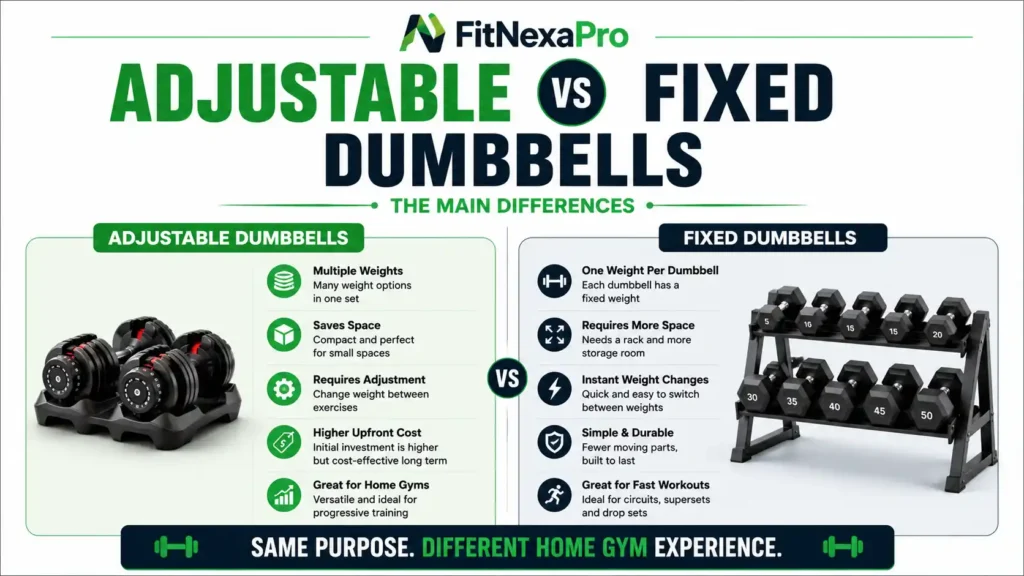
The biggest difference comes down to space versus convenience.
Adjustable dumbbells consolidate multiple weights into a smaller footprint.
Fixed dumbbells give you immediate access to each individual weight.
Imagine your workout includes:
- Heavy goblet squats
- Moderate dumbbell rows
- Lighter shoulder raises
- Biceps curls
With adjustable dumbbells, you change the resistance between exercises.
With fixed dumbbells, you simply put one pair down and pick up another.
Neither approach automatically produces better fitness results. Current ACSM guidance emphasizes that many resistance-training approaches can be effective, and equipment type itself is generally less important than appropriate training and consistency for the average healthy adult.
The better dumbbell is therefore usually the one that fits how and where you train.
Which Takes Up Less Space?
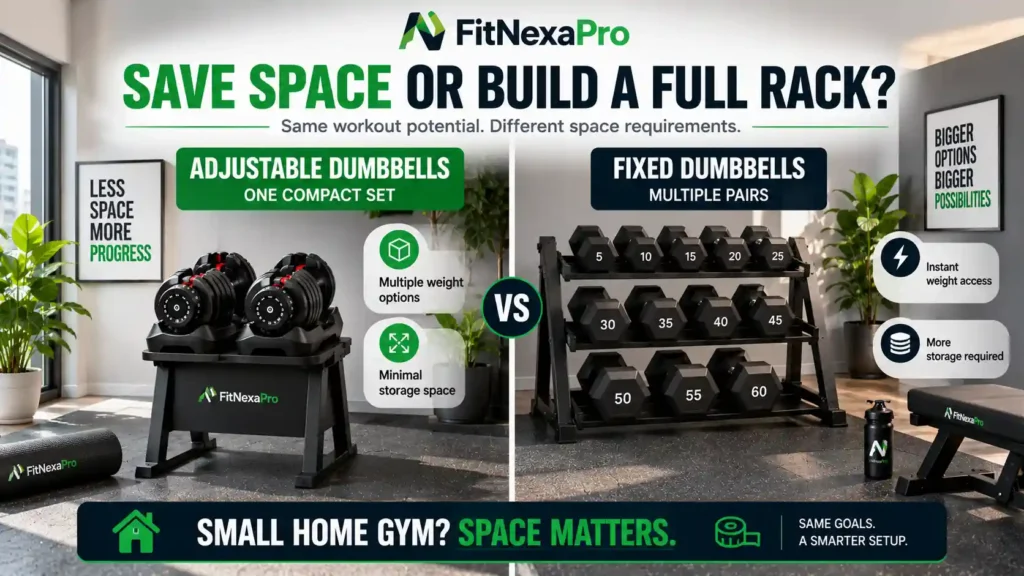
Adjustable dumbbells are the clear winner for space efficiency.
A complete fixed dumbbell collection can require a dedicated storage rack and a significant amount of floor space.
Adjustable dumbbells may replace many individual pairs while occupying only a small area.
This can make a major difference if you train in a:
- Bedroom
- Apartment
- Small spare room
- Living room
- Compact garage gym
If you’re following our Best Home Gym Equipment for Beginners guide and trying to create a practical setup without filling an entire room, adjustable dumbbells are worth considering.
Fixed dumbbells make more sense when you have enough dedicated training and storage space.
Which Is More Affordable?
The answer depends on how many weights you need.
A single pair of basic fixed dumbbells can be cheaper than a quality adjustable set. If you only need one or two weights, fixed dumbbells may therefore cost less.
The situation changes when you want a broad resistance range.
Buying many separate pairs can become expensive, particularly as you progress to heavier weights.
An adjustable system usually has a higher upfront price, but one pair can replace several fixed pairs.
When comparing prices, don’t compare:
one adjustable set vs one fixed pair.
Instead compare:
the adjustable set vs all the fixed dumbbells required to provide a similar weight range.
That gives you a more useful comparison.
Which Is More Convenient During Workouts?
Fixed dumbbells win for speed.
If you need a different resistance, you simply pick up another pair.
This can be particularly useful for workouts involving:
- Supersets
- Circuit training
- Drop sets
- Rapid exercise transitions
Adjustable dumbbells require you to change the resistance.
Modern selector systems can make this relatively quick, but it still adds another step.
The difference may be insignificant during traditional strength training because you are resting between sets anyway.
If you strongly value fast transitions, however, fixed dumbbells provide the simpler experience.
Which Is Better for Progressive Overload?
Both can work well.
As you become stronger, your workouts generally need to progress rather than remain unchanged indefinitely.
Federal physical-activity guidance notes that strength development is progressive over time and that gradually increasing resistance, repetitions, sets, or training frequency can contribute to continued improvements.
Adjustable dumbbells make progression convenient when their available weight range and increments match your needs.
You can gradually increase resistance without buying another pair each time.
Fixed dumbbells can provide equally straightforward progression—but only if you already own the next weight.
This is something beginners should consider before purchasing equipment.
Don’t only ask:
“What weight can I lift today?”
Also ask:
“Will this equipment still be useful when I get stronger?”
Which Is More Durable?
Fixed dumbbells generally have the advantage in simplicity.
Because many fixed dumbbells contain few or no moving components, there is less mechanically that can go wrong.
Adjustable dumbbells can contain selectors, locking systems, plates, dials, or other moving parts depending on their design.
That doesn’t mean adjustable dumbbells are inherently fragile. Build quality varies significantly between products.
However, adjustable systems often require more careful handling.
Dropping an adjustable dumbbell may damage its adjustment mechanism depending on the manufacturer’s design, while some fixed dumbbells are designed to tolerate heavier gym use.
Always follow the manufacturer’s handling instructions.
Which Feels Better to Lift?
This is partly personal preference.
Fixed dumbbells usually have predictable dimensions. A lighter dumbbell is generally smaller than a heavier one.
Some adjustable dumbbells maintain a relatively large overall shape even when lighter resistance is selected.
That can affect certain exercises by making the dumbbell feel bulkier.
Handle shape and grip also matter.
ACSM recommends considering whether a free-weight handle feels comfortable and provides an appropriate grip when selecting equipment.
If possible, try the dumbbells before buying them.
Pay attention to:
- Handle comfort
- Grip
- Balance
- Dumbbell length
- Adjustment mechanism
- Overall feel
These details can matter more during regular training than they appear to when shopping online.
Which Is Better for Beginners?
For many beginners building a home gym, adjustable dumbbells may be the more practical choice.
They provide several resistance levels without requiring you to purchase and store many separate pairs.
This is particularly useful because beginners often don’t yet know exactly which weights they’ll need for every exercise.
You might need heavier resistance for squats and rows but considerably less for shoulder or arm exercises.
Adjustability gives you flexibility while your strength develops.
That said, a beginner who wants maximum simplicity and has enough space may prefer fixed dumbbells.
There is no requirement to use adjustable equipment to get stronger. Dumbbells are free weights, and ACSM describes free weights as an effective option for improving strength and fitness when used appropriately.
Which Is Better for Small Home Gyms?
For a small home gym, adjustable dumbbells are usually the better option.
One compact pair can potentially replace a substantial collection of individual weights.
Combine them with:
- An exercise mat
- Resistance bands
- An adjustable bench
and you can perform a wide variety of exercises without dedicating an entire room to fitness equipment.
This is also why adjustable dumbbells were one of the core recommendations in our beginner home-gym setup.
If space is your biggest limitation in the adjustable vs fixed dumbbells decision, adjustable models have a strong advantage.
Which Is Better for Serious Strength Training?
This depends on your training style and how much space you have.
A well-equipped home gym with a complete fixed dumbbell rack offers excellent convenience. You can move rapidly between weights and don’t need to adjust anything.
For that reason, someone with a large dedicated home gym and a generous equipment budget may prefer fixed dumbbells.
However, adjustable dumbbells can still support serious resistance training if their maximum resistance and increments are appropriate for your program.
Before purchasing an adjustable set, check its maximum weight.
If you expect to outgrow that resistance quickly, the system may eventually limit some exercises.
Pros and Cons of Adjustable Dumbbells
Advantages
Save space: One pair can replace several fixed pairs.
Broad resistance range: Useful for exercises requiring different weights.
Easy progression: Increase resistance as your strength improves.
Potential long-term value: May cost less than purchasing many separate fixed pairs.
Good for home gyms: Particularly useful in apartments and small workout spaces.
Disadvantages
Higher initial cost: Quality adjustable systems can require a larger upfront investment.
Adjustment time: You need to change resistance between exercises.
More moving components: Some systems require careful handling.
Can feel bulky: Certain designs remain relatively large at lighter settings.
Pros and Cons of Fixed Dumbbells
Advantages
Simple: No adjustment mechanism.
Fast weight changes: Pick up another pair immediately.
Durable: Many designs are mechanically simple.
Natural sizing: Different weights often have appropriately different dimensions.
Excellent for circuits: Easy to transition quickly between resistance levels.
Disadvantages
Require more space: Multiple pairs need storage.
Can become expensive: Building a large collection adds up.
May require a rack: More equipment means additional storage.
Expansion costs: You may need to buy more dumbbells as you become stronger.
Adjustable vs Fixed Dumbbells for Different Users
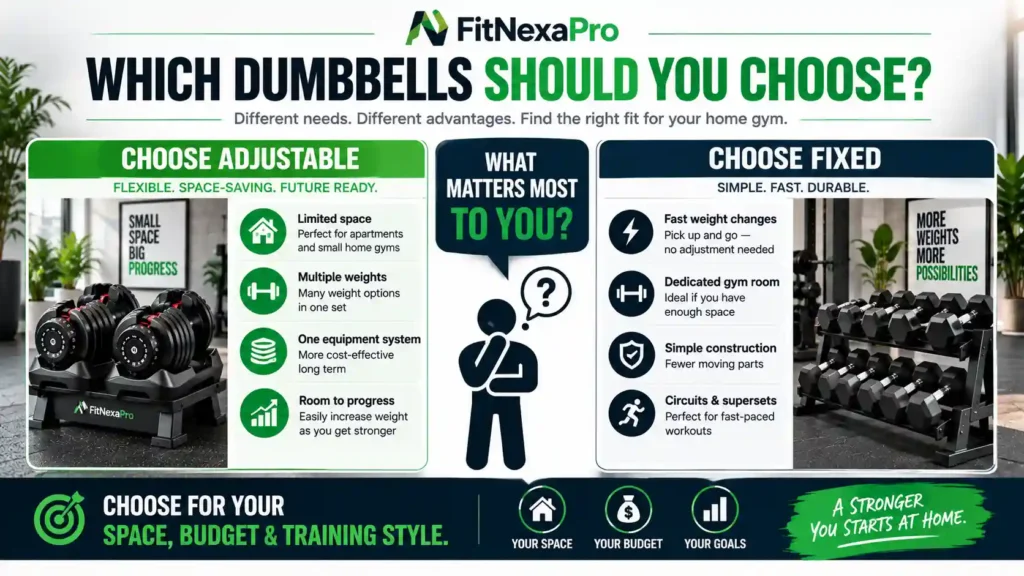
Choose adjustable dumbbells if you:
- Have limited space
- Want several weights in one compact system
- Are building your first home gym
- Want to expand your resistance range without buying many pairs
- Don’t mind spending a few seconds changing weights
Choose fixed dumbbells if you:
- Have a dedicated gym room
- Value quick weight changes
- Frequently perform circuits or supersets
- Prefer simple equipment with fewer moving parts
- Have enough budget and storage for multiple pairs
What Weight Range Should Beginners Consider?
There isn’t one correct dumbbell weight for every beginner.
Appropriate resistance depends on the exercise, training experience, strength, technique, and goals.
A weight suitable for a shoulder raise may be far too light for a squat.
That’s another reason a range of resistance is useful.
Rather than searching for one “perfect beginner weight,” choose equipment that lets you perform exercises with good control while providing room to progress.
If you’re unsure how to structure your training, our How Many Sets and Reps Should You Do? guide can help you understand the relationship between exercises, repetitions, sets, and resistance.
Adults are generally advised to perform muscle-strengthening activities involving the major muscle groups on at least two days per week.
Physical Activity Guidelines for Americans
Frequently Asked Questions
Are adjustable dumbbells worth it?
They can be an excellent investment for home gyms, particularly when you need several resistance levels but have limited storage space. Whether they’re worth the cost depends on the weight range, adjustment system, build quality, and how frequently you’ll use them.
Can adjustable dumbbells replace fixed dumbbells?
For many home workouts, yes. A sufficiently broad adjustable set can replace several pairs of fixed dumbbells. Fixed dumbbells may still be preferable when rapid weight changes are important.
Are fixed dumbbells better for beginners?
Not necessarily. Both types can work for beginners. Fixed dumbbells are simpler, while adjustable dumbbells provide more resistance options in less space.
Can you build muscle with adjustable dumbbells?
Adjustable dumbbells provide resistance just like fixed dumbbells. Muscle-building results depend more on your overall training, appropriate resistance, progression, recovery, and nutrition than on whether the dumbbell adjusts. ACSM’s updated guidance similarly emphasizes that specific equipment type is not the key determinant of results for the average healthy adult.
Do adjustable dumbbells break easily?
Not necessarily, but they often contain more moving parts than fixed dumbbells. Durability varies by design and manufacturer. Follow the product’s instructions regarding use, storage, and whether the dumbbells can safely be dropped.
Final Verdict: Adjustable or Fixed Dumbbells?
When comparing adjustable vs fixed dumbbells, there isn’t one winner for every home gym.
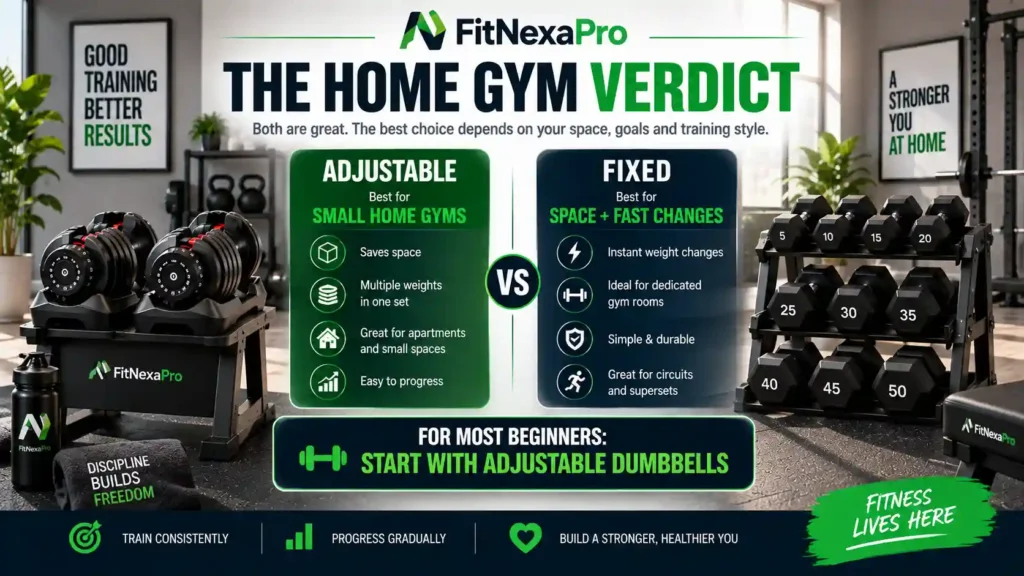
For most beginners and small home gyms, I would start with adjustable dumbbells. They save space, provide multiple resistance levels, and make it easier to expand your training without filling the room with separate weights.
Fixed dumbbells become particularly attractive when you have plenty of space, want instant weight changes, prefer simpler equipment, or are building a larger dedicated gym.
Whichever you choose, focus less on owning the “perfect” dumbbell and more on finding equipment that allows you to train consistently and progress over time.
The best equipment is ultimately the equipment that fits your space, your training style, and the workouts you’ll actually do.
2 Comments