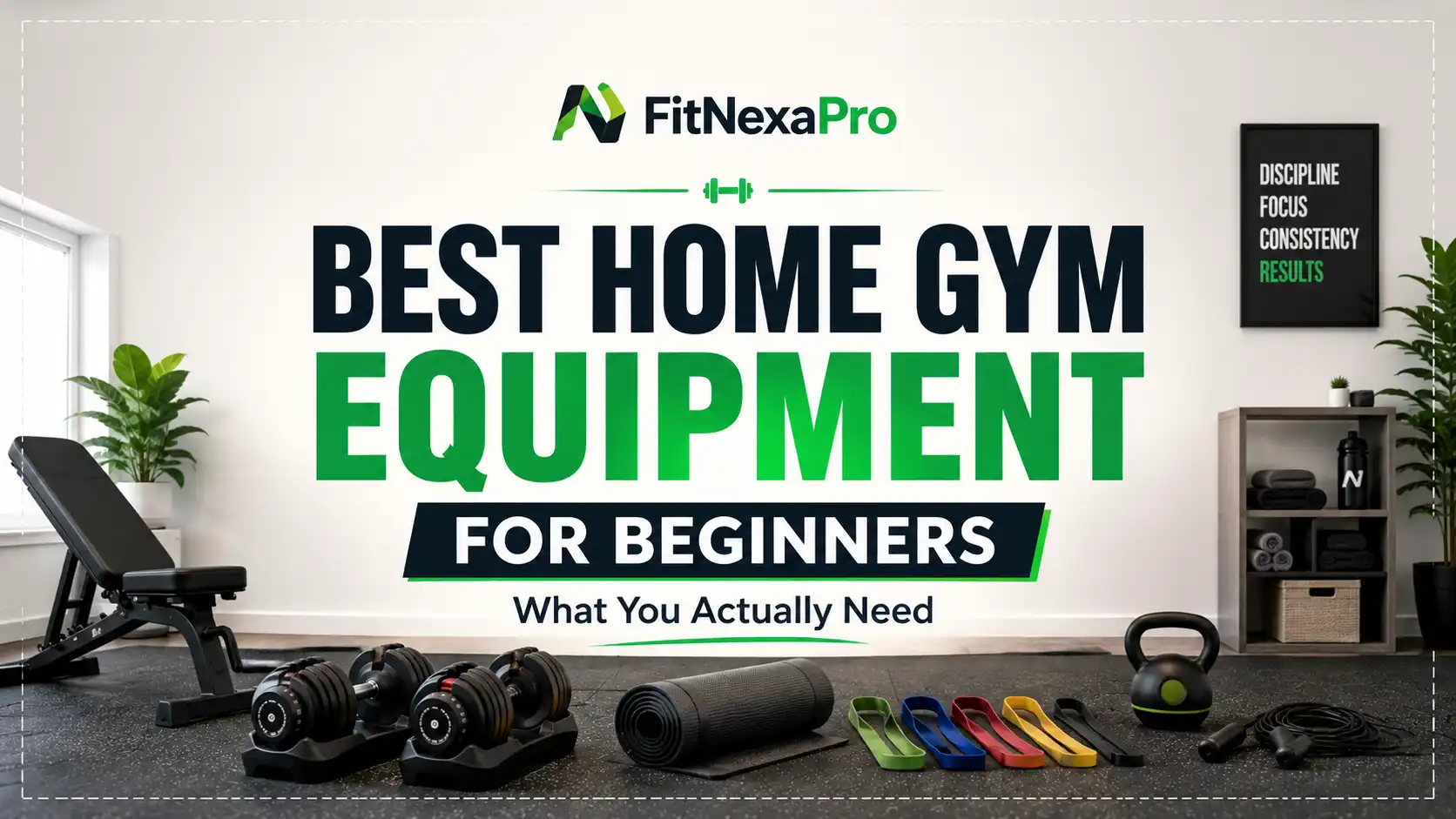
Best Home Gym Equipment for Beginners: What You Actually Need
Building a home gym can make exercise more convenient, but beginners often make the process more complicated—and more expensive—than necessary.
You might see home gyms online filled with squat racks, cable machines, treadmills, benches, barbells, dozens of weight plates, and multiple sets of dumbbells. While that equipment can be useful, you don’t necessarily need all of it to start exercising effectively at home.
The best home gym equipment for beginners depends on your goals, available space, budget, and the type of workouts you enjoy.
For many beginners, a few versatile pieces of equipment can provide enough variety for strength training, cardio, mobility, and full-body workouts.
Instead of trying to recreate a commercial gym in your house, start with equipment you will actually use.
This guide explains which pieces are worth considering first, what you can skip initially, and how to build a practical beginner home gym without wasting money.
Best Home Gym Equipment for Beginners: What Do You Really Need?
There is no universal list of equipment that everyone needs.
Someone interested primarily in strength training will have different requirements from someone who wants to improve cardiovascular fitness.
Your available space matters too.
A person exercising in a small apartment might prefer adjustable dumbbells and resistance bands, while someone with a dedicated garage gym may eventually want a rack, barbell, bench, and weight plates.
Before buying anything, ask yourself three questions:
What type of exercise will I actually do?
How much space do I have?
What is my realistic budget?
Answering those questions can prevent you from buying expensive equipment that eventually becomes unused furniture.
1. Exercise Mat
An exercise mat is one of the simplest pieces of home workout equipment.
You can use one for:
- Core exercises
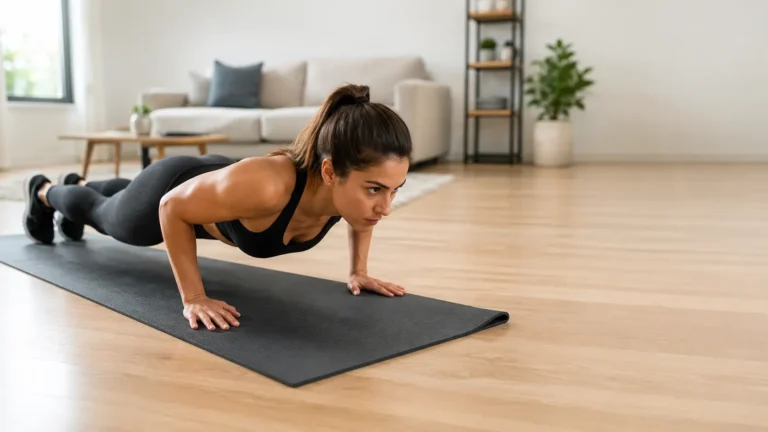
- Push-ups
- Mobility work
- Stretching
- Bodyweight workouts
- Floor exercises
A mat also creates a designated workout area, which can be helpful if you’re exercising in a bedroom or living room.
When choosing one, consider the flooring underneath it.
If you’re primarily doing stretching and floor exercises, comfort may be more important. If you’re performing exercises where stability matters, an extremely soft or thick mat may feel less stable.
You don’t need the most expensive mat available.
Look for one that provides adequate grip, sufficient space for your body, and a surface you can clean easily.
2. Resistance Bands
Resistance bands are among the most versatile options for a beginner home gym.
They’re relatively small, portable, and can be used for many exercises.
Depending on the type of band and setup, you can use resistance bands for movements such as:
- Rows
- Chest presses
- Shoulder exercises
- Biceps curls
- Triceps exercises
- Glute exercises
- Leg exercises
- Assisted movements
There are several types available, including loop bands, long resistance bands, and tube-style bands with handles.
Different resistance levels also allow you to gradually make exercises more challenging.
Bands can be especially useful when you have limited storage space.
However, inspect resistance bands regularly for signs of damage or deterioration and follow the manufacturer’s instructions regarding anchoring and safe use.
3. Adjustable Dumbbells
If your main goal is strength training, dumbbells are one of the first major purchases I would consider.
A pair of dumbbells allows you to perform a large variety of exercises, including:
- Goblet squats
- Romanian deadlifts
- Lunges
- Chest presses
- Shoulder presses
- Rows
- Biceps curls
- Triceps exercises
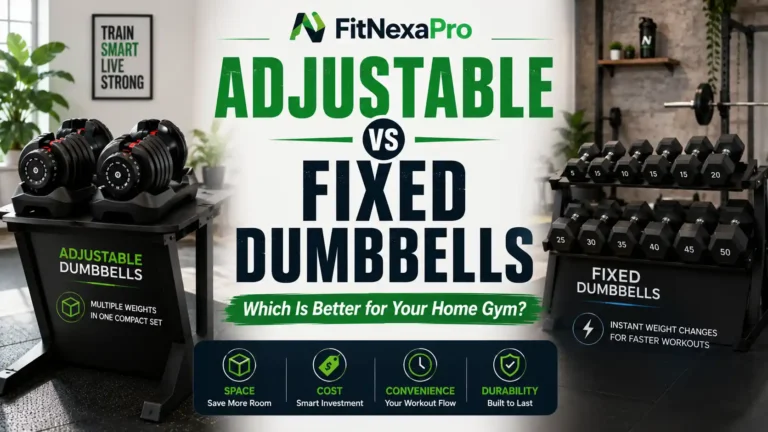
The main decision is whether to buy fixed or adjustable dumbbells.
Fixed dumbbells are convenient because you simply pick up the weight you need. The downside is that buying several pairs requires more space and can become expensive.
Adjustable dumbbells allow multiple weight settings within one pair, making them particularly useful for smaller home gyms.
The trade-off is that some adjustable systems are bulkier, require time to change resistance, or have specific handling requirements.
For many beginners with limited space, adjustable dumbbells offer a useful balance between exercise variety and storage efficiency.
4. A Stable Workout Bench
A bench isn’t essential on your first day, but it can significantly expand the exercises available once you begin using dumbbells.
A workout bench can be used for:
- Dumbbell chest presses
- One-arm rows
- Seated shoulder presses
- Split squats
- Step-ups, when appropriate for the bench design
- Supported exercises
An adjustable bench can provide flat and inclined positions, giving you more exercise options.
But don’t rush to buy one if your budget is limited.
You can begin many exercises without a bench and add one when your training routine actually requires it.
If you purchase a bench, pay attention to its stated weight capacity, stability, dimensions, and manufacturer instructions.
5. Kettlebell
A kettlebell can be another versatile addition to a home gym.
It can be used for traditional strength exercises as well as more dynamic movements.
Examples include:
- Goblet squats
- Deadlift variations
- Rows
- Carries
- Presses
Some people enjoy kettlebell-focused training, while others may get everything they need initially from dumbbells.
Therefore, I wouldn’t automatically purchase both.
If you’re building your gym gradually, choose the resistance tool that best matches the workouts you plan to follow.
You can always expand later.
6. Pull-Up Bar
A pull-up bar can add vertical pulling exercises to a home workout setup.
Depending on your strength level, it can be used for pull-ups, chin-ups, or certain assisted variations.
However, installation and safety are important.
Doorway-mounted and wall-mounted products have different requirements and weight limits.
Before using one, make sure the product is compatible with the installation location and follow the manufacturer’s mounting and weight-limit instructions.
If you’re not ready for pull-ups, you can still train your back using dumbbell or resistance-band rows.
So a pull-up bar is useful, but it isn’t mandatory for a beginner.
7. Jump Rope
If you enjoy faster-paced cardio, a jump rope is inexpensive and requires very little storage space.
It can be useful for short cardio sessions or as part of a warm-up when appropriate for your fitness level.
However, jumping isn’t suitable or comfortable for everyone.
You also need enough overhead and floor space to use the rope safely.
If jumping doesn’t suit you, walking, cycling, or another form of aerobic exercise may be a better option.
Don’t buy equipment simply because it appears on a generic “must-have” list.
Choose activities you are likely to perform consistently.
8. Foam Roller
A foam roller is another optional accessory you might consider.
It is commonly used for self-myofascial release and mobility routines.
It doesn’t replace your actual strength or cardiovascular training, so I would prioritize your core workout equipment first if you’re working with a limited budget.
Think of a foam roller as an accessory rather than the foundation of your home gym.
Do Beginners Need a Treadmill?
No.
A treadmill can be useful, but you don’t need one simply because you’re creating a home gym.
Walking and running outdoors may already provide the cardio activity you want.
A treadmill becomes more attractive if you prefer indoor walking or running, live somewhere where weather frequently interferes with outdoor exercise, or value the convenience of exercising at home.
The disadvantages are obvious:
Treadmills can be expensive, heavy, and require significant floor space.
They may also require maintenance.
If your budget is limited, I would first establish whether you consistently enjoy walking or running before investing in a large machine.
What About an Exercise Bike?
Exercise bikes are another popular home cardio option.
Compared with many treadmills, some bikes have a relatively compact footprint and allow you to exercise while remaining indoors.
There are several styles, including upright, recumbent, and indoor cycling bikes.
Again, the best choice depends on the activity you enjoy and your individual requirements.
If you’re choosing between major cardio machines, we’ll cover this separately in our upcoming Treadmill vs Exercise Bike guide.
For your first home gym, you don’t necessarily need either machine.
Do You Need a Barbell and Squat Rack?
Not initially.
A barbell setup can become extremely valuable for people who want to progress with exercises such as squats, presses, and deadlifts.
But a proper barbell home gym involves more than buying a bar.
Depending on your training, you may need:
- Weight plates
- A suitable rack
- Appropriate flooring
- Collars
- A bench
- Adequate ceiling and floor space
Safety considerations also become increasingly important as resistance increases.
For someone completely new to strength training, dumbbells and resistance bands may provide a simpler entry point.
You can invest in a rack and barbell later if your training goals justify it.
Best Home Gym Equipment for Small Spaces
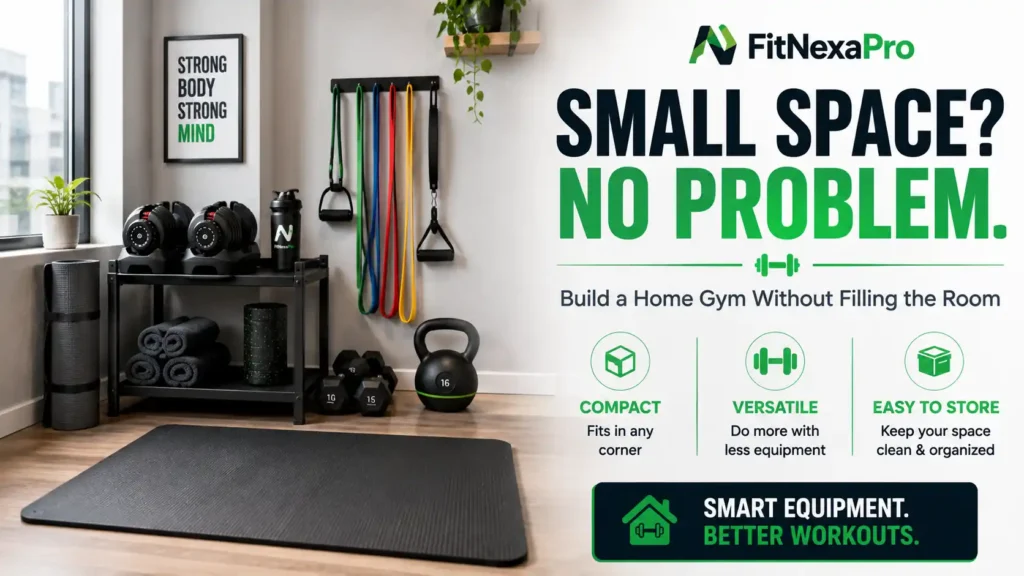
You don’t need a dedicated room to exercise at home.
If you live in an apartment or have limited space, prioritize equipment that can be stored easily.
A compact setup might include:
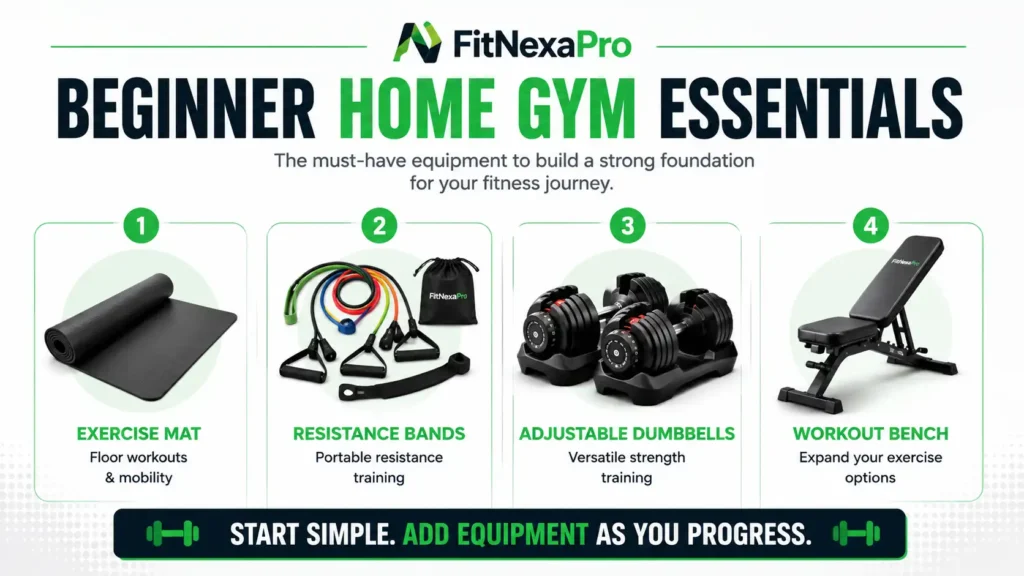
Exercise mat
Resistance bands
Adjustable dumbbells
These three items alone can support a surprisingly broad range of exercises.
You could store the bands in a drawer, roll up the mat, and keep adjustable dumbbells in a corner.
If additional space becomes available later, you could add a folding or adjustable bench.
The goal is to make your workout setup fit your home—not make your home fit your workout equipment.
Best Home Gym Equipment on a Budget
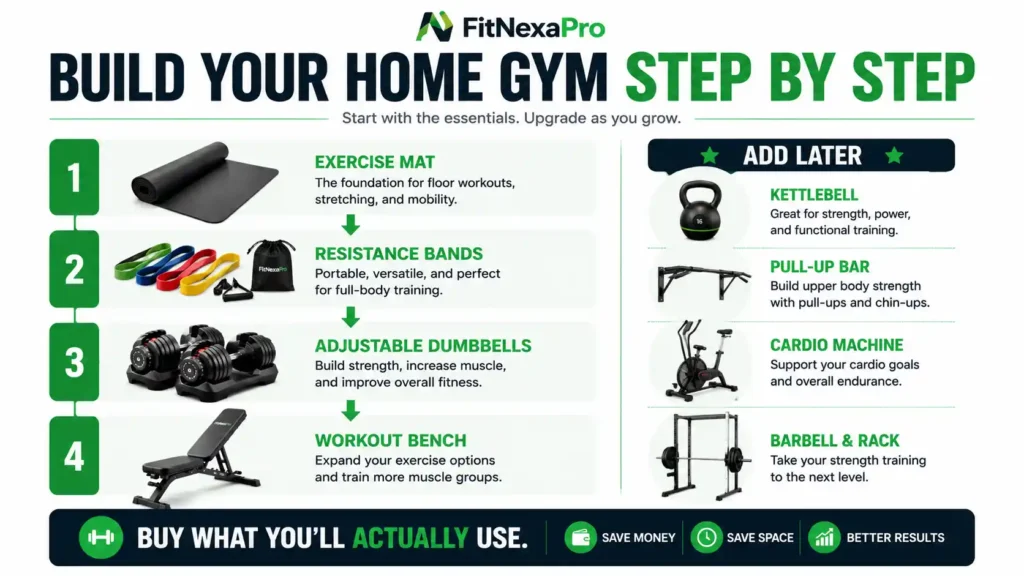
If you’re working with a limited budget, don’t try to buy everything at once.
Start with equipment that offers the greatest versatility for the money.
A sensible purchase order could be:
First: Exercise mat
Second: Resistance bands
Third: Dumbbells
Fourth: Bench
Later: Specialized strength or cardio equipment
Your exact order can change depending on your goals.
Someone who already performs bodyweight workouts might skip the mat and save toward dumbbells.
Someone who mainly wants cardio may spend very little on strength equipment initially.
Buying gradually also gives you time to discover what you actually enjoy using.
Home Gym Equipment for Strength Training
For beginner strength training, your equipment should allow you to perform movements covering the major muscle groups.
You don’t need a separate machine for every muscle.
A pair of dumbbells, for example, can support exercises for your legs, chest, back, shoulders, arms, and more.
Resistance bands can provide additional exercise variations.
As you become stronger, however, you need a way to continue challenging yourself.
That’s why resistance range matters when buying strength equipment.
A very light dumbbell may be appropriate for one exercise but quickly become insufficient for stronger movements such as squats or deadlift variations.
Think about progression, not just what you can lift today.
According to the CDC’s physical activity guidance, adults should include muscle-strengthening activity on at least two days each week.
Can You Build Muscle With Home Gym Equipment?
Yes, resistance training at home can contribute to muscle development.
Muscle growth isn’t limited to commercial gym machines.
Your muscles respond to resistance and training stimulus.
ACSM’s updated resistance-training guidance emphasizes that many forms of resistance training can be effective and that consistency is more important than overly complicated programming. It also notes that resistance training using elastic bands, bodyweight, and home-based routines can produce meaningful benefits.
That means you don’t need an enormous collection of machines to start.
You do, however, need a way to make your training appropriately challenging as you improve.
This could involve adding repetitions, increasing resistance, adding sets when appropriate, improving exercise technique, or progressing to harder exercise variations.
Our guide on How Many Sets and Reps Should You Do? explains how beginners can structure resistance training and gradually progress.
How Much Should You Spend on a Home Gym?
There is no amount you must spend.
A basic setup can be relatively inexpensive, while a complete garage gym can cost thousands.
Rather than setting your budget based on what fitness influencers own, divide equipment into three groups:
Essential now
Equipment you know you’ll use immediately.
Useful later
Equipment that would expand your workouts once you’ve established a routine.
Nice to have
Equipment that looks appealing but isn’t currently necessary.
This simple approach can prevent unnecessary purchases.
If you haven’t exercised consistently yet, start small.
You can always spend more later.
Home Gym vs Gym Membership
A home gym offers convenience.
You don’t need to commute, wait for equipment, or adjust your workout around gym opening hours.
However, commercial gyms provide access to much more equipment without requiring you to buy or store it.
They may also offer classes, trainers, and a social environment.
Neither option is automatically better.
A home gym may be ideal if convenience helps you train consistently.
A commercial gym may be better if you enjoy having access to many machines and heavier resistance.
Some people even use both.
Choose the environment that makes regular exercise easier for you.
Common Home Gym Equipment Mistakes
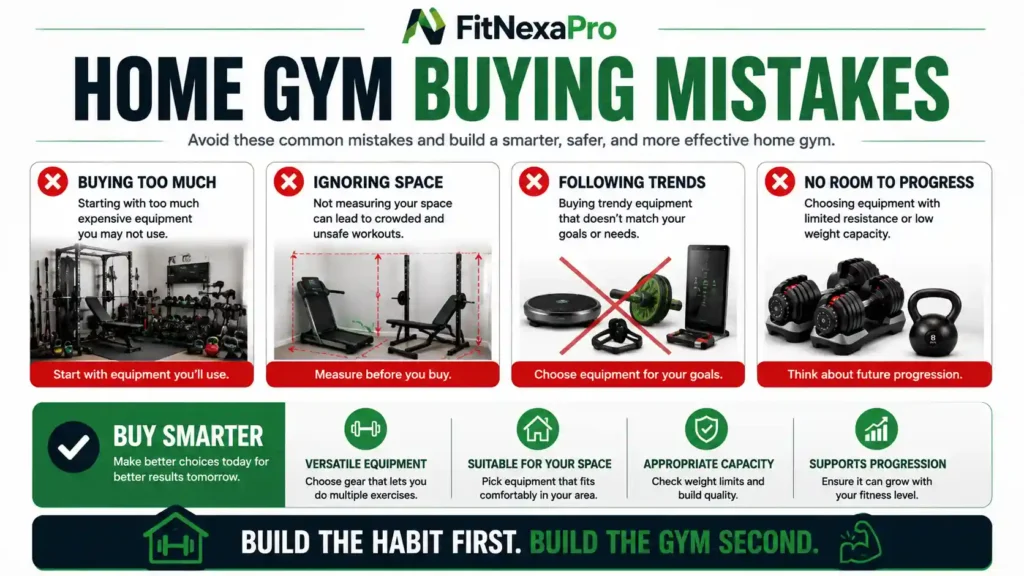
Buying Too Much Too Soon
This is probably the biggest mistake.
You don’t know what you’ll use consistently until you’ve developed a routine.
Start with the basics.
Buying Equipment Because It’s Trending
A piece of equipment being popular on social media doesn’t mean it fits your goals.
Ignoring Available Space
Measure your room before ordering large equipment.
Remember that you may need additional clearance around equipment while exercising.
Buying Resistance You Can’t Progress With
If strength training is your goal, consider whether your equipment will remain useful as you become stronger.
Ignoring Weight Limits
Benches, racks, pull-up bars, and other equipment have manufacturer-specified limits.
Check them before purchasing and using the product.
Choosing Price Over Safety and Stability
The cheapest option isn’t always the best value.
For equipment that supports your body or significant resistance, stability and build quality matter.
Building a Gym Before Building the Habit
A $5,000 home gym won’t help if you never use it.
Establish the exercise habit first.
Then upgrade your equipment as your training develops.
A Simple Beginner Home Gym Setup
If I were building a beginner home gym from scratch, I would keep the first setup simple.
Start with:
1 exercise mat
1 set of resistance bands
1 pair of adjustable dumbbells
That gives you enough equipment to begin a wide variety of workouts.
Once you’re consistently training, consider adding:
An adjustable bench
Then, depending on your goals:
A kettlebell
Pull-up bar
Cardio equipment
Barbell and rack
You don’t have to buy everything on this list.
Your home gym should evolve alongside your training.
How to Choose Home Gym Equipment
Before buying any piece of equipment, consider:
Purpose: What exercises will you perform with it?
Frequency: How often will you actually use it?
Space: Where will you use and store it?
Adjustability: Can it support different exercises or resistance levels?
Stability: Does it feel appropriate for its intended use?
Weight capacity: Does the manufacturer’s rating meet your needs?
Progression: Will it remain useful as your fitness improves?
Budget: Is there something more important you should buy first?
A versatile product you use three times every week is usually more valuable than an expensive machine you rarely touch.
Frequently Asked Questions
What home gym equipment should a beginner buy first?
For many beginners, an exercise mat, resistance bands, and dumbbells provide a versatile starting setup. Your priorities should still depend on your training goals and available space.
Can I build a home gym in a small apartment?
Yes. Resistance bands, adjustable dumbbells, and a mat require relatively little storage space and can support many exercises.
Do I need a bench for home workouts?
No. Many exercises can be performed without one. A bench becomes useful when you want more options for dumbbell presses, supported rows, seated exercises, and other movements.
Are adjustable dumbbells worth it for beginners?
They can be especially useful when storage space is limited because one adjustable pair can replace several fixed-weight pairs. Consider adjustment range, build quality, dimensions, and your budget.
Do I need cardio equipment at home?
No. Walking, running, stairs, and other forms of physical activity can provide aerobic exercise without a machine. Home cardio equipment is mainly a matter of convenience and preference.
Should I buy a treadmill or weights first?
That depends on your primary goal and preferred exercise. Someone focused on strength training may benefit more from resistance equipment, while someone who strongly prefers indoor walking or running may prioritize a treadmill.
Final Thoughts
The best home gym equipment for beginners isn’t necessarily the most expensive equipment or the setup with the most machines.
It is the equipment that helps you exercise consistently.
For many beginners, a simple combination of resistance bands, adjustable dumbbells, and an exercise mat provides an excellent starting point.
From there, you can add a bench, kettlebell, pull-up bar, cardio machine, or barbell setup when your training actually requires it.
Start small.
Learn which workouts you enjoy.
Develop consistency.
Then allow your home gym to grow with you.
That approach can save money, save space, and help ensure every piece of equipment you buy has a genuine purpose.
One Comment