How to Choose Dumbbell Weight for Beginners: A Practical Starting Guide
Walking into a gym or shopping for your first pair of dumbbells can create a surprisingly difficult question: what weight should you actually use?
Choose a dumbbell that is too light and the exercise may not challenge you enough. Choose one that is too heavy and you may struggle to control the movement, shorten your range of motion, or sacrifice technique just to complete the repetitions.
The problem is that there is no single “beginner dumbbell weight” that works for everyone.
Your appropriate starting weight depends on the exercise, your current strength, training experience, repetition target, and how well you can control the movement.
This guide explains how to choose dumbbell weight for beginners using a simple testing method you can apply at home or in the gym.
There Is No Perfect Beginner Dumbbell Weight
You may see recommendations telling beginners to start with a particular number of kilograms or pounds. These can provide a rough reference, but they should not be treated as a universal rule.
Two beginners of the same age and body weight may have very different strength levels because of their previous activity, occupation, sports background, injury history, and individual differences.
There is another important reason a single number doesn’t work:
You shouldn’t necessarily use the same dumbbell weight for every exercise.
For example, you can usually handle considerably more resistance during a goblet squat or dumbbell Romanian deadlift than during a lateral raise.
The better question is therefore not:
“What dumbbell weight should a beginner use?”
It is:
“What weight allows me to perform this particular exercise with good control while making the final repetitions challenging?”
That approach is much more useful.
How to Choose Dumbbell Weight for Beginners
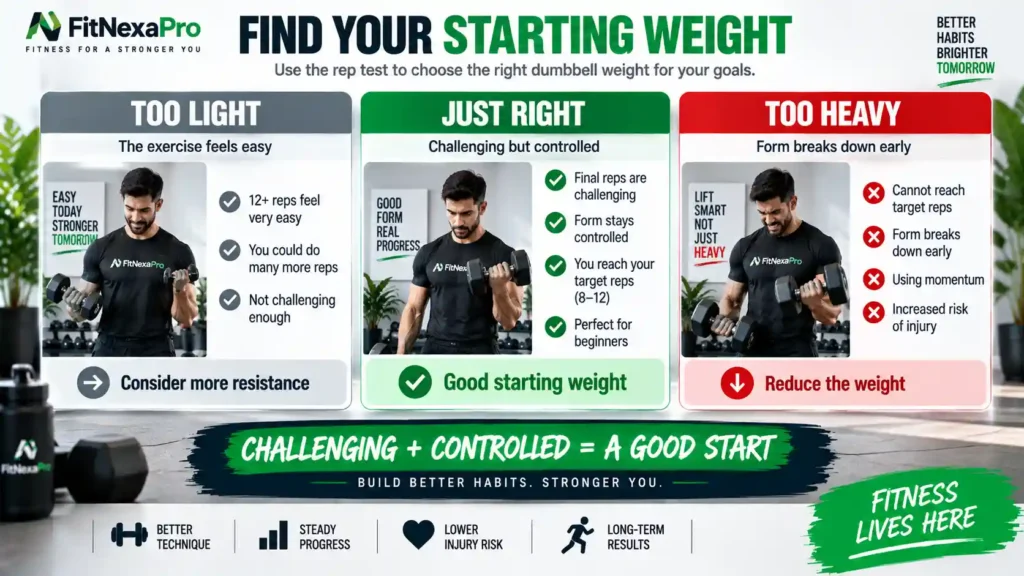
A simple way to find your starting weight is to use what we can call the rep test.
Suppose your workout calls for 8–12 repetitions.
Choose a light-to-moderate dumbbell and perform the exercise with controlled technique.
Pay attention to what happens near the end of the set.
If you could easily perform many more repetitions
The dumbbell is probably too light for that particular training goal.
For example, if you complete 12 repetitions and feel you could comfortably perform another 10, you probably have room to increase the resistance.
If you cannot reach your target repetitions with good form
The weight is probably too heavy.
If you’re aiming for 10 repetitions but your technique begins breaking down at rep six, reduce the weight.
If the final few repetitions feel difficult but remain controlled
You have probably found a reasonable starting resistance.
You should still be able to maintain your posture, range of motion, grip and movement control.
The goal isn’t to make every set as painful or exhausting as possible. The goal is to find resistance that challenges the muscles without forcing you to abandon good technique.
Federal physical activity guidance similarly describes muscle-strengthening exercise as activity that makes the muscles work harder than they are accustomed to, and notes that resistance can progressively increase over time.
Your Dumbbell Weight Should Change With the Exercise
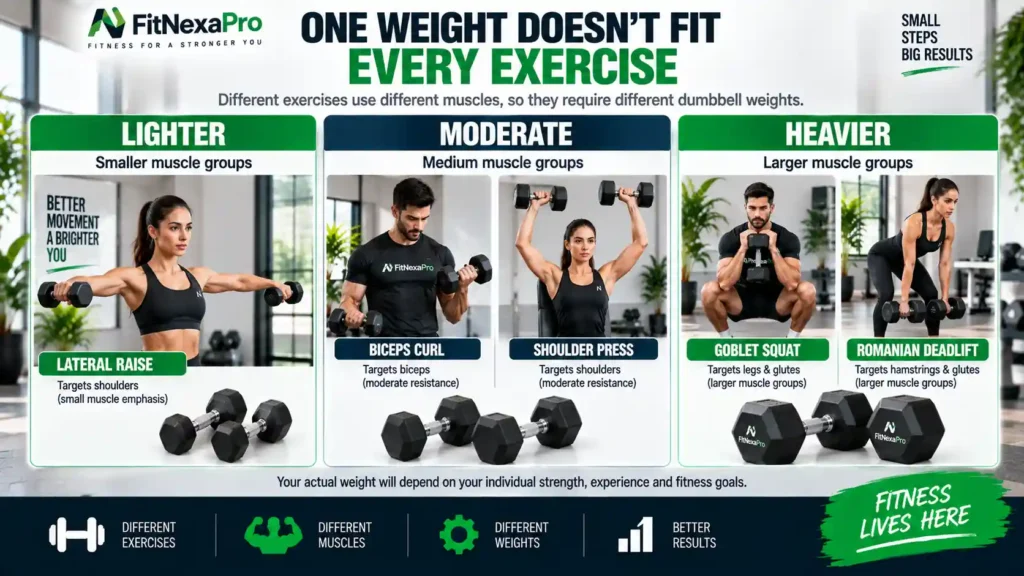
This is one of the most important lessons for a beginner.
Imagine you own one pair of 5 kg dumbbells.
That weight might feel appropriate for curls.
But 5 kg may feel extremely difficult for lateral raises while being relatively easy for squats.
That’s because different exercises use different muscles and movement patterns.
Large compound movements generally involve more muscle mass than smaller isolation exercises.
You might therefore use relatively heavier dumbbells for movements such as:
- Goblet squats
- Romanian deadlifts
- Dumbbell rows
- Lunges
- Dumbbell presses
And lighter weights for exercises such as lateral raises, rear-delt raises or certain arm movements.
Don’t judge your strength by comparing the weight you use across exercises.
The exercise determines the appropriate resistance—not your ego.
A Practical 8–12 Rep Test
For a beginner learning a new exercise, here’s an easy process.
Start with a weight you believe you can control.
Perform approximately 8–12 repetitions slowly enough to remain aware of your technique.
At the end, ask yourself three questions:
Was my form still controlled?
If you had to swing your body, rush the movement or significantly shorten the range of motion, the resistance may be too heavy.
Were the final repetitions challenging?
If every repetition felt effortless, you may eventually need more resistance.
Could I probably perform a few additional good repetitions?
Leaving some capacity while you’re learning a movement can be sensible. You don’t need to test your absolute limit during your first workout.
The CDC notes that 8–12 repetitions can count as a set for muscle-strengthening activity and recommends performing strengthening exercises at an effort where another repetition becomes difficult.
CDC guidance on muscle-strengthening activity
Don’t Test Your Strength on the First Workout
One common beginner mistake is treating the first gym session like a strength competition.
You don’t need to discover the heaviest dumbbell you can possibly lift.
Your first few workouts should help you learn:
the exercise → the movement → your comfortable range → your appropriate resistance
Think of your first week as a calibration period.
Write down the dumbbell weight and repetitions used for each exercise.
For example:
Goblet squat: 10 kg × 10 reps
Dumbbell row: 6 kg × 10 reps each side
Shoulder press: 5 kg × 8 reps
Biceps curl: 4 kg × 10 reps
Lateral raise: 2 kg × 12 reps
These numbers are only an example—not recommended starting weights.
Your own results may be higher or lower.
After several sessions, your training log becomes far more useful than a generic online chart because it reflects your actual strength.
How Do You Know When to Increase Dumbbell Weight?
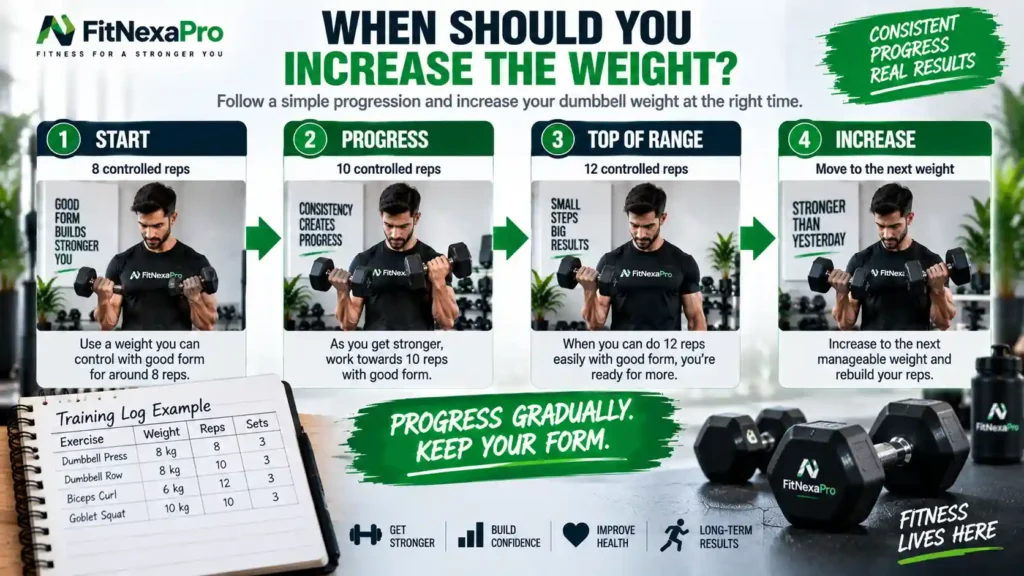
Once you consistently reach the top of your target repetition range with controlled technique, consider a manageable increase in resistance.Finding your starting weight is only the beginning.
As you train consistently, a weight that was once difficult can become easier.
That’s normal.
Consider this example.
You begin dumbbell rows with a weight you can perform for:
Week 1: 8 controlled repetitions
Later:
Week 2: 10 controlled repetitions
Then:
Week 3: 12 controlled repetitions
If you can repeatedly complete the top of your target repetition range with solid technique and the set no longer feels sufficiently challenging, you can consider moving to the next manageable weight.
After increasing the resistance, your repetitions may temporarily decrease.
For example:
8 kg × 12 reps → 10 kg × 8 reps
Over time, you can work toward performing more controlled repetitions with the new weight.
This is a simple form of progressive resistance.
ACSM’s updated 2026 resistance-training guidance emphasizes that training variables such as load and volume should be matched to the individual’s goals, while consistency remains a major factor in getting results.
ACSM 2026 resistance training guidelines
Signs Your Dumbbells Are Too Heavy
Beginners sometimes assume heavier automatically means better.
It doesn’t.
A dumbbell may be too heavy for the exercise if you consistently:
Swing your body to move it.
Momentum begins doing part of the work.
Lose control during the lowering phase.
The dumbbell drops rather than being controlled.
Shorten your range of motion dramatically.
You change the exercise simply to move the weight.
Cannot reach your planned repetition range.
Your muscles fail much earlier than expected.
Lose your normal posture.
You excessively lean, twist or compensate.
Experience sharp or unusual pain.
Muscle effort and fatigue are different from sudden joint or sharp pain. Stop an exercise that causes pain rather than trying to push through it.
Using a lighter dumbbell with better control is usually more useful than lifting something heavier just because the number looks impressive.
Signs Your Dumbbells May Be Too Light
Going too light creates the opposite problem.
Your weight may be ready to increase when you can perform your target repetitions easily while maintaining full control and still feel capable of performing many more.
But don’t increase weight simply because an exercise feels comfortable once.
Consider whether you are:
using a full controlled range of motion,
avoiding unnecessary momentum,
performing the intended number of sets,
and consistently finding the weight easy across multiple workouts.
If all of those are true, a small increase may be appropriate.
Should Beginners Buy Fixed or Adjustable Dumbbells?
This is where your equipment choice can affect progression.
If you buy only one fixed pair of dumbbells, you may quickly discover that the same weight doesn’t suit your entire workout.
A pair that’s good for shoulder presses could be too heavy for lateral raises and too light for squats.
Multiple fixed pairs solve this problem, but they require more storage space and usually more total equipment.
Adjustable dumbbells allow you to change resistance between exercises without maintaining a large dumbbell rack.
That makes them particularly useful for a home gym where space is limited.
However, fixed dumbbells can be faster to grab and switch during workouts and may make sense for people who have enough room for several pairs.
If you’re deciding between the two, read our Adjustable vs Fixed Dumbbells: Which Is Better for Your Home Gym? guide before buying.
A Better Way to Buy Your First Dumbbells
Don’t choose dumbbells based only on what other beginners use.
Instead, think about your actual workout.
Write down the exercises you plan to perform.
For example:
Goblet squat
Romanian deadlift
Dumbbell row
Floor press
Shoulder press
Biceps curl
Lateral raise
Now notice the problem.
One fixed weight is unlikely to be ideal for all seven exercises.
If your budget permits, adjustable dumbbells or several different fixed weights give you more flexibility to match resistance to each movement.
If your budget is very limited, resistance bands can also expand your exercise options without requiring a large collection of weights.
Our Resistance Bands vs Dumbbells guide explains when each option makes more sense for a beginner.
Your First-Week Dumbbell Testing Plan
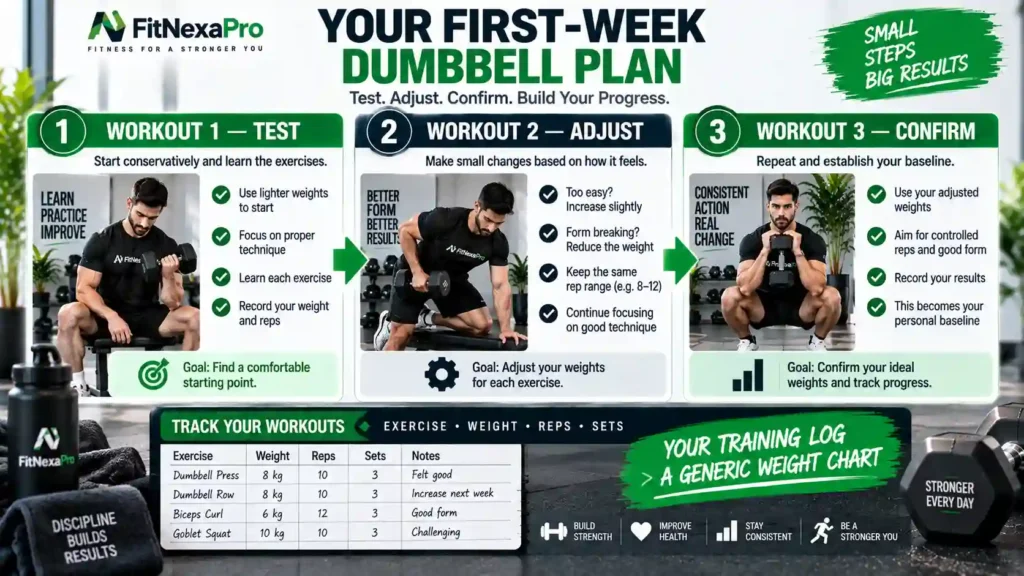
Use your first few workouts to test, adjust and confirm an appropriate dumbbell weight for each exercise.Instead of guessing your perfect weight before you begin, use your first week to learn it.
Workout 1 — Test
Choose conservative weights and focus on learning each exercise.
Record the resistance and repetitions.
Workout 2 — Adjust
For exercises that were extremely easy, test a slightly heavier weight.
For exercises where you struggled to maintain technique, reduce the resistance.
Workout 3 — Confirm
Repeat your adjusted weights.
You should now have a much clearer idea of the appropriate resistance for each exercise.
From there, maintain a simple training log.
You don’t need complicated software.
Something as basic as:
Exercise | Weight | Reps | Sets
is enough to show whether you’re progressing.
Don’t Increase Everything at the Same Time
Suppose your workout starts feeling easier.
That doesn’t mean you need to simultaneously:
increase the dumbbell weight,
add more repetitions,
add more sets,
reduce rest periods,
and add more exercises.
Changing everything makes it difficult to understand what is actually driving your progress—and can make a manageable routine unnecessarily difficult.
For beginners, simple progression is easier to track.
You might first increase repetitions within your planned range. Once you can comfortably reach the top of that range with good technique, consider a manageable increase in resistance.
Then repeat the process.
Strength Training Doesn’t Need to Be Complicated
Beginners sometimes spend so much time searching for the “perfect” dumbbell weight that they delay actually training.
The broader goal is consistency.
Current CDC guidance recommends that adults include muscle-strengthening activities involving all major muscle groups on at least two days each week.
And resistance training doesn’t require an elaborate commercial gym. ACSM’s 2026 evidence review notes that home-based training, elastic resistance and other nontraditional approaches can produce meaningful improvements.
Start with equipment you can safely control, learn the fundamental exercises, track your workouts and gradually progress.
That’s a much better strategy than worrying about whether someone else curls twice the weight you do.
The Bottom Line
If you’re wondering how to choose dumbbell weight for beginners, don’t search for one universal number.
Choose the weight exercise by exercise.
Start conservatively, perform your target repetitions with controlled technique and pay attention to how difficult the final repetitions feel.
If you cannot maintain good form or reach your intended repetition range, reduce the weight.
If you consistently reach the top of your repetition range and could comfortably continue for many more reps, consider increasing it.
Most importantly, record what you do.
Within a few workouts, you’ll have something much more useful than a generic dumbbell-weight chart: your own starting point and a clear path for progression.